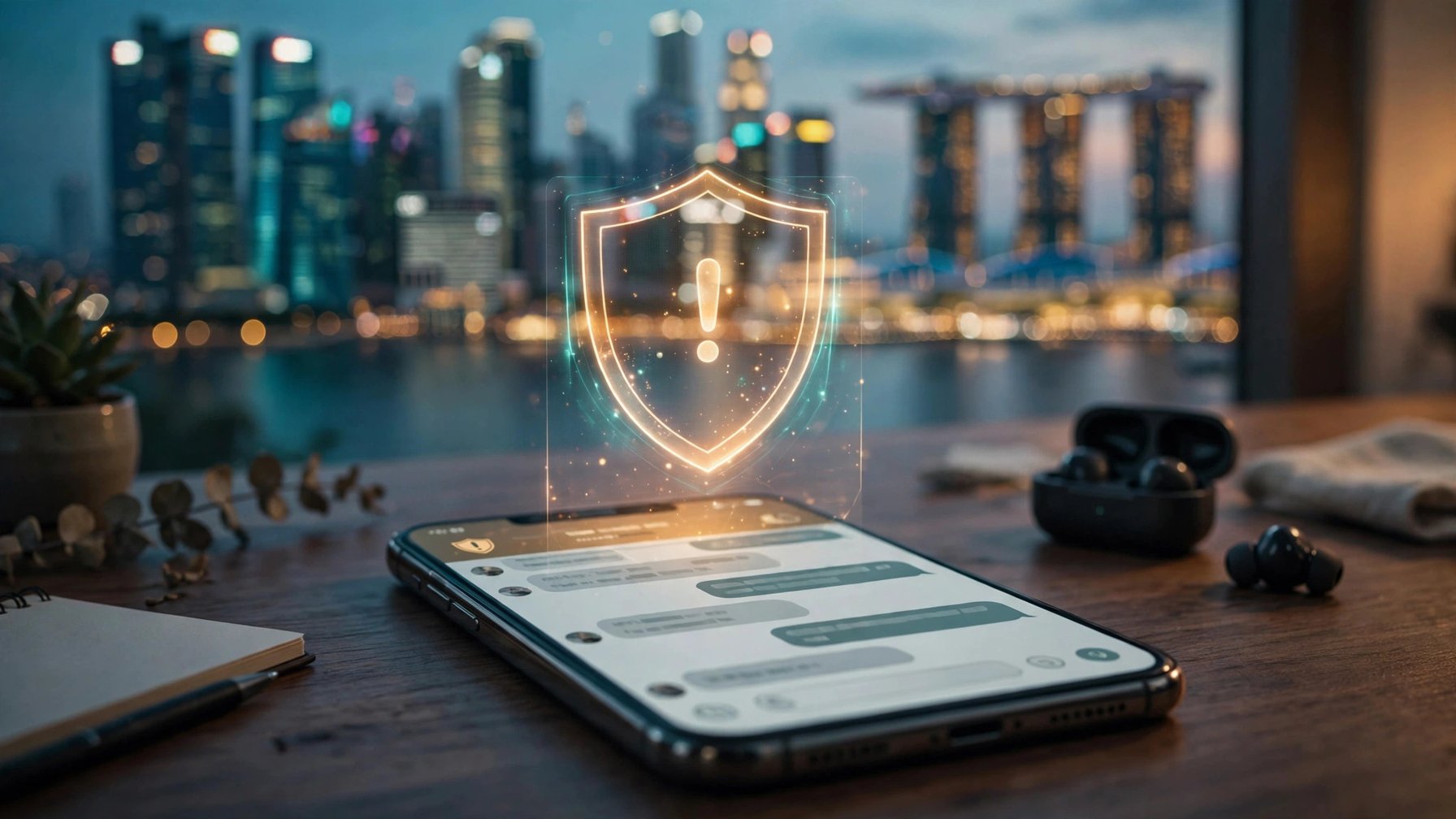
Gemma's lightweight model has been put to work fighting scams on phones in Singapore. On October 14, 2026, Google DeepMind announced on its official blog that it has delivered an on-device scam detection model together with Singapore's Government Technology Agency (GovTech): the model analyses conversations directly on the phone, raises a real-time warning when it spots manipulative patterns, and never sends chat content off the device. The work sits inside DeepMind's National AI Partnership with the Singapore Government and was presented at Singapore International Cyber Week (SICW 2026).
Why Singapore moved detection onto the device
Scams are not a niche risk in Singapore. The figures DeepMind cites: scams account for over half of reported crime in the country and more than S$4 billion in losses since 2019, and tactics have shifted from simple phishing links to long social-engineering conversations in which attackers build a convincing persona before asking for money — now up to 80% of all losses. The catch is that these conversations mostly happen inside end-to-end encrypted chat apps, where servers cannot see the content and traditional cloud scanning has nothing to scan. Moving detection on-device places the judgement at the only point where the conversation is visible, without breaking encryption.
A two-stage pipeline: save battery first, look closer second
The binding constraint for an always-on detector on a phone is battery life. DeepMind's answer is a two-stage pipeline: a very lightweight classifier screens each inbound message at minimal power cost and flags candidates, and only then does the fine-tuned Gemma model read a larger slice of the conversation to confirm a manipulative scam or discard a false alarm. Training was localised as well: the model was fine-tuned on Singaporean scam conversations, from impersonations of public institutions, banks and local figures to trending regional schemes, so it can tell benign small talk apart from genuine manipulation.
Governance on the training side decides whether this can be trusted
The announcement is explicit about how development was constrained: fine-tuning took place inside a GovTech-managed cloud environment with training data kept isolated; the data came from anonymised datasets derived from scam reports and intelligence feeds, with no personally identifiable information; and the model was stress-tested against synthetic dialogues and local corpora before release. For a government-led safety system that reads citizens' chats, these details are not decoration — the training process first has to prove it never touched citizens' chats itself.
Note the delivery shape: this is not a consumer app to download, but a model that messaging platforms and operating-system vendors can integrate. The real tests therefore come later — how many platforms adopt it, whether users act on the warnings, and whether false-alarm rates hold up in real traffic. But the direction is already clear: as scams hide inside encrypted conversations, defence has to move on-device too, and the value of a small model like Gemma is measured for once not by benchmarks, but by whether it can sit on an ordinary phone, always on and ready.