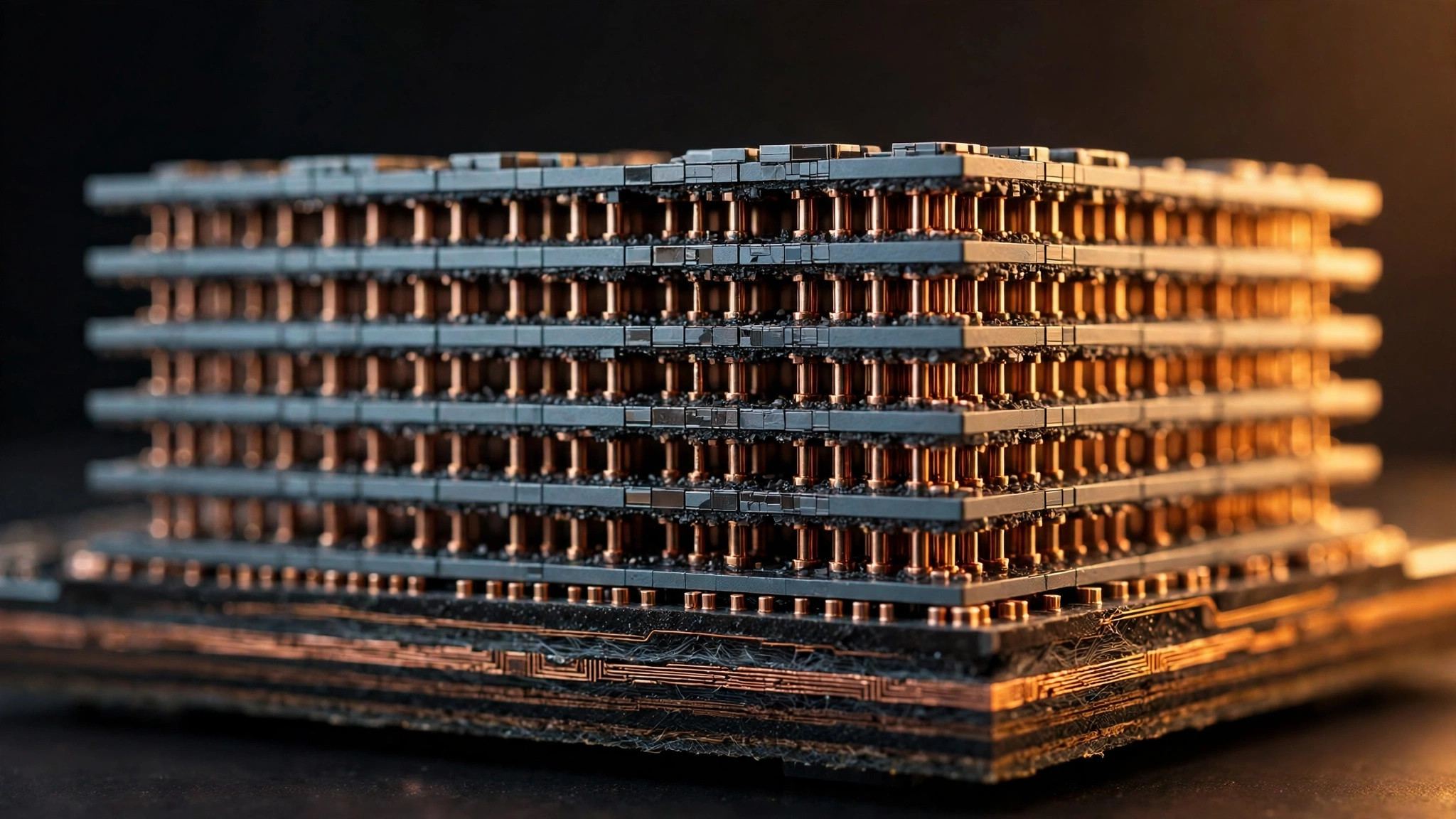
On November 26, 2026, Bloomberg reported that Huawei will present a homegrown high-bandwidth memory design at the ISSCC conference in February 2027: 64 channels and 4,096 data interfaces, twice the bit width of the current HBM4 standard. It is the first time Huawei has publicly shown a complete homegrown HBM design — and a new development in the one component Chinese AI chips are missing most under US export controls.
What 4,096 bits means
The paper is titled 'A 64-Channel 4096-DQ Custom HBM with Memory Controllers and 5-Layer Wafer-on-Wafer Hybrid Bonding'. It stacks memory layers with five-layer wafer-level hybrid bonding and integrates the memory controller directly into the memory stack. ISSCC is the leading chip-design conference, and it only accepts papers with real silicon and measured data — acceptance alone is a form of validation. Huawei has four papers accepted this time, covering a flagship phone chip, AI processor power delivery, high-speed wired communication and this custom HBM, with the full presentation scheduled for February 16, 2027.
Accepted for publication is not the same as ready to manufacture
Memory is becoming the real bottleneck for Chinese AI compute: on the grey market, one HBM3E stack costs about $4,000, and one accelerator needs six to eight of them, so memory alone adds $20,000 to $30,000. Huawei has already been reported asking customers to source HBM themselves for its next-generation Ascend servers. If the 4,096-bit interface holds up, then with the Ascend 960's advertised 288GB capacity and 9.6TB/s of bandwidth, the paper numbers would pass Nvidia's B300 at around 8TB/s. But the distinction matters: those are marketing figures, not measurements, and Bloomberg also cautions that how far the design has actually been implemented is unclear — between a paper and mass production lie yield, cost and supply chain. In the same week, Nvidia was reported to have halted server shipments to four Southeast Asian countries, as export controls spread from the chips themselves to every link in the flow of compute.
The real test comes on February 16, 2027, when the ISSCC presentation should bring measured data — and after that, whether the Ascend 960 ships on schedule in the first quarter of 2027 and whether its bandwidth numbers hold up. Until then, this looks more like a technology roadmap than a chip you can buy.