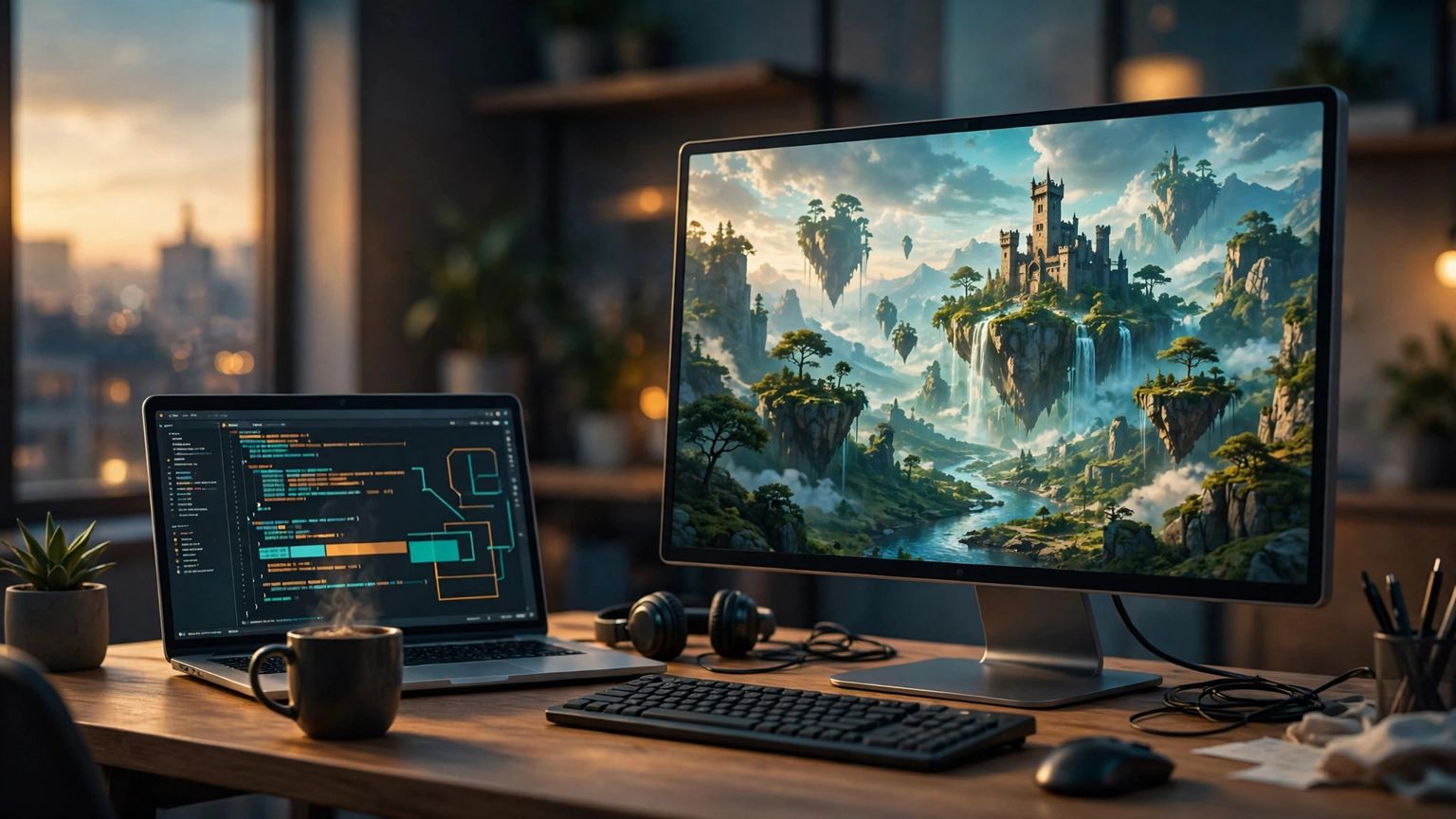
On November 19, Google put its world model Genie 4 in developers' hands: it is now available through the Gemini API and Google AI Studio, generating interactive 720p worlds you can steer in real time for about $0.10 a second. It is the key step from research demo to developer tool — just a day earlier, Genie 4 opened to Ultra subscribers inside the new Project Genie.
Developers call the model as models/genie-4 through the v1beta Interactions API, streaming over WebRTC in the browser or WebSocket on the server, with a single-session ephemeral token so the main API key never reaches the client. From a text prompt, a reference image, or both, Genie 4 continuously generates a 720p world at 24 frames per second, with synchronized native audio — ambient soundscapes, sound effects, and character dialogue. You move with WASD or arrow keys and type new prompts mid-session to change the weather, lighting, objects, or events, while Gemini's reasoning keeps the world state coherent.
About $0.10 a second, but a session lasts two minutes at most
Pricing is per token: $1.50 per million input tokens for prompts or reference images, $9 per million text output tokens, and $17.50 per million video output tokens including audio — roughly $0.10 per second, or about $6.05 per minute. The bar is not low: it is paid tier only, with no free tier. A single session is capped at 120 seconds, and the documentation warns that visual stability may degrade after 60 to 90 seconds; serving currently comes only from data centers in the United States, Western Europe, and Japan. AI Studio adds an interactive canvas and starter apps so developers can experiment before integrating.
From research model to developer tool
Genie 4 first appeared as a research model on October 27, open only to trusted testers. Google positions it clearly: prototyping interactive experiences, visualizing spatial designs, and training robotics and AI agents. Every output carries an imperceptible SynthID watermark. It is worth noting that Google still classifies it as frontier research, not a replacement for a production game engine — the picture is generated live over a rolling temporal window, with no permanent 3D scene, so the world does not keep remembering where you have been.
For developers, the real test starts after the 120 seconds: how much the world remembers, and how stable it stays, will decide whether it can grow beyond a demo into a usable prototyping tool. Google has given no timeline for longer sessions or wider regions, and serving is currently limited to the United States, Western Europe, and Japan. The next thing to watch is whether AI Studio's sample apps produce a first batch of reproducible play patterns.