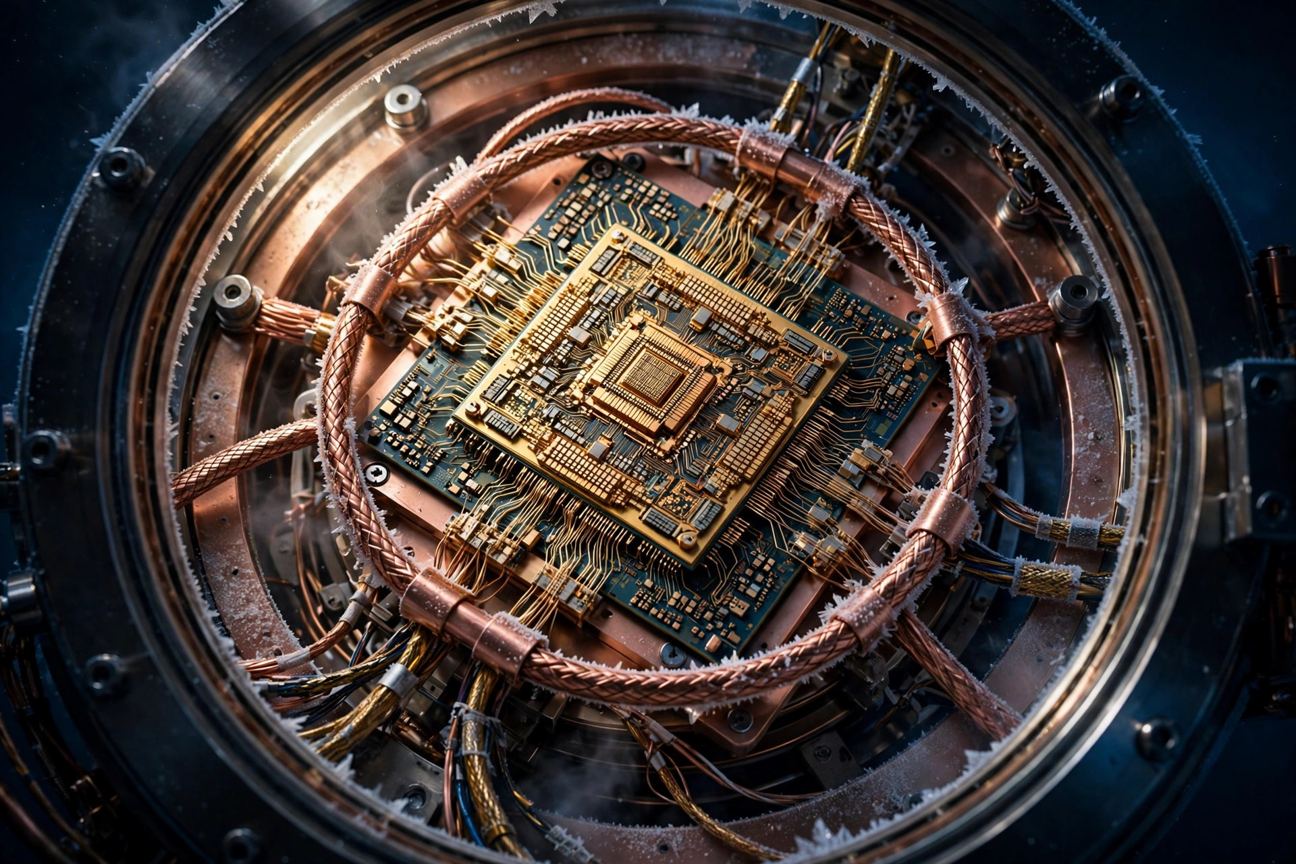
On November 19, 2026, Google's Quantum AI team published a paper as the cover story of Science, showing that quantum 'contextuality' can hold up stably at the scale of 105 qubits. In the experiment, the Willow processor won 98.3% of a cooperative game in which classical strategies have a firm ceiling, above the 88.9% classical limit. It is a step for quantum computing from proof of principle to proof at scale — but not yet a declaration of general quantum advantage.
What 98.3% means in the magic-square game
The experiment centers on the Mermin-Peres magic-square game: four qubits answer together, classical strategies win at most 88.9%, and Willow reached 98.3%, with nine task assignments each run 100,000 times. The team extended the same kind of test to multi-party GHZ-type games and hidden linear function problems, scaling all the way to the chip's full 105 qubits; the 105-qubit math problem produced a valid answer more than half the time. Willow is the 105-qubit superconducting processor Google released in December 2024; this work first appeared as a preprint in December 2025 and has now passed peer review to land on the cover of Science — like the AI breakthrough on an 18-year-old quantum conjecture covered here before, progress came from verifiable experimental results, not from vision statements.
Not yet time to call it quantum advantage
'Contextuality' means a measurement outcome is not fixed in advance; it depends on which other measurements are made alongside it — and researchers believe this property is what gives certain quantum algorithms their power. The experiment also stated its limits: the paper concedes there is no unconditional proof of quantum advantage for a general computational model, the classical cost of the 105-qubit experiment still rests on a conjecture, and most of the games lost came down to residual hardware noise. In other words, this is proof that 'a quantum property survives being scaled up,' not a quantum computer ready to do useful work.
Two things are worth watching next: whether Google can push the noise down further and keep larger-scale tests equally stable, and whether other labs adopt the same games as a benchmark and publish their own comparison scores. Ordinary readers will not be swapping devices because of this any time soon, but one key question mark on the quantum roadmap has been crossed out.