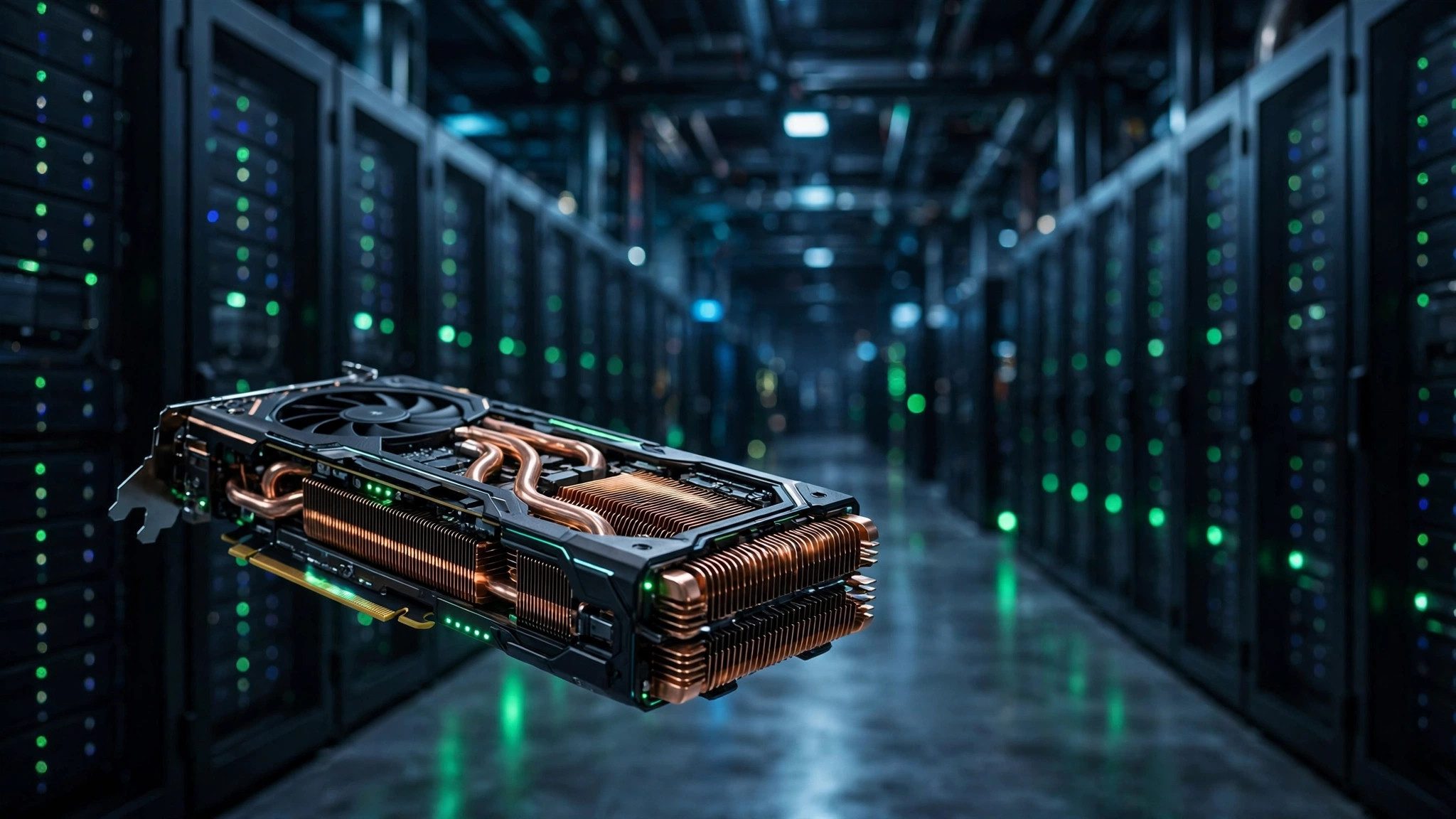
On November 16, 2026, NVIDIA published the first MLPerf results for its Vera Rubin platform during SC26: the new platform swept every MLPerf Training v6.1 benchmark, the only platform with results on every test, with the Vera Rubin NVL72 delivering up to twice the per-GPU performance of the previous-generation GB300 NVL72.
Twice the Performance Per GPU, Scaling That Barely Drops Off
Training speed is the heart of this result. MLPerf Training measures how long it takes to train a range of models to a target accuracy, covering large language models, image generation, recommender systems, and reinforcement-learning post-training. In NVIDIA's numbers, training DeepSeek-V3 scaled from 256 to 1,024 GPUs at about 97% efficiency, cutting training time from 16 minutes to around four. Running the same benchmark on GB300 systems, NVIDIA also submitted the largest-scale result of the round, at 10,240 GPUs. Twenty partner organizations submitted results on the platform, including Azure, CoreWeave, Google Cloud, Dell, Hewlett Packard Enterprise, and Oracle. Vera Rubin had already landed in supercomputing clusters, as covered in NVIDIA's Vera Rubin Lands in Supercomputing Clusters.
Treat the 10x Efficiency Claim With Caution
The other set of numbers covers agentic inference. In its first MLPerf Endpoints submission, the Vera Rubin NVL72 delivered more than ten times the throughput per watt of the GB300 NVL72 on the Kimi K3 agentic task, at comparable response speed. But that figure comes with a caveat: it is a provisional result that has not yet passed MLCommons Association verification and may still change after peer review. It also compares a single configuration — 32 accelerators against 48 — so it cannot be read as 'every agentic task runs ten times faster.' NVIDIA has not disclosed Vera Rubin's pricing or availability dates either.
For anyone planning a compute purchase, the results cut two ways: the training numbers have been verified by MLCommons, so Vera Rubin's generational leap is real, and hardware choices and timelines for the next round of large-model training may have to be recalculated. The 10x inference figure, by contrast, should wait for the verification outcome. Demand on the compute side is hot as well — Google's TPU order visibility extends to 2029. Two things are worth watching next: MLCommons' verification of the provisional results, and when NVIDIA discloses Vera Rubin's availability and pricing. Until then, the GB300 remains the verified, off-the-shelf option.