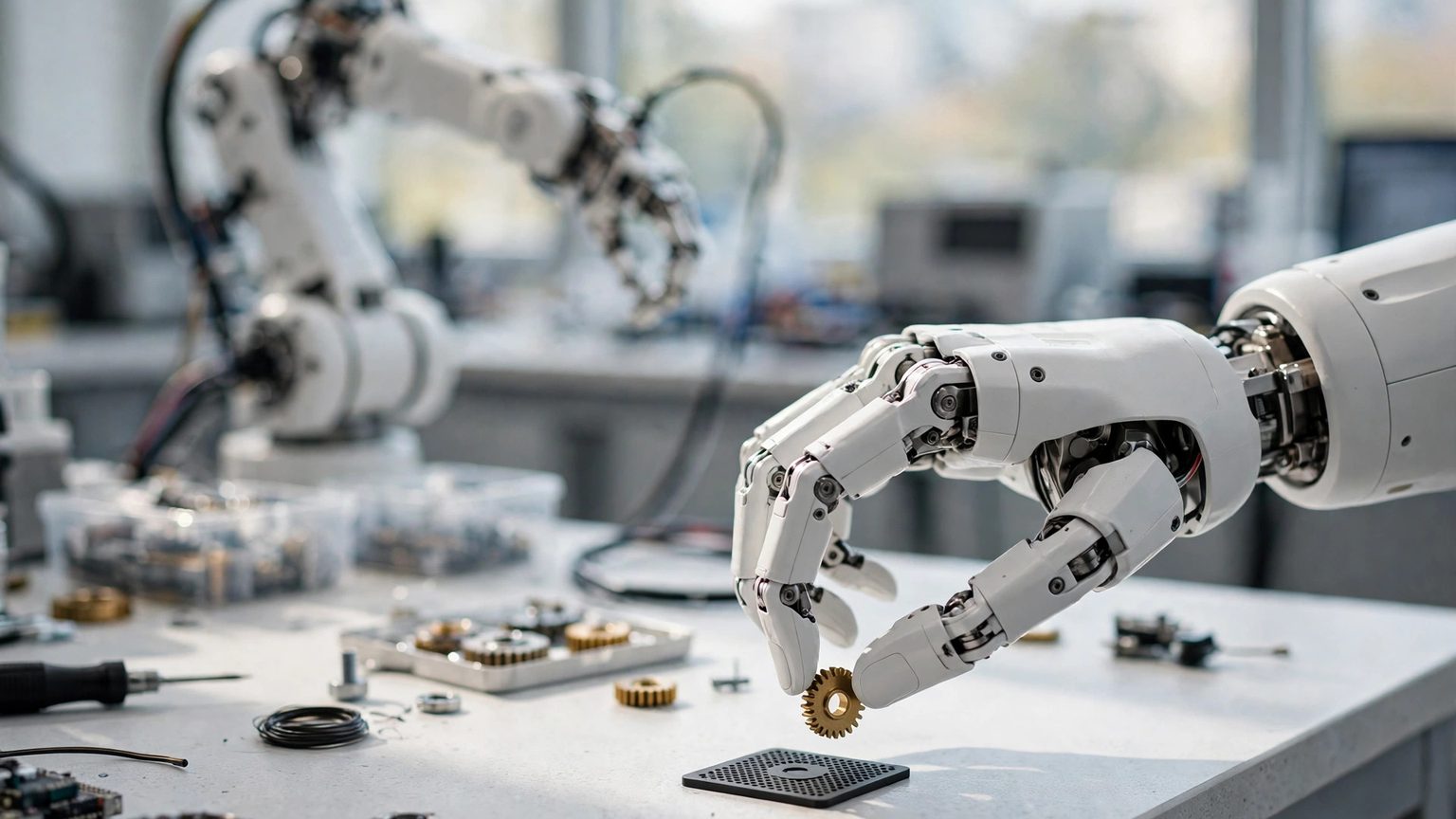
On November 9, NVIDIA unveiled GR00T 2, a robot foundation model, at the Conference on Robot Learning (CoRL) in Austin, Texas. The core change is how robots learn: instead of relying only on demonstrations performed on real robots, they can now pick up dexterous manipulation skills by watching first-person human video. In NVIDIA's 50-task evaluation, the model completed at least 40 of the tasks without any task-specific demonstration, averaging 71% success with just one demonstration per task and 95% with five.
GR00T 2 is an open world action model built on the NVIDIA Cosmos platform, with 2 billion parameters. Its training data includes 100,000 hours of NVIDIA open-source first-person human video, and the accompanying Human-1M-100K dataset is released under a CC BY 4.0 license, allowing commercial use. It can transfer skills learned from human demonstrations across different robot bodies, and AI agents can chain multiple skills together through its API and recover from errors. NVIDIA says GR00T 2 ranks among the top three models across the RoboCasa365, RoboLab, RoboDojo and MolmoSpaces benchmarks. Released alongside it are the open-source simulation training framework Isaac Lab 3.0 and two industrial evaluation benchmarks, DexBench and VABAR.
The early adopters all point at factory and service settings: Foxconn is applying GR00T 2 to server-manufacturing automation, Siemens is evaluating industrial use cases, Nexuni is testing it for robotic laundry handling, and MicroAGI is using it for Ethernet cable swapping. For robot teams, the real change is the cost of data: filming people doing the work is far cheaper than running demonstration after demonstration on physical robots, so even small teams can build training data. But 95% is still a score from controlled tests — a single mistake on a production line can stop it, so reliable deployment is still some way off. Learning from video is not NVIDIA's idea alone: Google's Gemini 4 Argon learned to throw by watching video too, and Xingyuan Chorus turns human operation videos directly into robot training data.
The next date to watch is December: NVIDIA's research page says the model code will be released in December, and whether the weights and training recipes come with it, and under what license, will only be confirmed then. Third-party scores on DexBench and VABAR are worth waiting for as well — NVIDIA's own numbers only count once they are reproduced on someone else's robot. CoRL runs November 9–12 in Austin, where NVIDIA robotics lead Jim Fan delivered a keynote.