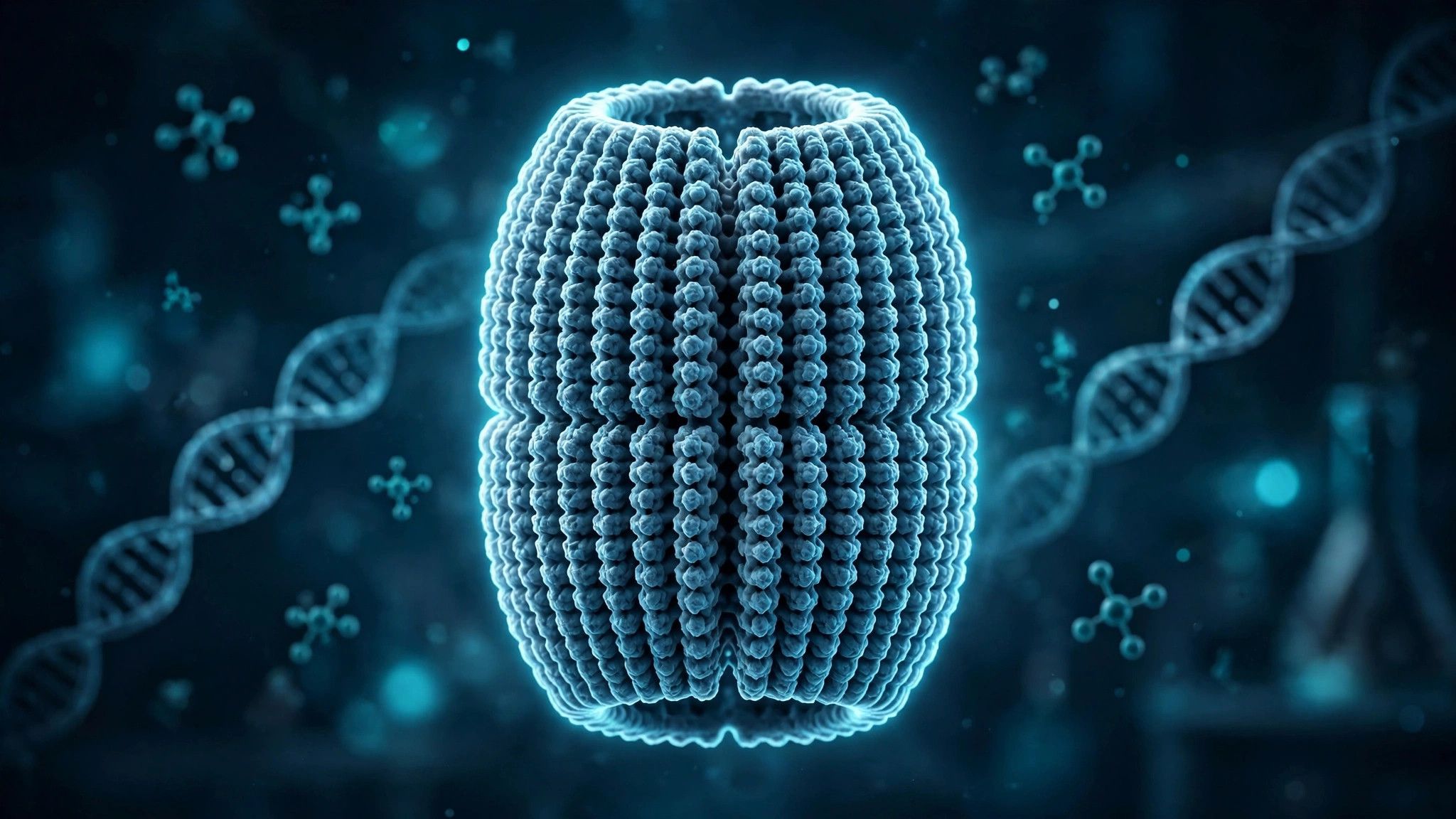
On November 4, Anthropic's biology research team unveiled research conducted with Claude throughout: the first 3D structure of a vault particle found in prokaryotic cells. These hollow protein barrels were discovered in 1986, and their function remains a mystery. The new structure comes from the L05 protein of a bacteriophage that infects bacteria, assembled from 96 copies of the same protein.
Fishing a barrel out of 15 billion sequences
The team first used Claude Science to search roughly 15 billion predicted protein sequences for distant relatives, finding traces across 29 bacterial phyla and four archaeal phyla. Of 44 candidate proteins tested in a cell-free expression system, 24 were moved into E. coli; 15 produced soluble protein, seven self-assembled into barrel-shaped particles, and cryo-electron microscopy confirmed four of them. The L05 particle is about 54 nanometers long and 45 wide, with a total mass of roughly 9.5 megadaltons, enclosing about 25% more volume than a human vault. Claude also shrank purification from the usual three days to about 90 minutes, and the first structural model arrived in 34 hours — a process that would normally take weeks. This is not Claude's first time working on proteins: it previously designed scorpion venom proteins autonomously in 64 hours, with 17 of 211 candidates confirmed in the lab.
AI makes mistakes too
What makes this report honest is that Anthropic did not only share the wins. A growth-medium recipe written by Claude contained an additive that interferes with getting DNA into cells, setting the project back by two weeks; early in cryo-EM processing, a skipped standard step produced a mirror-image map. The team's conclusion: errors are caught quickly in areas they know well, but cost time in areas they don't.
There are still limits: the particles have only been made in laboratory E. coli, and whether they form in their natural hosts is unverified; the work has been submitted to bioRxiv as a preprint and has not yet been peer-reviewed. Anthropic says the whole project went from screening to solved structure in under four months, and most steps could be reproduced by an ordinary lab using existing Claude products — only the cryo-EM analysis, which ran hundreds of GPUs in parallel, exceeds what most academic institutions can muster. The next step is figuring out what vaults actually do inside cells, and whether they can be re-engineered into nanocapsules for delivering enzymes.