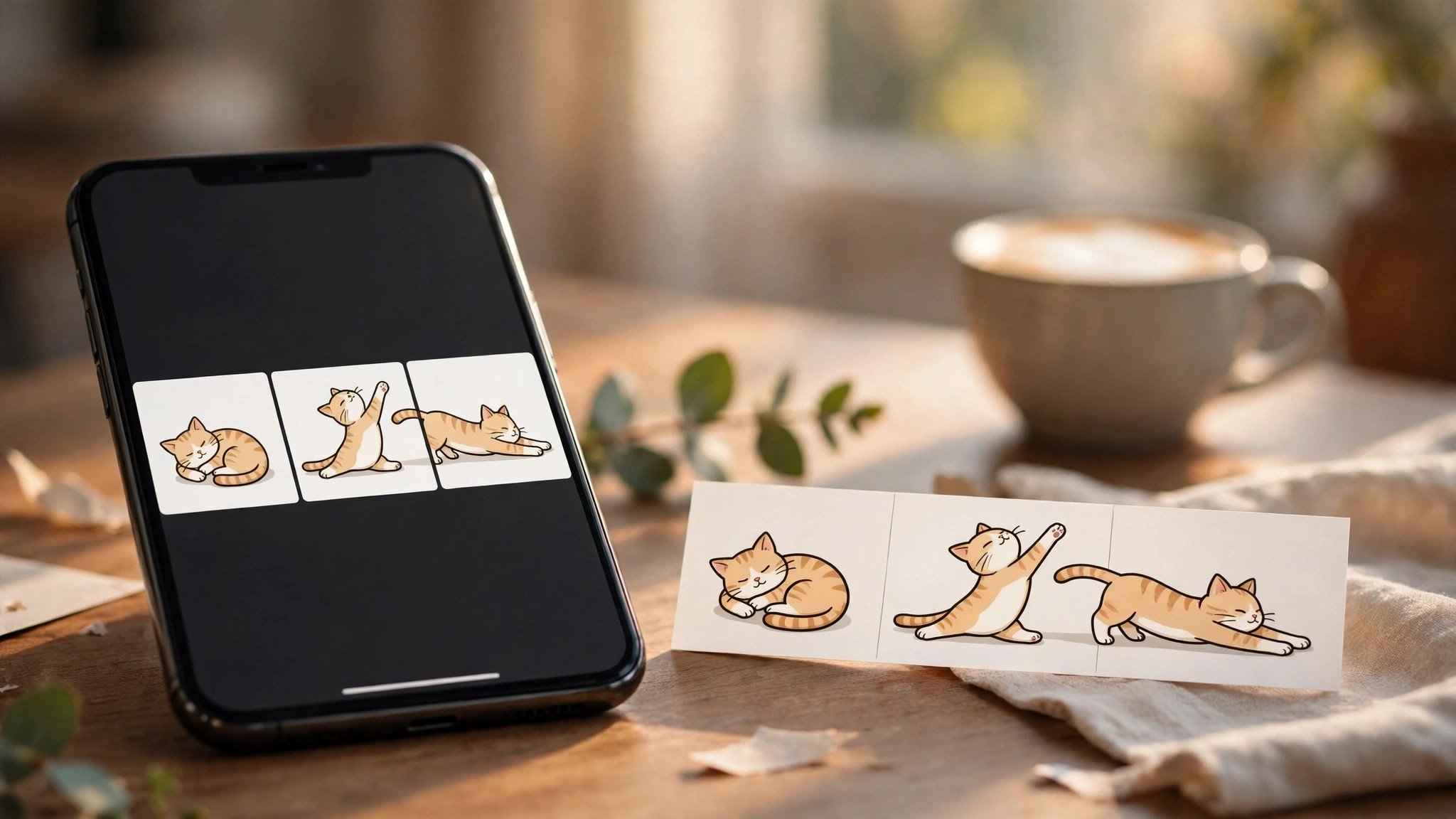
ChatGPT Images 2.6 launched on November 4, taking image generation from “one still image” to “a moving GIF, directly”: users can generate GIFs from text or a photo, adjust playback speed, and edit individual frames, while reusable reference images let the same character, pet, or person keep their look across different prompts. OpenAI says ChatGPT and the API now generate more than 4 billion images a week, up from 3 billion when Images 2.5 launched in September. The update is rolling out to all ChatGPT and Codex users on web, desktop, and mobile.
GIFs and reference images fix the “hard to revise” problem
The point of GIFs is not just that they move, but that they can be edited: after generating, users can change the speed, edit a single frame, and then share, instead of producing a still and stitching it together in another tool. Reference images solve a different annoyance — previously, keeping the same character consistent meant redescribing them and rerolling every time; now the look can be saved as a reference image and reused in later prompts, making character consistency much easier to hold. Together, they make image generation more like a workbench that can be revised again and again, rather than a one-shot lottery. For people making social content, product images, and storyboards, the saving is the time spent redoing work; but a GIF is several frames, so the chance of a detail going wrong is higher than with a single image, and important finished pieces still need a frame-by-frame check.
The API splits into fast and slow tiers, and the system card leads with GIF risks
On the developer side, two new API models arrive at the same time: GPT-Image-2.6 Flare is built for speed, with OpenAI saying generation is about 50% faster than the previous generation; GPT-Image-2.6 Sunburst is built for quality and consistency across repeated edits, suited to product images and character assets that need several revisions. The boundary to note is that, as of publication, pricing for the new API models had not been announced, so developers should not estimate costs from old prices. The system card published the same day also leads with GIF risks: harmful meaning conveyed across frames is harder to spot, and the safety reasoning model reviews the generation caption together with the frame grid; in an evaluation of 310 GIFs labeled policy-violating, recall was 77.66%, while OpenAI also acknowledges that motion-related violations remain hard to catch fully. In other words, the GIF feature is handy, but the platform does not claim its content review is foolproof, and GIF requests involving people — especially minors — remain under stricter limits.