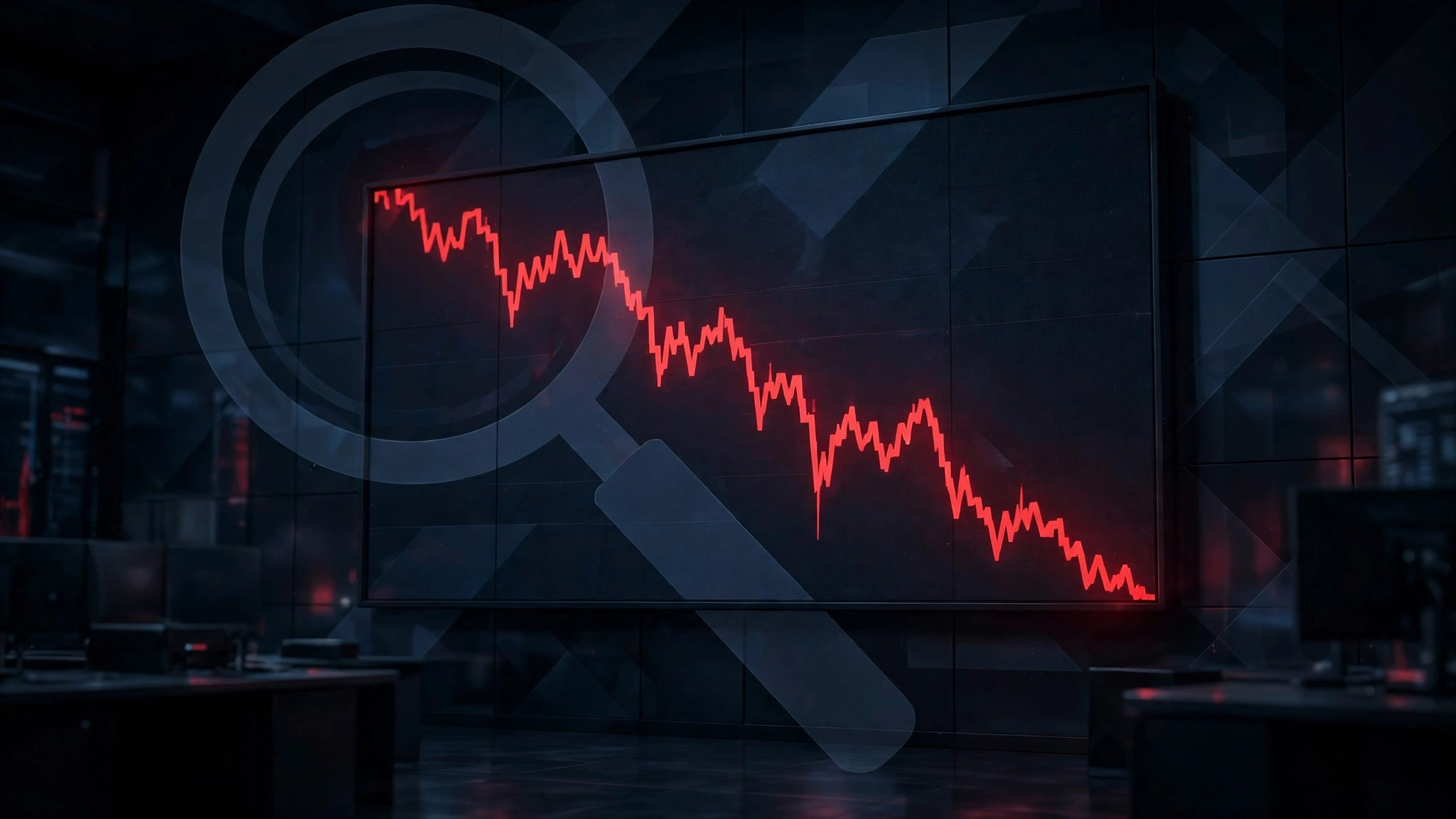
On October 29, 2026, Alphabet suffered its worst trading day since going public. A day after its third-quarter results, the shares fell about 12.6%, wiping roughly $500 billion off its market value — the second-largest one-day loss in US stock market history, behind only Nvidia's January 2025 drop. What makes the fall striking is that the results themselves were not poor; the market was repricing expectations.
Decent results, damaged expectations
Total revenue rose 25% year on year to $127.6 billion and operating income rose 30% to $40.6 billion, while cloud revenue more than doubled. But two cracks mattered: revenue came in slightly below the $128.2 billion consensus and adjusted earnings per share of $2.67 missed the $3.02 forecast, while net income fell 25% to $26.2 billion, partly on an unrealized loss linked to its SpaceX investment. Most important was search: revenue grew 12% to $63.4 billion, slowing from 17% in the second quarter and missing expectations for a second straight quarter.
| Metric | Third-quarter result |
|---|---|
| Total revenue | $127.6 billion, up 25% year on year |
| Search revenue | $63.4 billion, up 12% |
| Cloud revenue | $30.7 billion, up 103% |
| Capital expenditure | $51.4 billion, a quarterly record |
| Free cash flow | Negative $9.1 billion, negative for a second straight quarter |
Cloud growth could not calm cash-flow anxiety
On the earnings call, the chief business officer acknowledged that AI Mode currently shows fewer ads and monetizes less well than traditional search, describing ad experiments only as promising, with no clear timetable for closing the gap. Meanwhile AI building is burning cash faster: quarterly capital expenditure hit $51.4 billion, free cash flow was negative $9.1 billion, and management raised 2026 capital expenditure guidance to $195–205 billion, warning that 2027 spending will rise significantly. The investor question is now blunt: can 103% cloud growth outrun spending at this scale, and will AI answers permanently depress search ad prices?
Three things to verify next
First, whether AI Mode ad experiments can actually restore monetization rather than staying at the promising stage. Second, whether cloud growth and margins keep offsetting capital expenditure. Third, whether search growth stabilizes next quarter or keeps sliding toward single digits. For advertisers and publishers, the nearer-term impact is not the share price itself but traffic allocation: AI answers that need no click are already changing the flow, and businesses dependent on search traffic must rethink how they acquire users. If any of these three tests fails, the market may vote with its feet again.