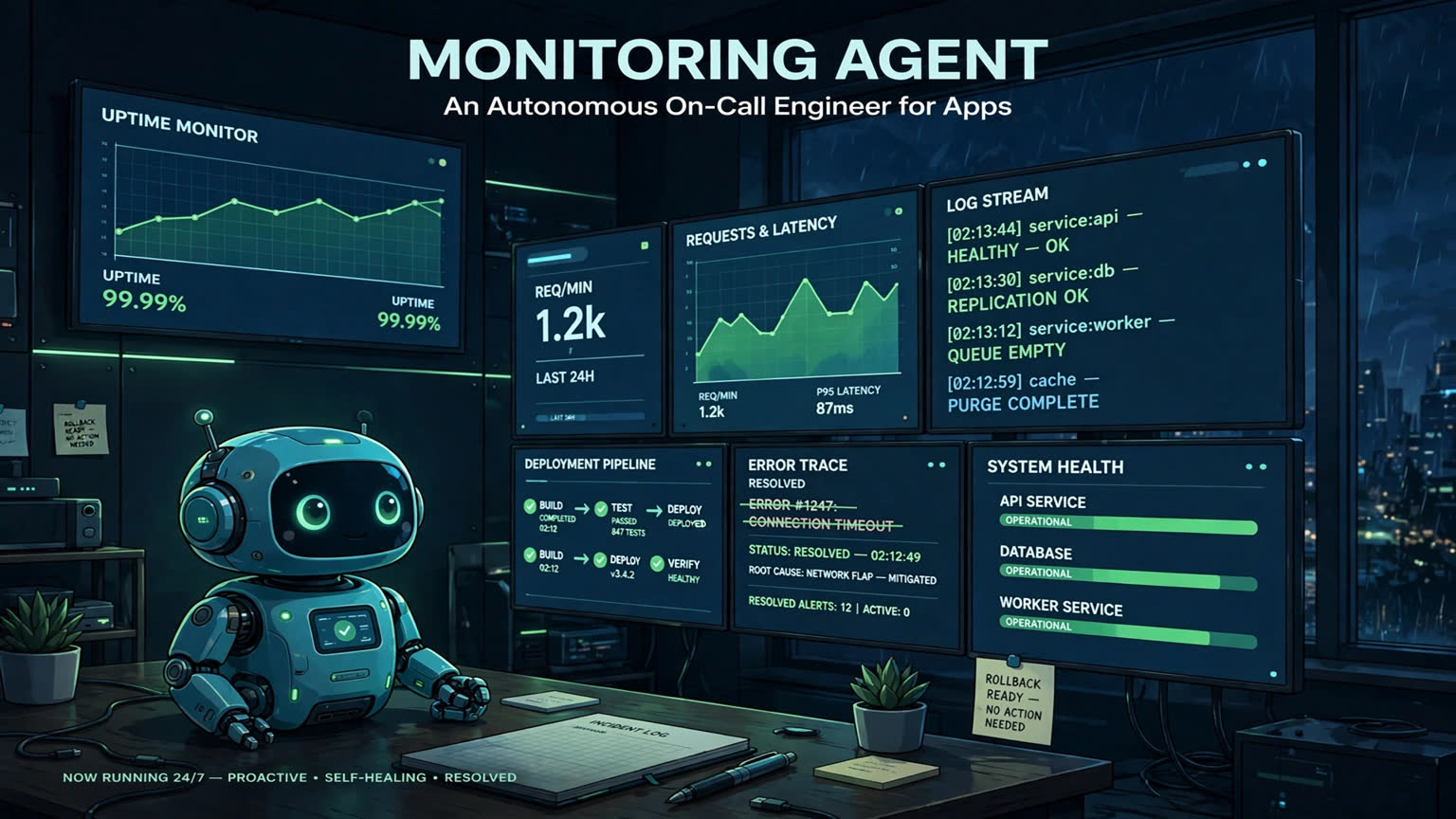
Replit's Monitoring Agent was officially released on the Replit blog on October 22, giving every developer who ships an app on Replit an "autonomous on-call engineer". At a large company, someone is on call: woken by alerts, reading logs, finding the cause, fixing it and shipping. For indie developers and small teams, all of that falls on the same person — building the product, answering users, and getting up at night to check the server.
The Monitoring Agent works in three steps. First, it looks at production: it can read production logs and metrics directly and investigate errors, slowdowns, and failed deployments on its own, without anyone digging through logs first. Second, it fixes: with alerting and autofix enabled, it gets notified when something breaks, finds the cause, validates a fix, then emails a summary of what happened and what changed. Third, it ships: with auto-publish enabled, it can deploy a validated fix to production automatically — whether fixes go out automatically stays in the user's hands.
The capability builds on App Monitoring, which Replit launched earlier this year — back then it only did health checks and "your app is down" alerts; now the fix-and-ship loop is closed. The entry point is in the app's Publishing settings: after publishing, turn on monitoring alerts and autofix.
Replit frames this in a bigger narrative in the blog: from a single pair-programming agent toward "autonomous software teams" that can do everything a modern software team does. Over the past six months they have shipped black-box security scanning and growth agents; production monitoring is the third piece. Their argument: building a working app is only the start — keeping it reliable, secure, discoverable, and improving used to take a whole team; with agents taking over that work, more people can turn ideas into real things.
Small teams benefit first; the risk sits at the "auto-publish" tier
Indie developers and small teams get the benefit first: they have no on-call rotation, and users usually discover outages before they do. By automating the discover–locate–fix–validate grind, the Monitoring Agent lets one person hold an on-call standard close to a team's.
But the automation boundary deserves scrutiny. Auto-fix and auto-publish hand write access to production to an agent: how rigorous the validation is, how smooth rollbacks are, how timely the email reports are — that decides whether this saves effort or creates trouble. Making auto-publish an opt-in switch is a pragmatic design — cautious teams can start with "fix and report", then open up auto-publish once it runs smoothly.
Zooming out, competition among AI app platforms is shifting from "whose generated code is better" to "whose apps stay alive longer": deployment, monitoring, fixing, and security are becoming standard platform capabilities. This Replit move formally productizes the ops layer.