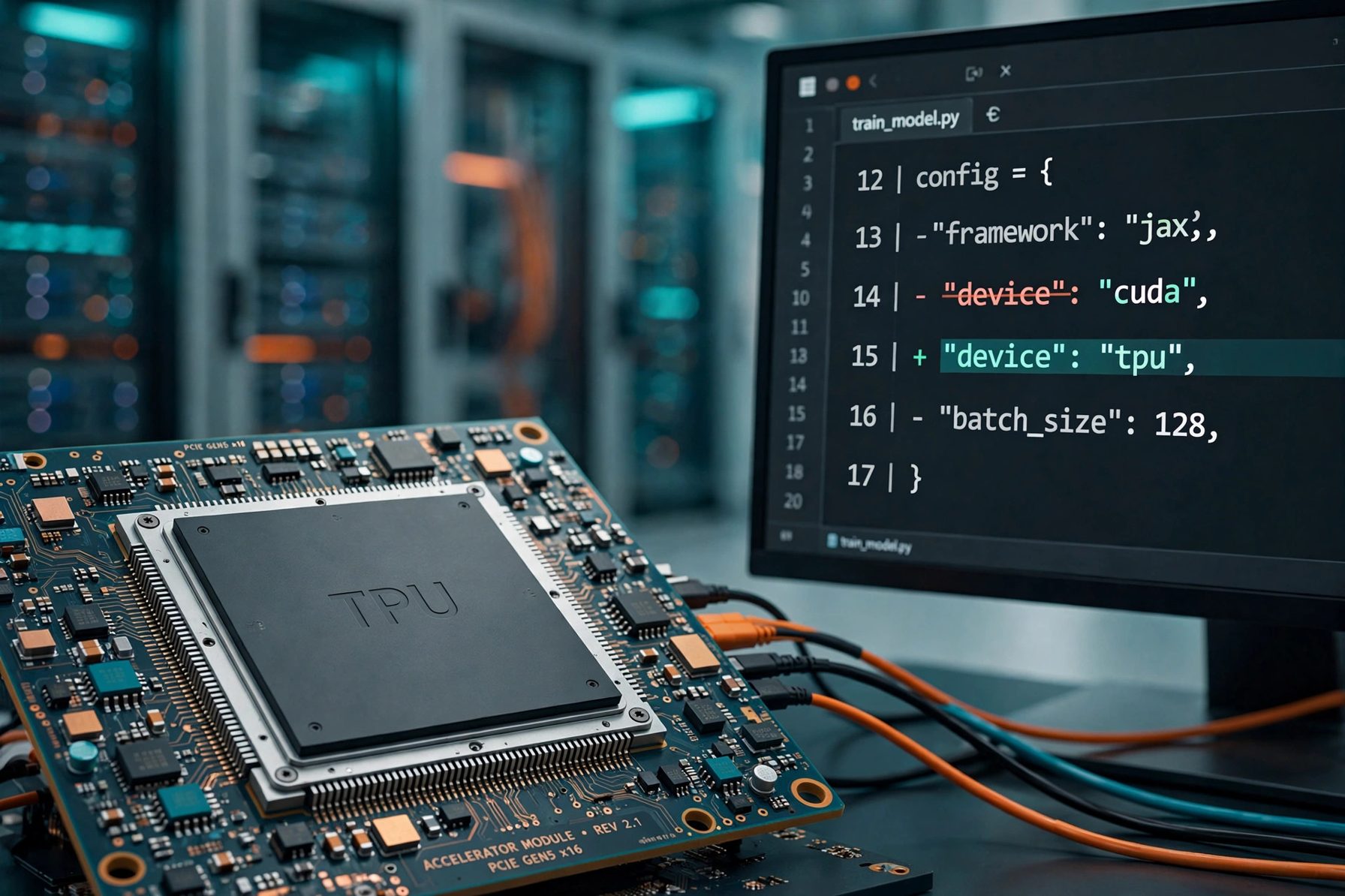
TorchTPU was announced as open source by Google and the PyTorch team at Meta on October 20, 2026, at PyTorch Conference 2026. For the first time, it turns Google's TPU into a native PyTorch device: in many cases, existing models only need .to("cuda") changed to .to("tpu") to start running on TPU hardware before any tuning begins.
Why the old bridge fell short
TPUs were long tied to TensorFlow and JAX. PyTorch users who wanted TPU access had to go through PyTorch/XLA, introduced in 2020. Built on lazy tensors, it required developers to mark compilable regions explicitly in their code, suffered from long compile times, lacked PyTorch's native eager execution mode used for everyday debugging, and often lagged behind new distributed training features. For teams with established PyTorch pipelines, the migration cost was not the model itself but having to rewrite their whole workflow.
A backend rebuilt from the bottom up
TorchTPU is not another translation layer on top of JAX. It was implemented as a principled PyTorch backend: no JAX dependencies in the runtime, solid eager execution, torch.compile based on Torch Dynamo, and TPU collectives supporting distributed idioms such as DDP, FSDP and DTensor at the lowest level of the stack. According to the official blog, it already supports around 450 ATen operators and has been validated out of the box on the 5,000 most downloaded Hugging Face models, including Qwen, DeepSeek, Gemma and Llama, as well as audio and vision models such as Whisper, CLIP and ViT. New vLLM and SGLang inference engines built on TorchTPU were launched alongside it, and training integrates with TorchTitan and Ray. Google says TorchTPU is already used in production for training and inference by some of its largest Google Cloud customers, and recommends it over PyTorch/XLA for new workloads.
Who gains a real option
The most direct beneficiaries are teams whose compute bills are tied to a single GPU supply: another hardware option that runs existing PyTorch code changes both pricing leverage and queue times. But one line of code solves whether a model runs, not how fast it runs. The team itself notes that tensor shapes, sharding and operator mixes tuned for GPU architectures still need re-tuning for the TPU's matrix units to approach peak performance. For individual developers the short-term impact is limited. This is better read as infrastructure loosening up: the six-year-old bridge between the PyTorch ecosystem and TPU compute has finally been replaced by a direct road.