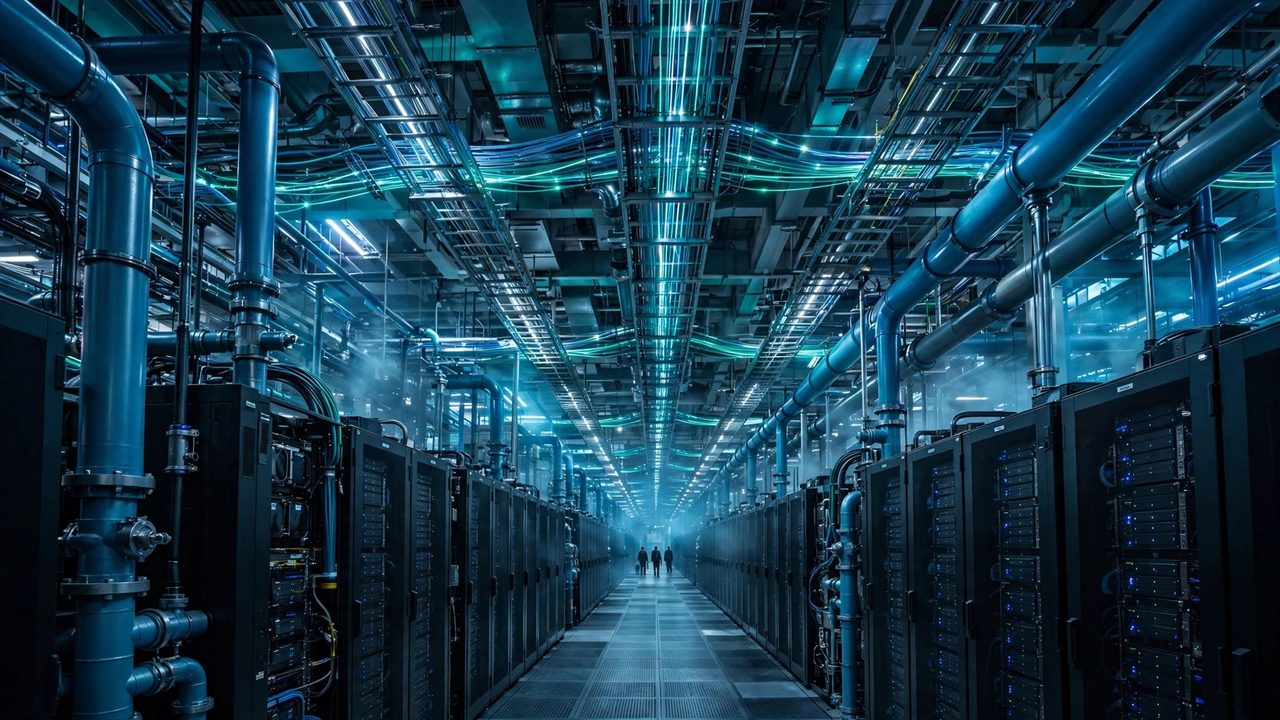
The first phase of Meta's Prometheus supercluster is complete. On October 19, 2026, Meta disclosed in a post on its official engineering blog that the gigawatt-scale supercluster in New Albany, Ohio, is already in service: the recently released Muse family of foundation models was trained there, and the end goal is to scale it to roughly one million GPUs.
Scale: hundreds of thousands of GPUs today, about a million at the finish
Prometheus currently comprises hundreds of thousands of GPUs spread across multiple buildings — traditional data center halls, AI-optimised halls and rapid-deployment structures — tightly interconnected by miles of fiber and functioning as a single machine. Two hardware generations are already deployed: Catalina, based on NVIDIA's GB200 NVL72, and Clemente, which moves to the GB300 NVL72, raising per-GPU memory from 192 GB to 288 GB and packing the full 72-GPU domain into a single rack. A third platform based on NVIDIA's Vera Rubin NVL72 is on the way. Meta's stated endpoint is around one million distributed GPUs running in lockstep.
The hard part is not stacking chips, it is staying up
In large training runs, a single failing host can slow or halt the whole job, which is why the industry measures goodput — the share of compute that does useful work. Meta reports pre-training goodput above 85% and reinforcement-learning goodput above 90% for Muse Wonder, with a mean time between interruptions of roughly 47,000 GPU hours, later raised above 54,000 GPU hours through firmware and other fixes. The cost hides in the details: NVL72 grows the tightly coupled domain from 8 GPUs to 72, multiplying the blast radius of a fault by about nine, so each domain runs only 64 GPUs and keeps 8 as in-rack spares; a 32,768-GPU training run needs roughly 13% extra hardware provisioned.
Networking and cooling: the unglamorous work behind a gigawatt
The aggregation network linking Prometheus' buildings spans from 2 km to over 100 km, delivering multiple Pbps per region pair, and the cluster consumes millions of miles of fiber strands and tens of thousands of switches. On the thermal side, closed-loop liquid cooling keeps rack power in the hundreds of kilowatts under control. In other words, the engineering challenge of this cluster no longer sits in any single chip, but in whether the optical, electrical and cooling systems can run on the same beat, reliably, for years.
Why this cluster is worth watching
Prometheus is the training base for the next frontier models from Meta Superintelligence Labs. The signal is clear: competition among the top labs is shifting from "how many accelerators can you buy" to "can you organise a million of them into one machine that rarely stops". For everyone else in the industry, procurement is just the entry ticket; systems-level reliability engineering is where the gap will open up over the next few years.