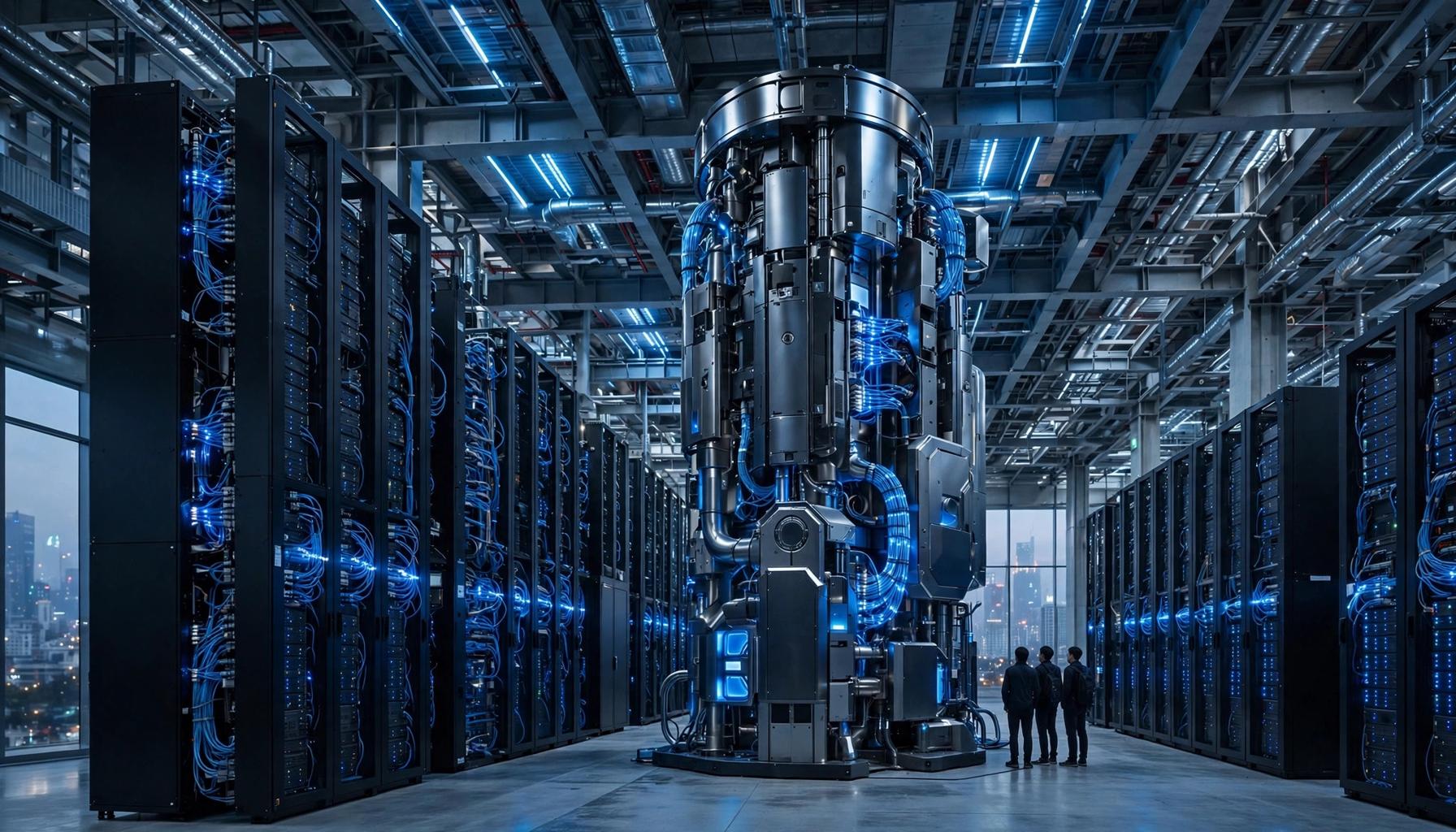
The Shuguang 8000 appeared in physical form on October 17, 2026 at HPC China 2026, the CCF National Conference on High Performance Computing, which opened in Shenzhen, where Sugon also showed its full-stack domestic HPC technology. On October 18, ten frontier application results running on the Shuguang 8000 were released during the conference, as reported by CCTV News and Jiemian News. China's first fully domestic 100,000-card AI supercluster, which entered service this August, stepped in front of the public as a real machine for the first time — and the focus was no longer its specifications, but what it has actually computed.
Start with the application list: from microscopic particles to the macroscopic universe
The ten results were released by Sugon together with multiple research teams, spanning astronomy, earth science, life science, materials simulation and engineering R&D, at scales running from microscopic particles to the evolution of the universe. According to the conference, the results mark key advances in simulation scale, precision and turnaround time, with several described as world firsts. The list gives the 100,000-card scale a checkable footnote: when the cluster entered service in August, the official line was that it supported more than 300 computing tasks across 26 fields; two months later, the count stands at more than 300 key applications deeply optimized across over 30 fields, more than 20 of them running on the full machine. On the same domestic-compute track, the Fengqing weather AI system has entered operational service, delivering global forecasts valid out to 11 days.
Its difference from an ordinary AI cluster is native fusion
The Shuguang 8000 is the first system to explicitly adopt a native supercomputing-plus-AI architecture: on a single foundation it runs both the highest-precision scientific computing and large-model training and inference, rather than stitching a supercomputing zone and an AI zone together. Built on a domestic heterogeneous chip architecture, it links 13,440 compute nodes and 100,000 accelerator cards at high speed, with more than a billion components. The real difficulty at this scale is coordination — if compute, storage, networking, liquid cooling or system software falls behind anywhere, whole-machine efficiency drops — which is why the exhibit also included high-performance storage, high-speed interconnects, advanced liquid cooling, and software such as the OneScience scientific model platform and scientific-computing agents.
How the compute gets used matters more than the card count
For universities, research institutes and industrial users, the most practical detail in this appearance is access: the Shuguang 8000 serves users through a core node of the National Supercomputing Internet, so capacity can be called on demand instead of building a 100,000-card cluster of one's own. Two things are worth watching next: when the full list of the ten results and their individual metrics will be published item by item — so far the conference has given only the field distribution and a general claim of several world firsts — and whether the number of full-machine applications keeps growing beyond twenty-odd. A 100,000-card cluster is ultimately valued not by peak compute, but by how many real tasks can keep the whole machine busy.