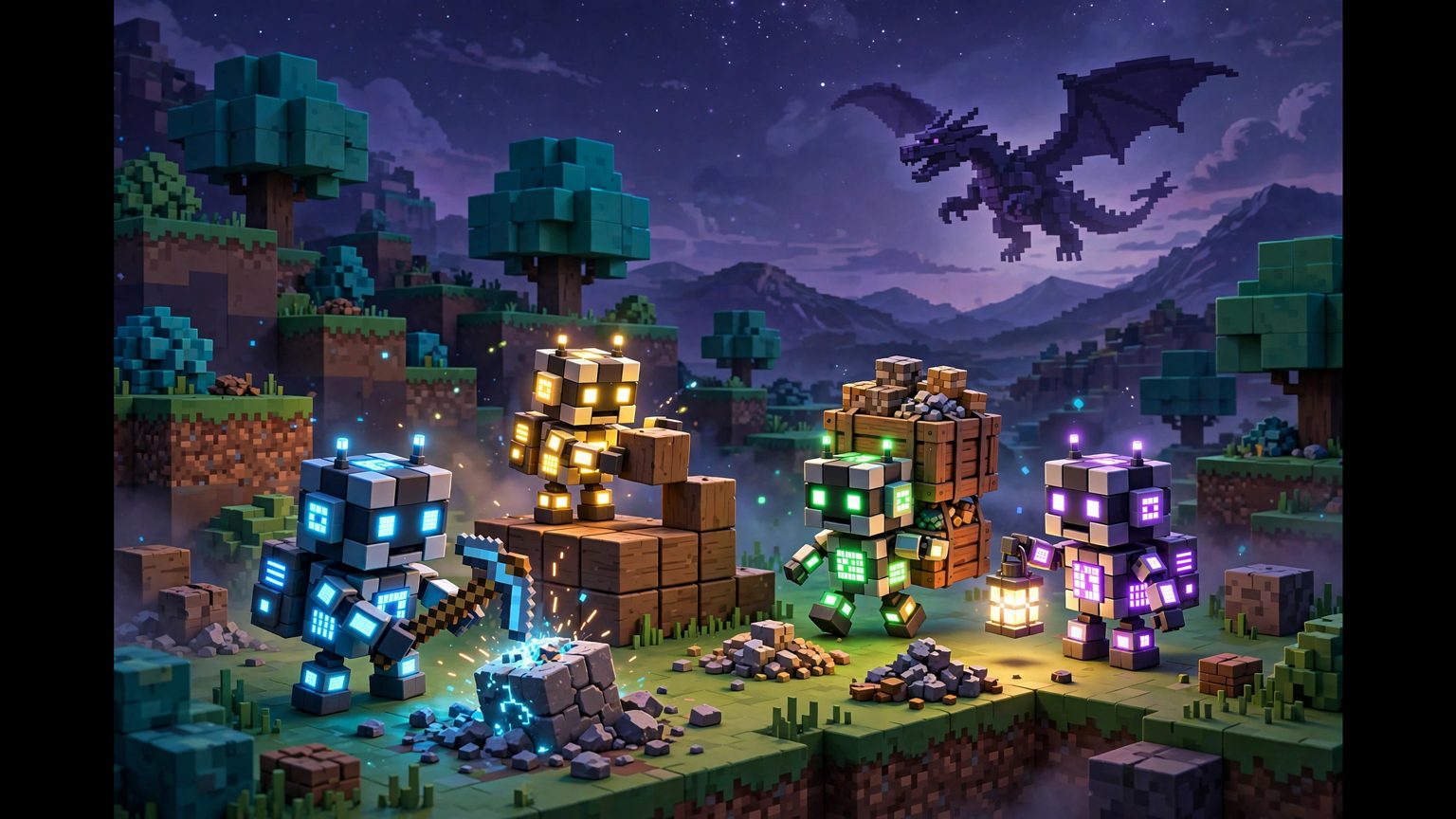
Gemini agents have produced a result that is hard to dismiss as a demo: on October 16, 2026, Google DeepMind researchers Satinder Singh and Roberta Raileanu reported on the Hugging Face blog that four general-purpose Gemini 4 Argon coding agents, starting from a random spawn point, completed Minecraft's survival mode on their own and defeated the Ender Dragon in 27 hours and 14 minutes. DeepMind's official account amplified the result the same day. According to the authors, this is the first end-to-end autonomous completion of Minecraft by AI agents using only the standard Mineflayer library — a "first" that is the authors' own claim and still awaits replication by others.
No screen, only code
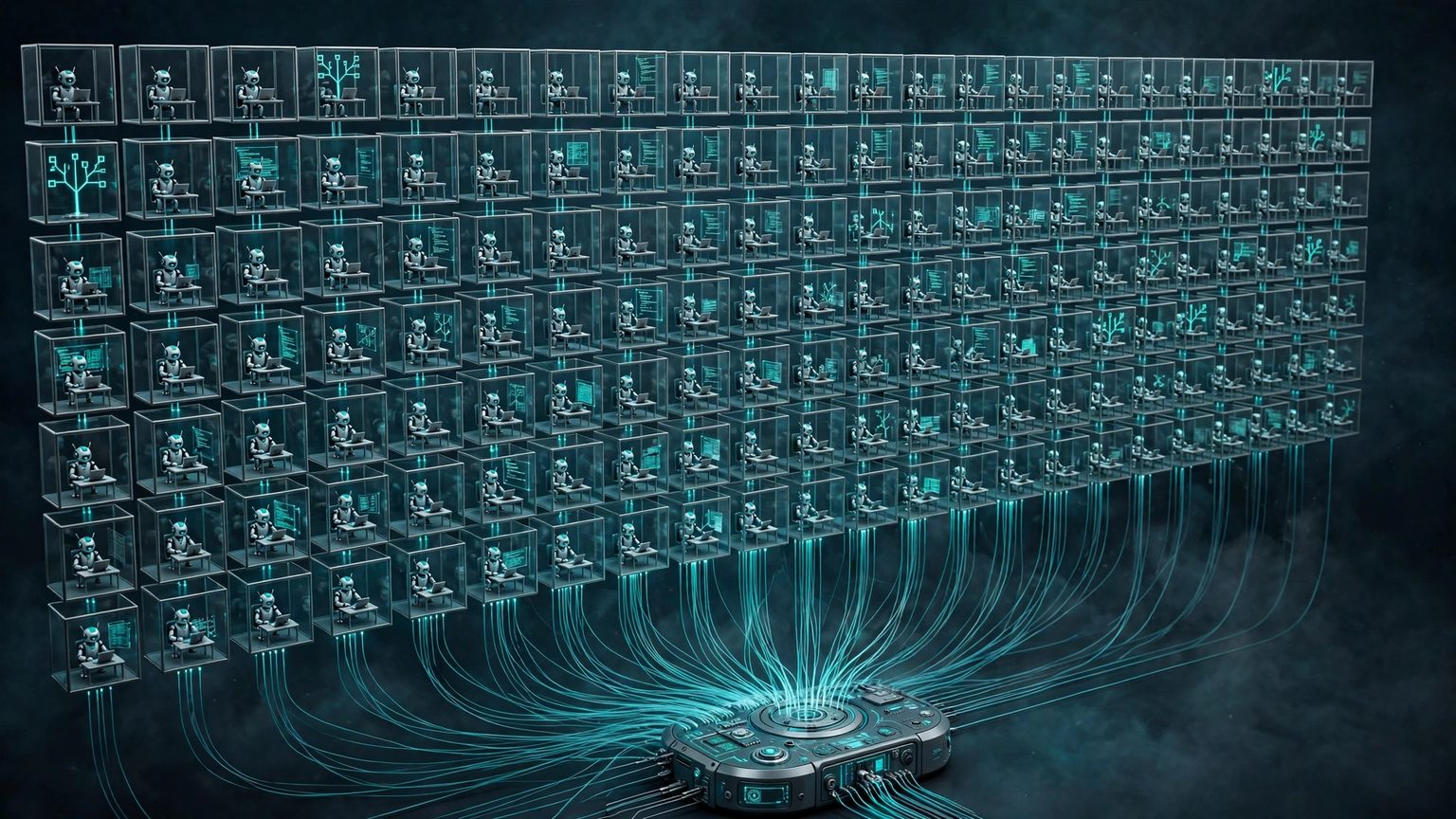
These agents play nothing like a human. They cannot see the game screen: each agent drives a Mineflayer bot and can perceive and act only through a programming interface, so problem-solving means writing JavaScript on the fly. Over 27 hours they wrote 2,783 programs totalling roughly 63,313 lines of code, and distilled 42 reusable helper functions. The researchers gave them no human-written game tools and no pre-assigned roles; the four agents could coordinate only through in-game chat and a shared memory.
The division of labour grew on its own. The report describes several behaviours that emerged along the way: some agents gradually concentrated on particular kinds of tasks, amounting to de facto specialization; they located one another through a form of triangulation; and when a teammate died and dropped its items, another agent would go and recover them. None of this collaboration was scripted — it emerged from a minimal setup of shared memory plus free-form messaging.
The other side of the ledger: 605 deaths, 1.35 billion tokens
The cost side of the run is just as striking. The four agents died 605 times on the way to victory, and the session processed about 1.35 billion input tokens and 16 million output tokens across roughly 24,000 model calls. By the report's own estimate, the API bill comes to about $520 at introductory pricing and $1,040 at standard pricing. In other words, the completion rests not only on capability but on a large error budget and uninterrupted long-horizon running — a single break in memory or tooling could have wiped out 27 hours of progress.
Read as an agent benchmark rather than a gaming stunt, the point becomes clearer. A Minecraft survival run is a complete long-horizon task: the goal decomposes into dozens of interdependent sub-tasks, with resource management, navigation, combat and building interleaved, and failures that the agents must clean up themselves. What the run shows is that, in an environment with a clear win condition and cheap retries, general-purpose coding agents with shared memory can already carry a task that lasts more than a day. It sits on the same curve as the workplace shift described in Anthropic's agents outnumbering its staff six to one: the frontier of agent capability is moving from completing a step to carrying a whole job.
The caveats belong on the record too: this is a single run reported by its own authors, in a world with an unambiguous finish line where death is reversible — most real long-horizon work offers no such cheap retries, and 605 deaths plus a four-figure dollar cost would read very differently in production. The next result worth watching is not a repeat completion, but the same setup on a new random map and a different task, finished with far fewer deaths.