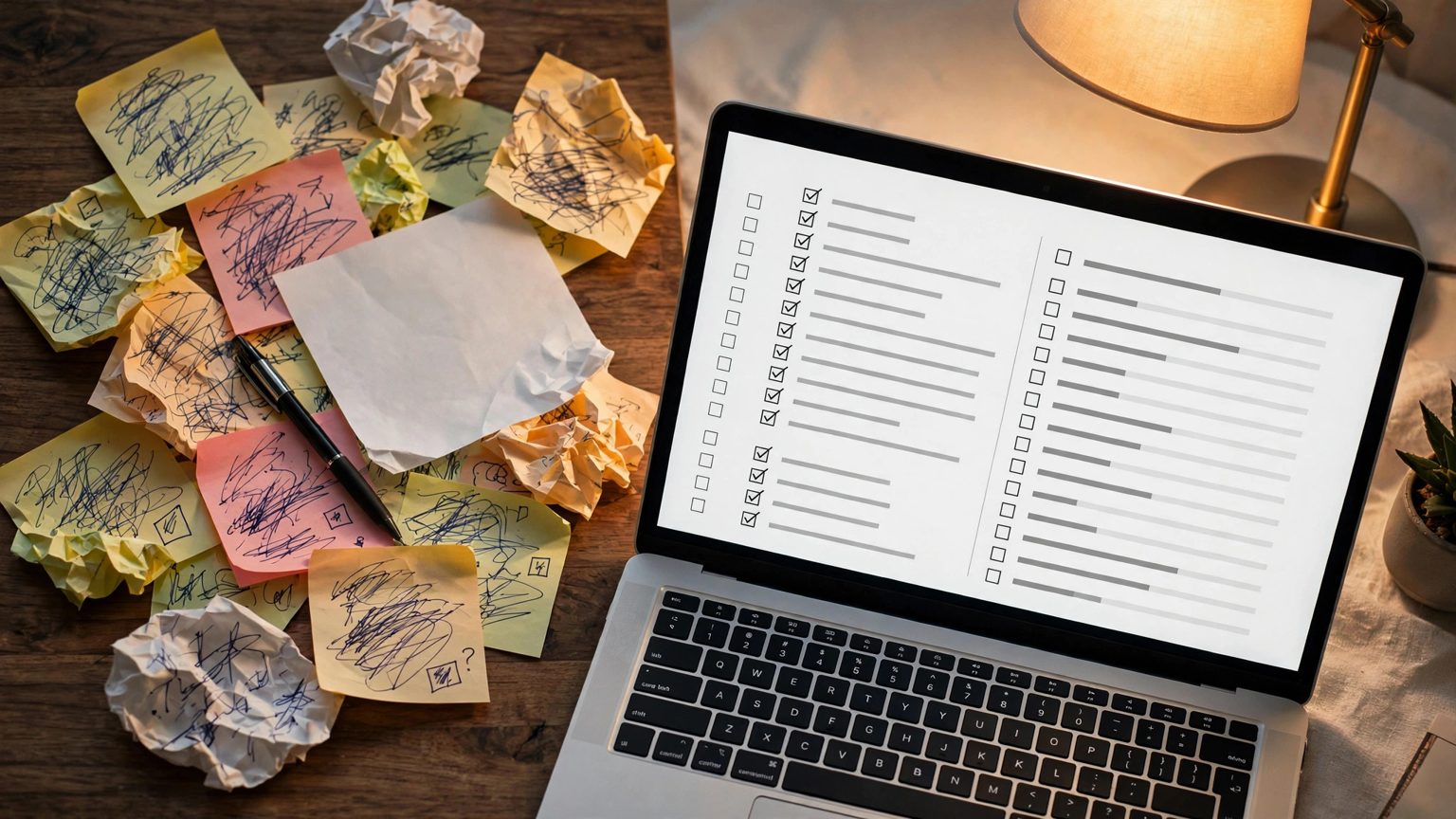
This reading notes prompt tackles the oldest reading problem: you understood a chapter while reading it, closed the book with only a vague sense that it made good points, and a week later cannot say what the author actually argued. Copy the prompt below into any AI chat, fill in the 5 variables, paste one chapter or your highlights, and you get a set of idea cards plus a concrete action list — not a reworded summary of the chapter.
When this prompt fits
- You read nonfiction — business, psychology, study methods — and want to turn its ideas into things you can actually use at work.
- You stopped halfway through a book and want to bank what you have read before continuing, instead of starting over.
- You need a discussable outline before a book club or group read, not a pile of scattered highlights.
It differs from a plain summary in output shape: a summary only shortens the text, while this prompt requires every idea card to carry evidence from the text, how it applies to your situation, and one small action you can take this week.
Copy this prompt as-is
# Role
You are a nonfiction reading coach who breaks an author's ideas into small units that can be discussed and acted on, and never adds claims the text does not make.

# This reading
Book and chapter: {{book and chapter}}
The problem I am reading this book to solve: {{reading goal}}
My role and current situation: {{my situation}}
Time span for the action list: {{action window}}
How familiar I am with this chapter: {{familiarity}}

# Chapter text or my highlights
---
{{chapter text}}
---

# Rules
1. Work only from the text pasted above; do not fill gaps from outside knowledge, and mark anything unclear as "not stated in the text";
2. Produce 4 to 6 idea cards, each with: the author's claim in one sentence, evidence from the text (quote or paraphrase with its location), a counterexample or limit, and how it connects to my situation;
3. If ideas repeat or contradict each other, merge the repeats and flag the contradiction instead of pretending they agree;
4. Finish with an action list: pick at most 3 items from the cards, each written as when, what, and what counts as done, ordered by how feasible they are this week;
5. No praise-filled book-review language and no vague evaluations in place of specific claims.

# Output format
Idea cards first, numbered one by one, then the action list, then one line listing what the text did not state and I should check in the book.
What to put in the 5 variables
| Variable | What to enter | Example |
|---|---|---|
| {{book and chapter}} | Title plus chapter or page range | Deep Work, chapter 2 |
| {{reading goal}} | The concrete problem behind your reading | Too many meetings fragment my focus time |
| {{my situation}} | Role, work context, real constraints | Product manager leading a team of five, afternoons full of meetings |
| {{action window}} | How far the action list should reach | This week / the next two weeks |
| {{chapter text}} | Full chapter, ebook excerpts, or your highlights | Highlights exported from your reading app |
{{familiarity}} is optional: write "first read" the first time, or "re-reading, focus on what differs from my earlier understanding" and the model will skip basic explanations and flag the differences.
Four details that make the notes usable
- Paste one chapter at a time: feed a whole book at once and the cards turn broad and empty. One chapter at a time keeps the evidence attached; merge the cards and remove duplicates after you finish the book.
- State a concrete problem, not a big word: swap "self-improvement" for "meetings keep chopping my day into pieces" and the relevance and action sections stop being generic.
- Keep at most 3 actions, each with a done criterion: "focus more" is not an action; "Wednesday and Thursday, 9 to 10 a.m., notifications off, work only on the proposal draft" is. If there are more, ask the model to cut to 3 by difficulty.
- Check the flagged gaps in the book: the final line listing what the text did not state marks exactly where invention is most likely; two minutes back in the book beats re-reading the whole chapter.
After finishing a chapter, keep going: ask the AI to turn the idea cards into quiz questions and correct you on the spot when you miss. Notes break the book open; the quiz proves you kept it. Used back to back, one chapter is genuinely read, not just highlighted.