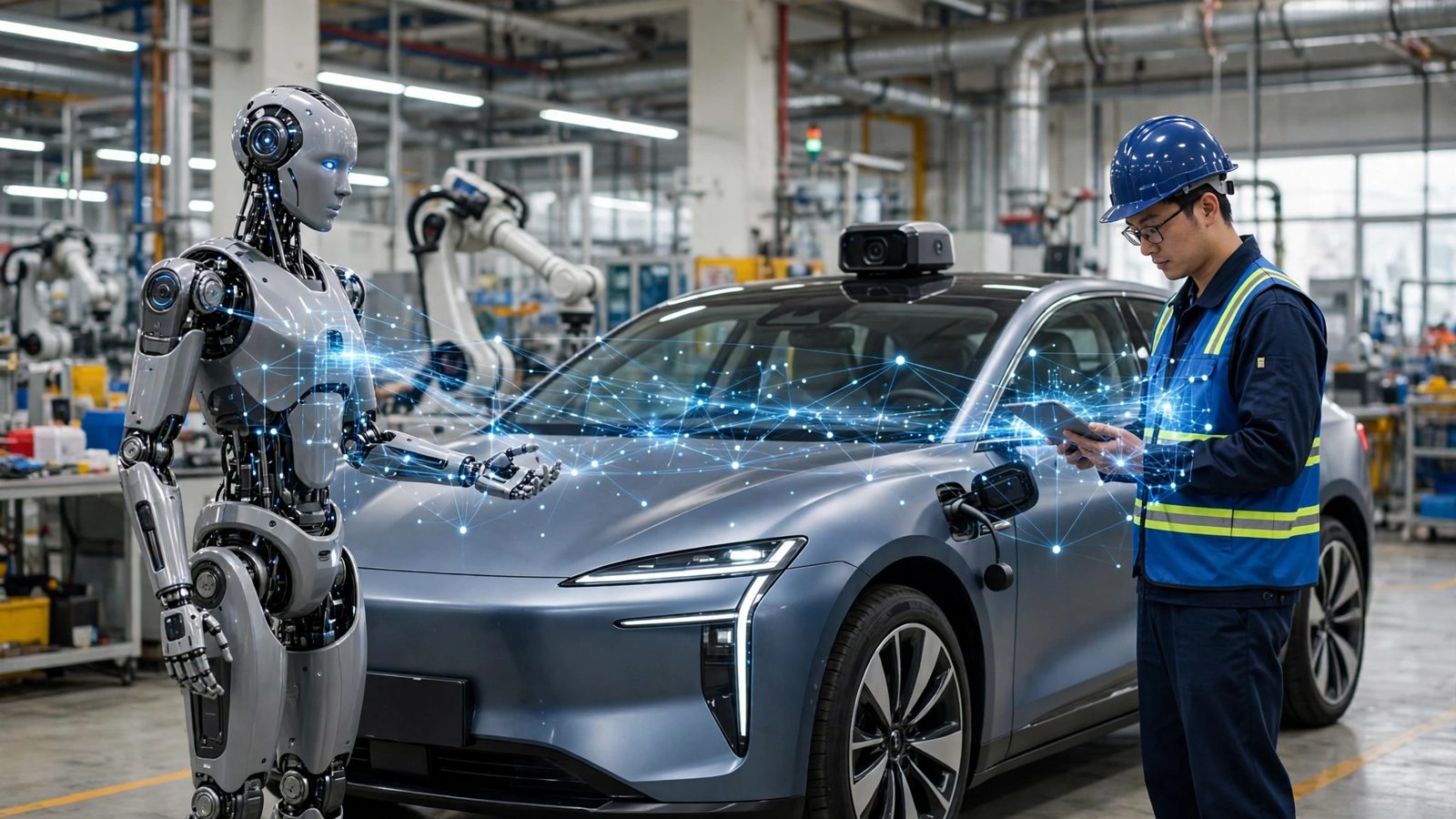
“AI Plus” moved into a standalone clause on October 9, 2026, in the Opinions of the CPC Central Committee and the State Council on Developing New Quality Productive Forces, released by Xinhua: fully implement the “AI Plus” action, use AI to upgrade traditional industries, and speed up scenario deployment of a new generation of smart terminals — intelligent connected new-energy vehicles, AI phones and computers, and humanoid robots. The document has nineteen items in all, and AI also appears in sections on research translation, data, finance and governance, but item ten is reserved for it alone, a different weight from the passing mentions in earlier documents.
Four things item ten actually says
Read closely, item ten carries four layers. First, upgrade the existing stock: bring AI into the production processes of traditional industries rather than only building standalone new products. Second, grow the terminals: three categories are named — intelligent connected new-energy vehicles, AI phones and computers, and humanoid robots — with faster scenario deployment required. Third, fix the supply side: accelerate innovation in AI and other digital-intelligent technologies, break through basic theory and core technologies, and strengthen the efficient supply of computing power, algorithms and data. Fourth, build the supporting layer for delivery and safety: lay out national AI industry-application pilot bases and high-value scenarios according to local conditions and by sector, while building technology monitoring, risk early-warning and emergency response systems so AI stays safe, reliable and controllable.
The pilot bases deserve a second look. They answer the gap industry complains about most: a model that works in the lab is not a system that delivers reliably in a factory, a hospital or a power grid. Piloting means validating technology in near-real conditions and working out the true retrofit cost before deciding on scale. Writing pilot bases into a central document amounts to admitting the bottleneck is not releasing more models, but the verification and delivery stretch.
AI runs through the rest of the document too
Across the full text, AI is a recurring thread. The research-translation section proposes using AI to lead a change in how research itself is done; future industries list embodied intelligence and brain-computer interfaces alongside quantum technology and 6G; market regulation calls for stronger governance in AI and biotechnology; the data section calls for data property rights and trading systems plus a nationwide integrated computing network. Together the outline is clear: fix supply in compute, algorithms and data, push delivery through terminals and pilot bases, and build governance and monitoring in parallel, rather than letting things run first and patching rules after incidents.
What it means in practice — and its limits
A dose of cold water is in order: this is a directional document. It announces no new investment totals, subsidy standards or timetable, and item ten sets no quantitative targets. How much resource any sector actually receives depends on follow-up implementation plans and pilot-base lists from ministries and local governments. Three signals are genuinely trackable: how the national AI application pilot bases are laid out and which industries they land in; whether the computing network and data-trading systems gain detailed rules; and who leads the monitoring and early-warning system and which risks it covers. For companies, the useful exercise is not chasing every buzzword in the text, but locating which layer their product sits in — terminals, pilot validation or data supply — because that is where policy resources will ultimately land.