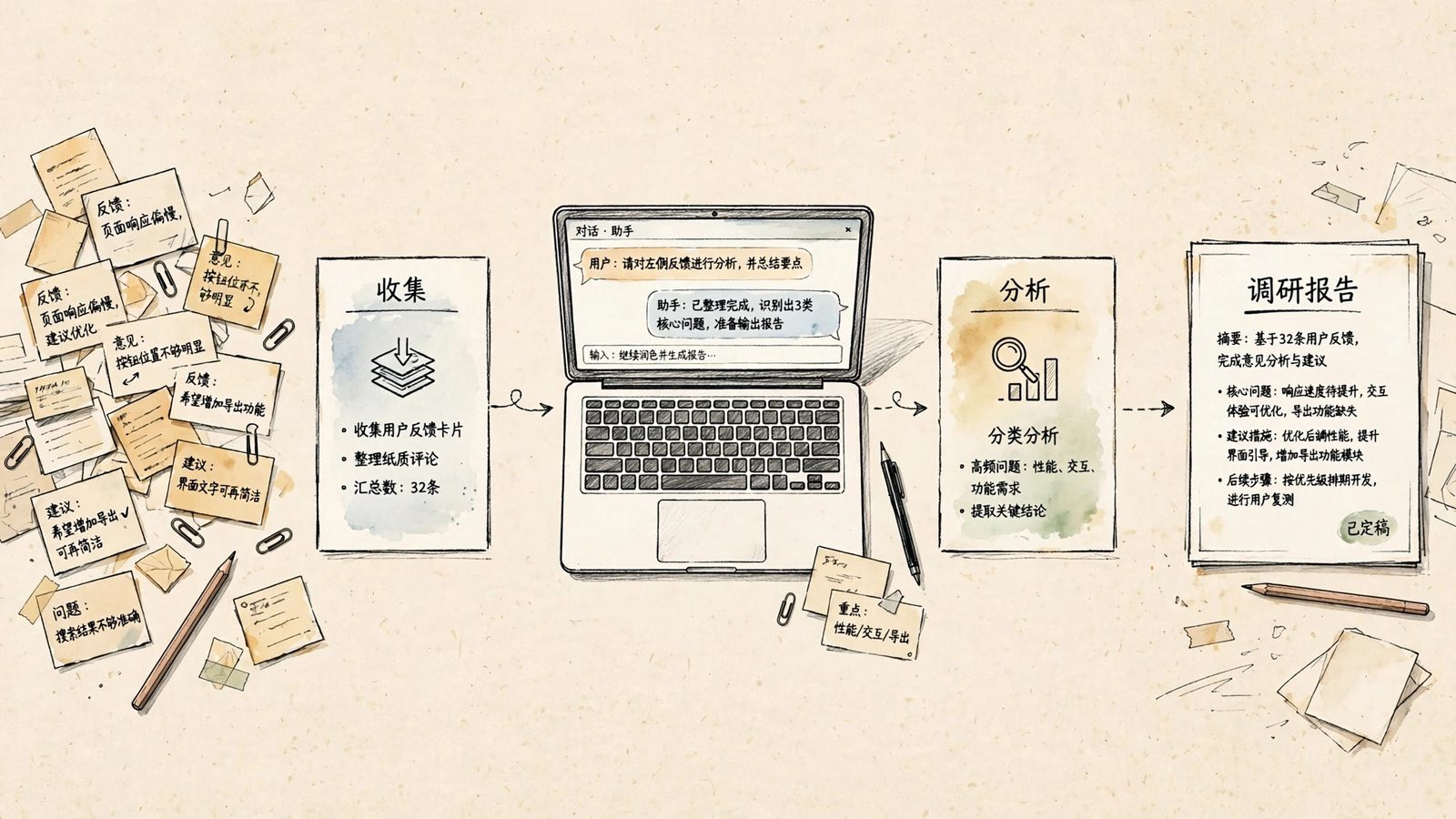
Workflow prompts solve a very concrete pain point: a recurring weekly compilation task handed to AI in one go produces unstable output — information gets dropped, details get hallucinated, the format is off. Split into a three-stage prompt pipeline, each stage does exactly one job, and the quality becomes controllable.
The most common scenario is the weekly user-feedback roundup. Feedback is scattered across app-store reviews, support chat logs, and surveys, and you need to turn it into a "user insights this week" report. Reading everything manually takes half a day; dumping it all on AI in one shot feels risky. Copy the prompt below, swap out the bracketed variables, and it's ready to use.
The prompt (copy and use)
You are an analyst who specializes in organizing information. Process this batch of material in three stages below. Do not skip any stage.

Stage 1: Collect and categorize
Read through [feedback content] item by item, and sort each item into these dimensions: [categories, e.g., feature requests / usage issues / praise / complaints].
List concrete items under each category. Do not merge them into vague one-liners, and do not drop any item.

Stage 2: Extract insights
For each category, answer three questions: 1) what comes up most often; 2) what its likely root cause is; 3) how to prioritize it (high / medium / low), with reasons.
Every conclusion must cite 1–2 verbatim quotes from the original feedback as evidence; if you cannot find a quote, write "no direct evidence available" — do not invent any.

Stage 3: Produce the final report
Write up the report in [output format]. If no format is specified, use a three-part structure: "weekly overview + categorized list + priority recommendations".
Keep the full text within [word limit, 800 words by default], conclusions and recommendations only, no preamble, no lectures.

Background: [product/business context, one or two sentences is enough]

Feedback content:
[paste user feedback, comments, and survey responses from all channels here]
How to swap the variables
| Variable | What to put in | Example |
|---|---|---|
| [feedback content] | Any batch of text you need to process | App-store reviews, support chat logs, survey responses |
| [categories] | Dimensions that match your business | E-commerce: logistics / quality / service / price; education: courses / instructors / service |
| [output format] | Tell the AI what the finished piece should look like | Weekly-report paragraphs, a table, an email draft, a slide outline |
| [product/business context] | One sentence of context so the AI's wording fits your business | We are a small online-education company |
| [word limit] | A length cap to prevent rambling | 800 words |
Why three stages are more reliable
A single prompt asks the AI to read everything, categorize, analyze, and write the report at once — it will drop the ball somewhere: a missed item in categorization leaves the insights without evidence; thin analysis turns the report into empty talk. With three stages, each task is simple enough on its own that the output stays stable. It's like an assembly line: quality checks are easy too — if stage one's result is off, just re-run stage one.
Three tuning tips
- Test-run with a small sample first. Paste 5–10 pieces of feedback to check whether the categories make sense, then paste the rest. This saves most of the rework.
- "Cite verbatim quotes" is a hard guard against hallucination. Requiring each conclusion to carry a source quote means the AI writes "no direct evidence available" when it can't back a claim, instead of inventing feedback.
- The three stages can run separately. If one stage's output disappoints, you don't have to redo everything — feed the previous stage's result back in and re-run just that stage. That's exactly where workflow prompts beat one-line prompts.
The same method works for organizing meeting transcripts or summarizing research interviews — the meeting-notes prompt introduced earlier is essentially the single-stage version of the same idea. Start with the most repetitive manual chore on your plate, run it through these three stages once, and next week's repeat work can reuse the same prompt as-is.