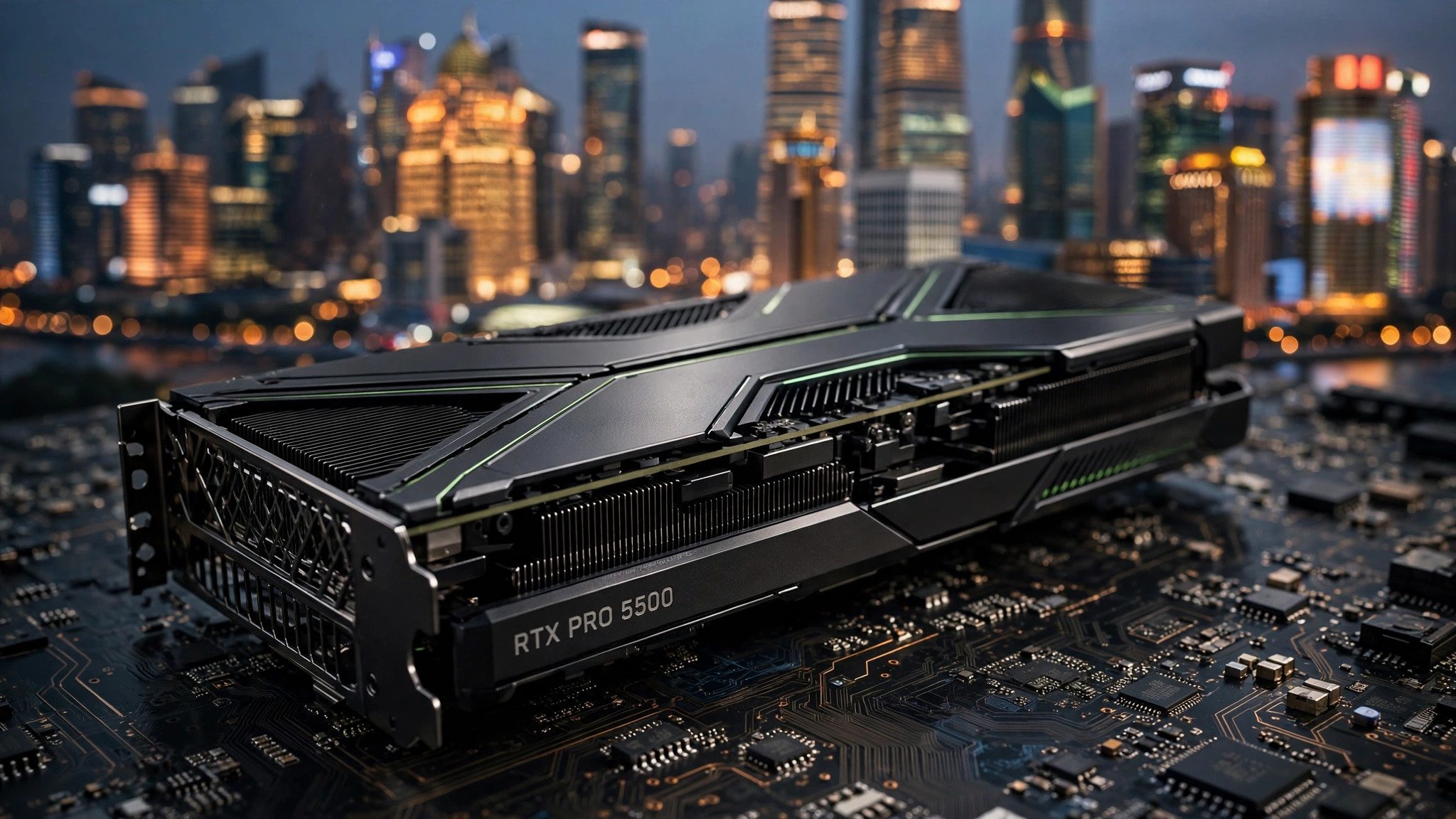
The RTX Pro 5500's path into China just took a new turn. On September 28, 2026, The Information reported, citing people familiar with the matter, that China's Ministry of Industry and Information Technology has asked companies including Alibaba and ByteDance how many of NVIDIA's new RTX Pro 5500 workstation chips they plan to buy, and what they intend to use them for. The report added that officials have signaled to some firms that such purchases "could be approved" — though no timeline, quota, or conditions have been set.
ByteDance is reportedly evaluating an order of about one million chips to support AI workloads, while NVIDIA plans to begin shipments to China in late December at an initial pace of roughly 500,000 units per quarter. At that rate, a single ByteDance order would absorb about two quarters of planned China supply. Separately, NVIDIA is said to want purchase intentions submitted by September 30, though Reuters said it could not independently verify the report.
An NVIDIA spokesperson responded that U.S. firms remain constrained by both "outdated U.S. export controls" and China's own limits on U.S. imports, stopping short of confirming any approval progress.
Why a "workstation" card matters
The RTX Pro 5500, launched earlier this month, is a Blackwell-generation professional workstation GPU: 84GB of GDDR7 memory, 21,760 CUDA cores, a starting price above $6,000, and power draw of up to 600W. It is positioned for high-end professional computing — not as a data-center accelerator, the category that successive rounds of U.S. export controls since October 2022 have primarily targeted.
That category distinction is the crux of the story. A "workstation card" sits outside the bullseye of data-center accelerator restrictions, giving Beijing far more regulatory latitude to approve such deals with less friction from Washington. Industry chatter already describes buyers planning to run larger AI models on servers packed with eight of the cards each — a familiar workaround when top-tier compute is restricted.
Who wants this deal done
For NVIDIA, the data-center business in China is effectively frozen: the company's $108 billion current-quarter revenue guidance assumes zero revenue from China data-center chips. Workstation cards are a separate category — if cleared, they would reopen a sales channel without touching the red lines of export controls.
For buyers like Alibaba and ByteDance, the logic is even simpler. Training and inference both need compute, and domestic alternatives are still catching up. Legally buying off-the-shelf Blackwell silicon, even in workstation form, would ease real bottlenecks.
Don't count the chips yet
Three uncertainties stand out. First, the approval is only a "signal" — no timetable, quota, or strings attached has been finalized. Second, Washington has not publicly stated the RTX Pro 5500's export-control status, and whether the U.S. Commerce Department adds new restrictions remains unknown. Third, Reuters explicitly said it could not independently verify The Information's reporting — until an official document lands, this is a "nearly done" story, not a done deal.
Markets are watching, too: NVIDIA shares initially rose in after-hours trading on the news, then reversed to close about 0.4% lower. The real watershed comes after October — whether Beijing issues a formal approval, and whether Washington intervenes. Whether the workstation card can become an "exception channel" in the U.S.-China chip standoff will be decided by paperwork, not by reporting.