
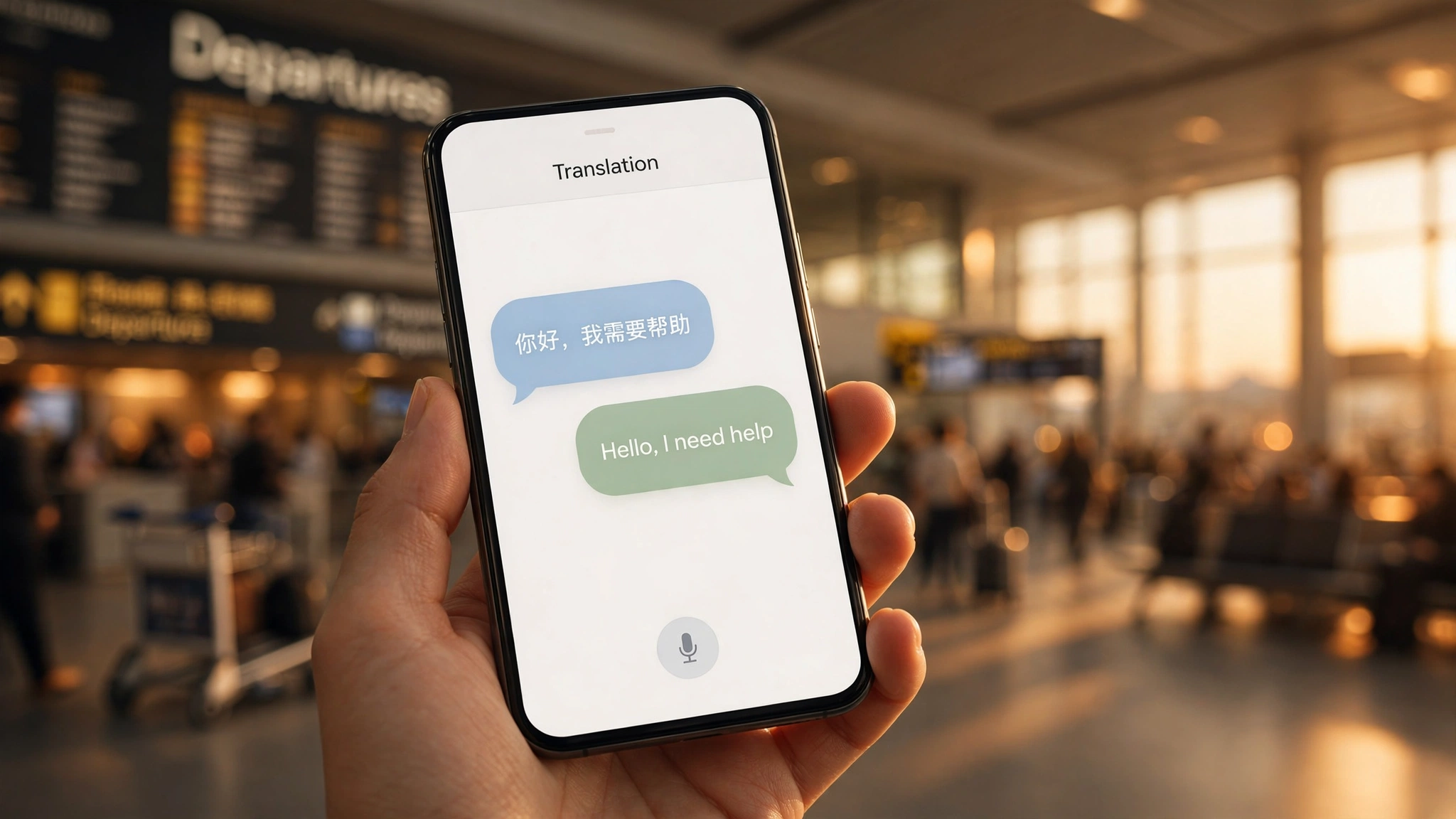
On September 24, 2026, Tencent Hunyuan announced the launch of its "Tencent Hy Translate" app, available simultaneously as a mini-program, browser plugin, and PC client. According to reports from IT Home and Jiemian News published the same day, the app is powered by the Hy-MT2 translation model, which Tencent Hunyuan open-sourced in May this year. It supports translation between 33 languages, covers 5 ethnic minority languages and dialects of China, and offers voice translation, photo translation, and offline translation. The app has launched in 12 countries and regions, including the United States, Japan, South Korea, Singapore, Malaysia, Thailand, Vietnam, Myanmar, and Hong Kong, Macao, and Taiwan.
Offline support is the real headline here
Translation apps are nothing new. What makes Tencent Hy Translate memorable is offline mode: users download the translation model to their phone in advance, and translation keeps working even with no network or poor signal.
That scenario is more common than it sounds: landing abroad before buying a local data plan, talking to a driver in an underground parking garage, reading road signs while driving through mountains — these are exactly the moments when you need translation most and the network is least reliable. Most mainstream translation apps are dead weight once offline, so offline capability is what decides whether an app becomes your go-to travel backup.
Offline has a quieter benefit too: translation happens entirely on-device, so sensitive content like chat logs and photos of documents never needs to be uploaded to the cloud. For users who regularly handle contracts or medical records, that matters more than a few extra languages.
Background: Hy-MT2 has been open source since May
Tencent Hy Translate didn't start from zero. Behind it is Hy-MT2, the translation model family Tencent Hunyuan open-sourced in May, with three sizes — 1.8B, 7B, and 30B-A3B — natively supporting translation between 33 languages and 5 ethnic languages/dialects. Compared with the previous Hy-MT1.5, Hy-MT2 shows clear gains in multilingual instruction following, domain-specific translation, and real-world translation scenarios.
The one to watch is Hy-MT2-1.8B, the on-device variant: designed for phones from the start, Tencent has compressed it down to a few hundred megabytes, and it's already running in production — for example, in Bilibili's real-time live-stream danmaku translation. The app's offline mode rides on exactly this on-device technology path: a model small enough to fit in your pocket without noticeably worse translation quality.
Who it's for — and who should skip it
The app fits three groups best: frequent international travelers, for whom offline translation covers those chaotic first hours after landing; people who work with ethnic minority languages, a coverage area rarely seen in mainstream translation apps; and privacy-conscious users who'd rather not send their chats to the cloud.
But the limits are real too. Thirty-three languages sounds like a lot, but daily use still centers on Chinese, English, Japanese, and Korean; quality for smaller languages needs real-world verification. And for "not a single character can be wrong" scenarios like legal contracts or medical documents, machine translation is only good for a first draft — critical files still need human review. That's true of every translation app, not just this one.
Zooming out, Tencent isn't trying to outdo Google Translate or DeepL on language count. Its bet is "offline + optimized for Chinese-language contexts." For Chinese-speaking users, an app that works without a network and handles Chinese more naturally may be more appealing than one supporting 100 more languages. If you're still comparing translation tools, see Which AI Translation Tool Is Best? DeepL, ChatGPT, and Google Translate for Different Scenarios.