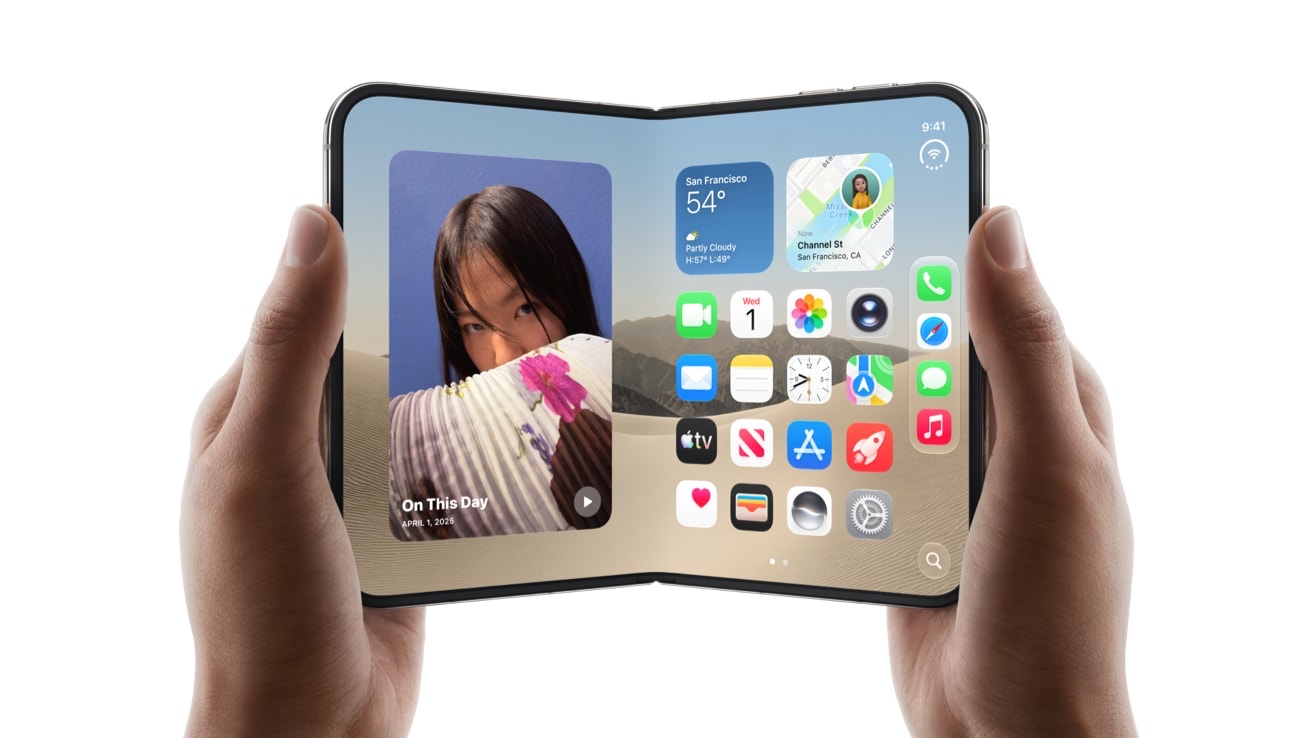
On September 9, 2026, Apple released its first foldable phone, the iPhone Duo, in Newsroom. When unfolded, it features a 7.6-inch inner screen, and when folded, it uses a 5.4-inch outer screen. It starts at $1999, with pre-orders starting October 16 and sales starting October 23. What truly stands out isn't just the foldable form, but how Apple integrates the A20 Pro, dual-screen multitasking, and Siri AI into a single mobile workflow.
Foldable screens are no longer just about enlarging content
The iPhone Duo's inner screen can run two apps side by side, open two windows for the same app, and save frequently used app combinations. For AI use, this means users can view information while letting writing, translation, or scheduling tools handle content, reducing frequent switching. The Siri AI beta also adds screen perception and camera understanding capabilities: users can have it interpret objects in the lens or continue operations in conjunction with the current page. Apple also supports future integration with the USB-C version of the Apple Pencil, further pushing this inner screen toward lightweight creative devices.
The A20 Pro leaves room for dual-screen AI
The chip is the key to whether this device can succeed. Apple claims the A20 Pro uses a dual 16-core neural engine, with AI processing power twice that of the A19 Pro and a 50% increase in memory bandwidth; New heat spreaders, dual batteries, and dual-screen scheduling control are responsible for continuous load control. Smart Take in the camera detects the person's status on the device and automatically captures it, indicating Apple is expanding its on-device model from "answering questions" to real-time perception. Previously, in our analysis of mobile AI system-level collaboration, we mentioned that the real difference is not in a single model, but in whether the entry point, context, and application can collaborate continuously. Duo is a hardware-focused attempt in this direction.
The first-generation product still has three challenges
- App adaptation: The value of split-screen depends on whether third-party apps truly leverage a wider canvas, not just stretch the interface.
- Battery life and cooling: When dual screens, real-time camera, and on-device inference run simultaneously, official data still needs real-world verification.
- Price Threshold: $1999 makes it more like a high-end productivity experiment rather than a mass-market model replacing mainstream iPhones in the short term.
Therefore, the significance of the iPhone Duo is not that "Apple has also made foldable screens," but that it is the first to provide dual-tasking, resident system space for mobile AI. If the app ecosystem keeps up, the foldable form may shift from a hardware selling point to an interface where AI assistants continuously participate in work; If adaptation and battery life are average, it will still be an expensive but clearly defined first-generation product.