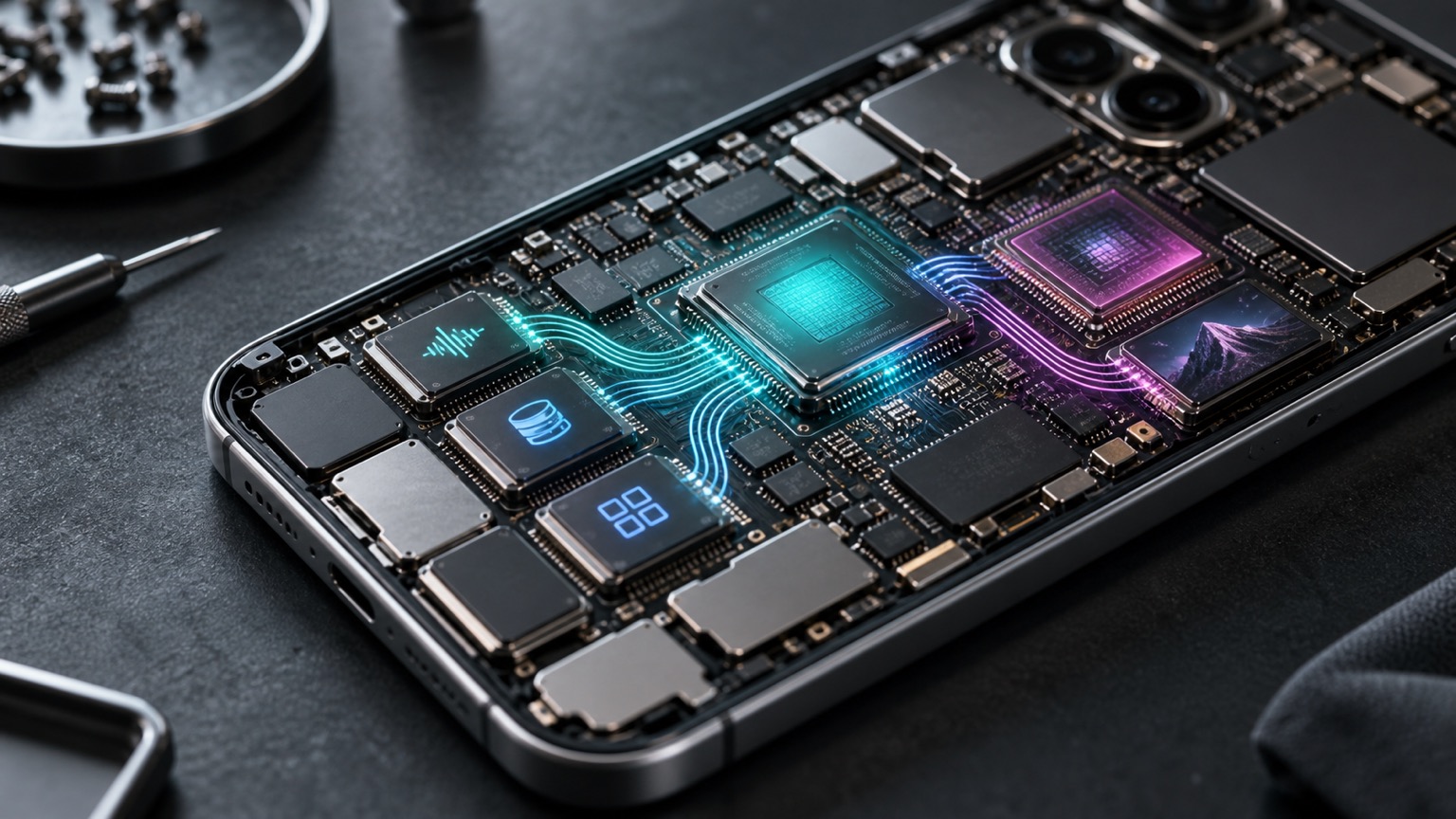
On September 8, 2026, Arm released CSS for Mobile 2, combining the C2 CPU cluster, Mali G2-Ultra NX GPU, system IP, and development software into a mobile AI-native computing platform. The key change is not adding another accelerator, but enabling speech understanding, memory retrieval, model execution, application calls, and graphics rendering to work together within the phone's power consumption and cooling limits.
Why can't mobile smart devices rely solely on NPUs?
Continuously running mobile agents need to retain context while scheduling local models, system applications, and cloud services. Model inference is just one part; task status, permission determination, web access, and application startup still heavily depend on the CPU; Neural graphics require the GPU to complete reconstruction, frame interpolation, and detail enhancement within the rendering pipeline. Therefore, Arm adopts a heterogeneous platform approach, assigning different compute units to the most appropriate stages, rather than compressing "AI performance" into a single peak number.
The C2 cluster consists of C2-Ultra, C2-Pro, and two sets of SME2 units. Arm's official results include up to 1.7x performance improvements for some of the latest AI models, as well as a representative agent workflow covering voice, memory, inference, applications, and browsing that is 24% faster than the previous generation. These are comparisons under Arm's selected conditions and cannot be directly translated into battery life or actual response times for all phones; device manufacturers' memory, cooling, and system scheduling will still change the results.
Neural graphics are placed inside the GPU
For the first time, the Mali G2-Ultra NX integrates dedicated neural acceleration capabilities into this mobile GPU architecture, paired with a new execution engine and third-generation ray tracing unit. It targets AI-native graphics on mobile devices, not just making chat models faster. For gaming and creative applications, the significance lies in that inference and rendering do not have to frequently cross fragmented software paths; developers can also access them through familiar frameworks.
What steps are needed before it actually gets into the phone?
- Chip manufacturers must complete their SoC design and verification based on CSS solutions.
- Phone brands need to open controllable system permissions to local agents and manage privacy boundaries.
- Application developers also need to verify the accuracy and latency of compression models under different memory configurations.
Therefore, CSS for Mobile 2 is more like the foundation for next-generation mobile platforms, rather than features consumers can download right now. Combining on-site local AI computing analysis with Apple M6 and M5 Ultra, we can continue to observe: the success of on-device AI increasingly depends on the overall coordination of CPU, GPU, memory, and software stack, rather than the promotional peak of individual chips.