Roboflow is a computer vision model development and deployment platform for developers, machine learning teams, and enterprises that need to build visual recognition applications to annotate images, train models, build vision workflows, and deploy to the edge, cloud, or API. It focuses on providing a complete computer vision toolchain from dataset to model deployment, with key capabilities including support for AI-assisted data annotation, Workflows, Train, Deploy, and Universe, and the ability to run models on device, edge, VPC, or API. It offers free entry or trial credits, which are suitable for verifying results with small tasks first. Note before use: Before the model goes live, verify data bias, misidentification risks, and accuracy in target scenarios. If you plan to adopt it for a long time, it is recommended to test input lead time, output availability, manual review costs, and permission boundaries with real samples before deciding whether to put it into a fixed process.
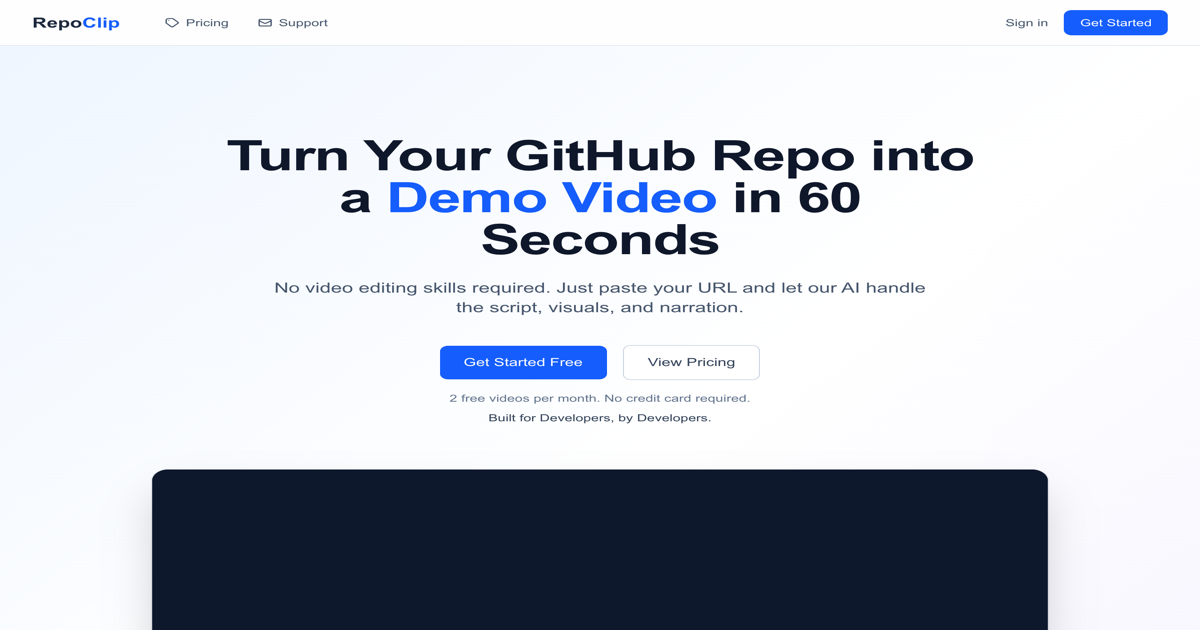
RepoClip is a GitHub repository demo video generator for developers, open-source project maintainers, and technical teams who need to demonstrate product prototypes when turning public GitHub repositories into demo videos with scripts, graphics, narration, and music. Its focus is on quickly forming shareable product explainer materials using repository links, and common capabilities include generating videos by entering public GitHub repositories, including scripts, visuals, narration, and music, and the first video can be generated for free. It offers free entry or trial credits, making it suitable for verifying the effect with small tasks first. Note before use: Private code, customer projects, and unpublished features should not be uploaded or publicly displayed. If the team is preparing for long-term adoption, it is recommended to test input materials, output quality, manual review costs, and permission boundaries with a set of real-world tasks before deciding whether to include a fixed process.
Reindeer is an AI workflow tool for teams that need to create, organize, convert, or review task-specific material before final use. It should be used with clear source material, a defined output goal, and human review for accuracy, rights, privacy, and publishing quality.
Refraction is an AI workflow tool for teams that need to create, organize, convert, or review task-specific material before final use. It should be used with clear source material, a defined output goal, and human review for accuracy, rights, privacy, and publishing quality.
ReadmeChef is an AI workflow tool for teams that need to create, organize, convert, or review task-specific material before final use. It should be used with clear source material, a defined output goal, and human review for accuracy, rights, privacy, and publishing quality.
RapidNative is an AI workflow tool for teams that need to create, organize, convert, or review task-specific material before final use. It should be used with clear source material, a defined output goal, and human review for accuracy, rights, privacy, and publishing quality.
Raindrop AI is an AI workflow tool for teams that need to create, organize, convert, or review task-specific material before final use. It should be used with clear source material, a defined output goal, and human review for accuracy, rights, privacy, and publishing quality.
Ragie is an AI workflow tool for teams that need to create, organize, convert, or review task-specific material before final use. It should be used with clear source material, a defined output goal, and human review for accuracy, rights, privacy, and publishing quality.
Raccoon AI is an AI workflow tool for teams that need to create, organize, convert, or review task-specific material before final use. It should be used with clear source material, a defined output goal, and human review for accuracy, rights, privacy, and publishing quality.
Qodex.ai is an AI workflow tool for teams that need to create, organize, convert, or review task-specific material before final use. It should be used with clear source material, a defined output goal, and human review for accuracy, rights, privacy, and publishing quality.
Qase is an AI workflow tool for teams that need to create, organize, convert, or review task-specific material before final use. It should be used with clear source material, a defined output goal, and human review for accuracy, rights, privacy, and publishing quality.
QA.tech is an AI workflow tool for teams that need to create, organize, convert, or review task-specific material before final use. It should be used with clear source material, a defined output goal, and human review for accuracy, rights, privacy, and publishing quality.
QA Sphere is an AI workflow tool for teams that need to create, organize, convert, or review task-specific material before final use. It should be used with clear source material, a defined output goal, and human review for accuracy, rights, privacy, and publishing quality.
ProtoBoost.ai is an AI workflow tool for teams that need to create, organize, convert, or review task-specific material before final use. It should be used with clear source material, a defined output goal, and human review for accuracy, rights, privacy, and publishing quality.
Prismic is an AI workflow tool for teams that need to create, organize, convert, or review task-specific material before final use. It should be used with clear source material, a defined output goal, and human review for accuracy, rights, privacy, and publishing quality.
PredictOPs is an AI workflow tool for teams that need to create, organize, convert, or review task-specific material before final use. It should be used with clear source material, a defined output goal, and human review for accuracy, rights, privacy, and publishing quality.
Predictive Equations is an AI workflow tool for teams that need to create, organize, convert, or review task-specific material before final use. It should be used with clear source material, a defined output goal, and human review for accuracy, rights, privacy, and publishing quality.
pre.dev is an AI workflow tool for teams that need to create, organize, convert, or review task-specific material before final use. It should be used with clear source material, a defined output goal, and human review for accuracy, rights, privacy, and publishing quality.
playmix.ai is an AI workflow tool for teams that need to create, organize, convert, or review task-specific material before final use. It should be used with clear source material, a defined output goal, and human review for accuracy, rights, privacy, and publishing quality.
Plat.AI is an AI workflow tool for teams that need to create, organize, convert, or review task-specific material before final use. It should be used with clear source material, a defined output goal, and human review for accuracy, rights, privacy, and publishing quality.
Pinecone is an AI workflow tool for teams that need to create, organize, convert, or review task-specific material before final use. It should be used with clear source material, a defined output goal, and human review for accuracy, rights, privacy, and publishing quality.
Pieces for Developers is an AI workflow tool for teams that need to create, organize, convert, or review task-specific material before final use. It should be used with clear source material, a defined output goal, and human review for accuracy, rights, privacy, and publishing quality.
Phare is an AI workflow tool for teams that need to create, organize, convert, or review task-specific material before final use. It should be used with clear source material, a defined output goal, and human review for accuracy, rights, privacy, and publishing quality.

Pangeanic is an AI data annotation, model evaluation and multilingual data platform. It is mainly used to provide multilingual training data, model alignment, LLM evaluation, data annotation management and enterprise-level AI deployment support. It is suitable for AI teams, government agencies, enterprise R & D, language technology teams and organizations that require multilingual data operations. Common uses include building multilingual model training data, evaluating LLM output quality and security, and deploying linguistic AI systems for enterprises or governments. When using it, it should be noted that data operation projects usually require clear labeling specifications, privacy processing and quality sampling mechanisms, and cannot rely solely on automated processes. For corporate and project-based procurement, it is usually necessary to contact the team to confirm the scope and quotation. It is recommended to use one or two low-risk tasks to test input materials, output quality, manual modification amount and final adoption ratio before deciding whether to put them into a fixed process.