Packfiles is a GitHub migration and configuration management tool mainly used to help enterprises plan and migrate code bases, teams and configurations such as Azure DevOps and Bitbucket Server, and accelerate migration tasks through Warp for Copilot. It is suitable for enterprise development platform teams, DevOps engineers, GitHub administrators and organizations that need to migrate code assets on a large scale. Common uses include unified migration of enterprises to GitHub, sorting out warehouses, teams and rights configurations, and reducing duplication during large-scale migrations. When using it, note that code migration involves permissions, history, CI/CD and security policies. Pilot warehouses and rollback plans should be made before formal migration. The page shows that starting from 100 free migrations, enterprise solutions can be billed per box or project. It is recommended to use one or two low-risk tasks to test input materials, output quality, manual modification amount and final adoption ratio before deciding whether to put them into a fixed process.

OwlityAI is an AI software quality testing platform that is mainly used to understand application interfaces through computer vision, automatically design tests, build automated processes, and discover defects. It is suitable for software teams, QA leaders, product teams and companies that need to reduce manual testing costs. Common uses include performing regression testing before going online, reducing duplication of manual QA work, and supplementing automated testing coverage for rapidly iterating products. When using it, note that autonomous testing cannot cover all business rules and boundary conditions. Complex authority, payment, compliance and core transaction processes still require manual QA to develop acceptance criteria. The page provides free trial and demonstration entrances, which is suitable for first verification with non-core applications. It is recommended to use one or two low-risk tasks to test input materials, output quality, manual modification amount and final adoption ratio before deciding whether to put them into a fixed process.
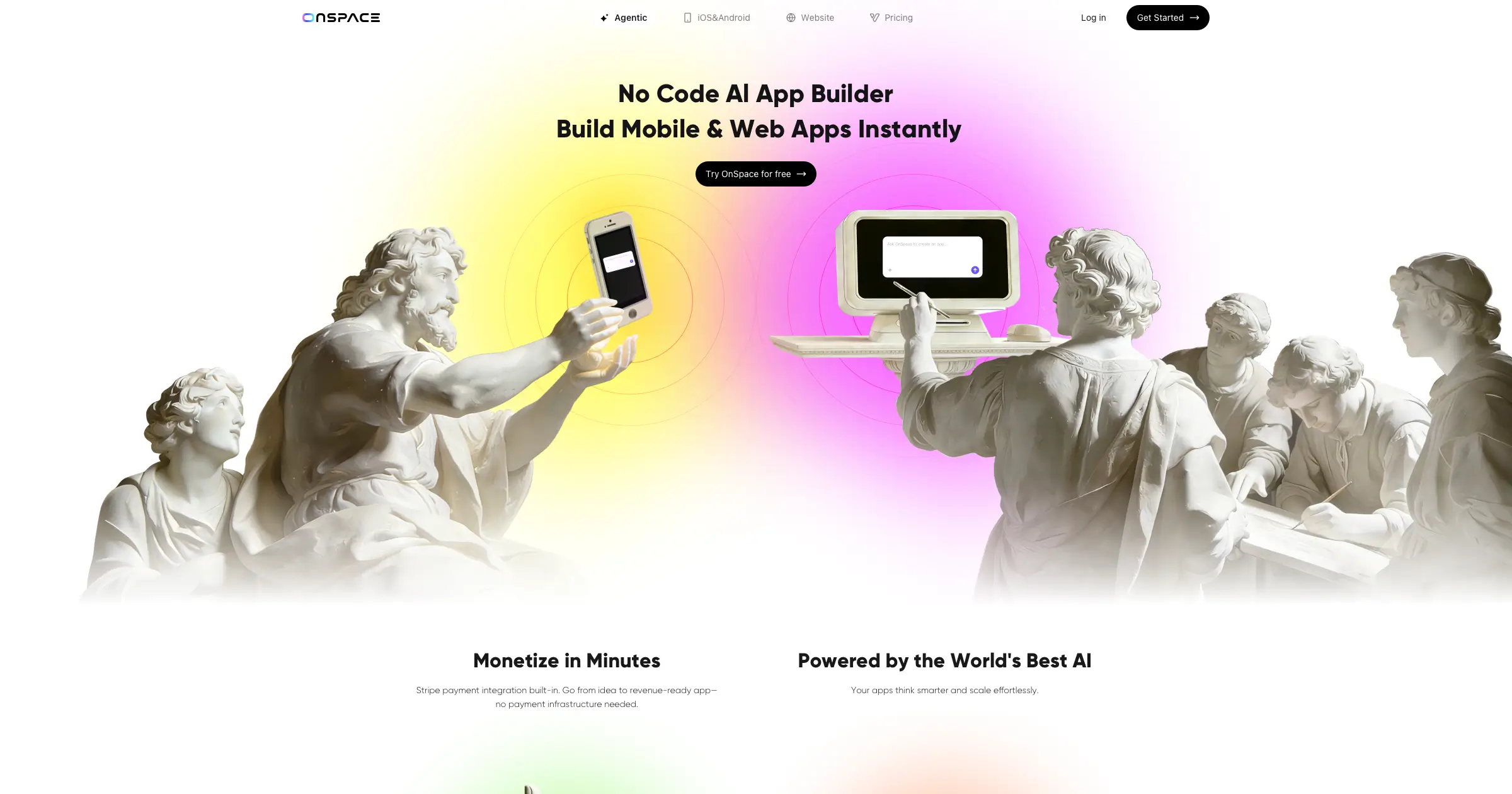
OnSpace.AI is an AI code-free application construction platform, which is mainly used to allow users to create applications, configure interfaces and generate business functions using natural language and visual processes, reducing the threshold for traditional zero-development. It is suitable for entrepreneurs, operations teams, product managers and non-technical users who want to quickly verify internal tools or MVPs. Common uses include verifying SaaS or tool-based MVPs, building internal management pages for teams, and turning forms, forms or processes into usable applications. When using it, note that code-less platforms are suitable for rapid verification and small and medium-sized businesses. When complex permissions, compliance data, deep integration, or high concurrency scenarios are involved, further architecture evaluation is needed. The page does not clearly display the full price. It is recommended to first confirm the release restrictions, data capacity and custom domain name capabilities from the trial or demonstration portal. It is recommended to use one or two low-risk tasks to test input materials, output quality, manual modification amount and final adoption ratio before deciding whether to put them into a fixed process.
Omnara is a coding agent command center mainly used to manage coding agents such as Codex and Claude Code from desktop, web and mobile terminals. It is suitable for developers, engineering teams, AI programming users, and people who need to manage agents remotely. It can manage coding agent sessions across devices, support parallel agents, work trees, and Git processes, and allow long-term tasks to continue running after the device is offline. When using it, note that the code generated by the agent still needs to be tested, reviewed and security checked, and cannot be directly merged into the production environment. It is recommended to use one or two low-risk tasks to test input materials, output quality, manual modification amount and final adoption ratio before deciding whether to put them into a fixed process.
Novita AI is an AI model API and proxy cloud platform that is mainly used to access multiple models, proxy sandboxes and GPU resources through one API. It is suitable for developers, entrepreneurial teams, AI application teams and platform engineers. It can provide multi-model API access, launch agent sandboxes and GPU instances, and is also suitable for quickly building AI applications and prototypes. Pay attention when using it, and evaluate model costs, current limiting, data security and fault coverage before going online. It is recommended that one or two low-risk tasks be used to test input materials, output quality, manual modifications, and final adoption ratios before deciding whether to put them into a fixed process and document whether they are suitable for long-term use and team review.
Not Diamond is an AI model routing and proxy cost control platform, which is mainly used to automatically select appropriate models for different queries, improve accuracy and reduce costs. It is suitable for AI application developers, agent system teams, platform engineers and model operators. It can recommend more suitable models upon request, help agent systems control model invocation costs, and can also be used to compare model performance and routing strategies. When using it, note that routing results need to be continuously verified in conjunction with the evaluation set. Critical tasks cannot rely solely on automatic recommendations. It is recommended to use one or two low-risk tasks to test input materials, output quality, manual modification amount and final adoption ratio before deciding whether to put them into a fixed process.
Nora is a deep reasoning agent for software development. It is mainly used to provide deep reasoning and Web3 scenario support for software development tasks. It is suitable for developers, Web3 teams, technical leaders and people who need complex code assistance. It can conduct in-depth reasoning around software development tasks, assist in understanding code, requirements and technical contexts, and can also provide specialized support in Web3 development scenarios. Be aware when using it that it cannot replace code reviews, security audits and testing, especially contract or fund-related code. It is recommended to use one or two low-risk tasks to test the input materials, output quality, manual modification amount and final adoption ratio, before deciding whether to put them into a fixed process, and recording whether they are suitable for long-term use and team review.
Nitrode is an AI spatial inference data platform mainly used to provide dynamic environment understanding data for large models, intelligent agents and world models. It is suitable for AI research teams, robot teams, model training teams and data engineers. It can provide high-quality data related to spatial reasoning, help models understand dynamic environments and action relationships, and can also be suitable for preparation for LLM, agent and world model training. Pay attention when using it, it is biased towards data and model training scenarios, and the data authorization, format, evaluation method and training cost must be confirmed before adopting it. It is recommended to use one or two low-risk tasks to test input materials, output quality, manual modification amount and final adoption ratio before deciding whether to put them into a fixed process.
Nimbalyst is a visual workspace for coding agents, which is mainly used to manage agent sessions, tasks, files and documents such as Codex and Claude Code. It is suitable for developers, AI programming teams, open source maintainers, and people who need to manage agents in parallel. It can manage multiple coding agent sessions and tasks, edit Markdown, charts, mockups, and code materials, and use a visual workspace to organize files and development context. Be aware when using it, it is suitable for managing the agent collaboration process, and code merging, testing and online still need to be manually confirmed according to project specifications. It is recommended to use one or two low-risk tasks to test input materials, output quality, manual modification amount and final adoption ratio before deciding whether to put them into a fixed process.
Nadi is an application crash monitoring and AI care assistant that is mainly used to monitor application crashes and help development teams understand failure clues. It is suitable for mobile application teams, independent developers, SaaS technical teams and people who need to stably track exceptions. It can centrally view application crashes and exception signals, use AI to assist in understanding crash contexts and processing priorities, and help teams transform fault information into follow-up issues. Pay attention when using it. It is suitable for auxiliary troubleshooting and alarm sorting, and cannot replace real device reproduction, log analysis and code review; the SDK, privacy and abnormal data range must be confirmed before accessing. It is suitable to use one or two low-risk tasks to test the input materials, output quality, manual modification amount and final adoption ratio, and then decide whether to put them into a fixed process.
MyScale is an AI vector database combined with SQL. It is mainly used to process large-scale multimodal vector data using SQL analysis and vector search. It is suitable for AI application developers, data engineers, search teams and machine learning teams. It can combine vector search with SQL analysis and target large-scale multimodal vector data queries. It can also provide hosting capabilities to facilitate the construction of semantic search and RAG applications. Be aware when using it that it is more suitable for teams with data and engineering foundations; evaluate query performance, index costs, data size, and existing database compatibility before migrating. It is suitable to use one or two low-risk tasks to test input materials, output quality, modification costs and final adoption ratio before deciding whether to put them into a fixed process.

Mocha is an AI code-less application builder that is mainly used to turn application ideas into deployable websites or internal tools. It is suitable for entrepreneurs, product managers, independent developers and non-technical business teams. It can use AI to generate applications from descriptions, support application deployment and web building, and provide a rapid prototyping process without code. When using it, it should be noted that complex permissions, payments, data models and production operation and maintenance still require technical review to provide free points and payment plans. Before formal adoption, it is recommended to use low-risk samples to test once, and record the input materials, output results, and manual modifications. and the final adoption ratio before deciding whether to put them into a fixed process. At the same time, it is recommended to compare the trial results with existing processes to confirm whether the team can reuse them stably, rather than making long-term choices based on the one-time generation effect.
Mixo is an AI website construction and small business customer acquisition page tool. It is mainly used to quickly generate business websites, landing pages and potential customer forms using AI. It is suitable for small business owners, entrepreneurs, independent service providers and local businesses. It can use AI to generate websites in a short period of time, provide potential customer collection and email contact capabilities, and support the common online display needs of small businesses. Pay attention when using it. Before launching the automatic website, you must check the brand copy, service scope, privacy policy and mobile performance. Free plans and low-cost subscriptions are provided. Before official adoption, it is recommended to use low-risk samples to test once and record the input materials and output results., the amount of manual modifications and the final adoption ratio, and then decide whether to put them into a fixed process.
Mintlify is an AI-native document and knowledge platform mainly used to create product documents and knowledge content for developers and AI. It is suitable for developer tool companies, API teams, technical writing teams, and engineering organizations. It can create beautiful technical document stations, support AI native knowledge management, and be structured for developers and AI agent reading. When using it, you should note that the quality of documents depends on the information architecture, version maintenance and accurate examples. You cannot rely solely on automatic generation to provide trials and team subscriptions. Before formal adoption, it is recommended to use low-risk samples to test once, and record the input materials, output results, and manual modifications. The amount and final adoption ratio are then decided whether to put them into a fixed process.
Middleware is an AI SRE full-stack observable platform that is mainly used to monitor applications, infrastructure, logs and real user sessions. It is suitable for DevOps, SRE, back-end teams and cloud-native engineering organizations. It can provide full-stack monitoring and diagnosis, use AI SRE Agents to assist in problem discovery, and support data ingestion control and synthetic inspections. Pay attention when using it. The observable platform needs to be correctly buried, alarm classification and accident process. Otherwise, it is easy to generate noise. Free data quotas and charge-by-volume. Before formal adoption, it is recommended to use low-risk samples to test once and record the input materials., output results, manual modifications and final adoption ratio, and then decide whether to put them into a fixed process.
Metaflow is a machine learning and AI project workflow framework mainly used to build, expand and deploy real-life machine learning, AI and data science projects. It is suitable for machine learning engineers, data scientists, platform teams and production environment AI projects. It can manage machine learning and data science workflows, support cloud expansion and production deployment, and make experimental, computing and deployment processes more traceable. When using it, it should be noted that it is an engineering framework that requires experience in code, infrastructure and model operation and maintenance. It is not suitable for open source use by completely untechnical users. Cloud resources are calculated separately for cost calculation. Before formal adoption, it is recommended to test it with low-risk samples and record the input materials, output results, manual modifications and final adoption ratio, and then decide whether to put it into a fixed process.
Metabob is an AI code analysis and debugging auxiliary tool. It is mainly used to assist parallel generative programming tools for defect analysis and refactoring. It is suitable for software engineers, code reviewers, AI programming users and R & D teams. It can provide real-time intelligent code analysis, discover potential defects and security implementation issues, and assist in debugging and refactoring legacy code. Pay attention when using it that static analysis and AI recommendations require developer verification and cannot replace testing, code review and security evaluation. Before individual developer plans and team payment plans are officially adopted, it is recommended to test with low-risk samples first and record the input materials., output results, manual modifications and final adoption ratio, and then decide whether to put them into a fixed process.
Meilisearch is a unified search and AI retrieval platform mainly used to build full-text search, semantic search and hybrid retrieval for applications. It is suitable for developers, product teams, data application teams and SaaS engineers. It can provide fast full-text search capabilities, support semantic search and AI retrieval scenarios, and serve as the search infrastructure for applications and websites. Pay attention to when using it. Index, permissions, update strategies and relevance evaluation need to be designed before going online. The quality of search results depends on the trial of the data structure and cloud subscription. Before formal adoption, it is recommended to test it with low-risk samples first and record the input materials., output results, manual modifications and final adoption ratio, and then decide whether to put them into a fixed process.

Mappedin is an indoor map and venue wayfinding software, mainly used for indoor map construction in shopping malls, airports, campuses, hospitals and large venues. It is suitable for venue operation teams, property management, retail complexes, campuses and large public space managers. It can use AI to assist in generating indoor maps from floor plans, support three-dimensional interactive maps and wayfinding navigation, and maps can be published to web pages, mobile terminals or venue system. Pay attention to the need to prepare accurate floor plans, space naming and operation data before landing; maintenance procedures should also be arranged for large venues to avoid disconnection between maps and actual moving lines. There is a free map entrance, and commercial venues pay according to the map or plan size. Before formal adoption, it is recommended to test once with low-risk materials or small samples, record the input quality, output results, manual modifications and final adoption ratio, and then decide whether to put them into the long-term workflow.
Macroscope is an AI code review tool for modern development teams, offering automated PR descriptions, code reviews, status updates, ticket context, and collaboration link support for Slack, GitHub, Jira, Libratic, and more. It's suitable for teams looking to merge PRs faster, catch bugs early, and synchronize development status. Make it clear that it is a code review aid rather than a final quality assurance, and key architecture, security, permissions, and data migration changes still need to be reviewed and tested by senior engineers. Before formal adoption, it is recommended to test with real but low-risk materials to check output quality, authorization boundaries, privacy handling, and manual review costs before deciding whether to put them into a long-term workflow.

Macaly is an AI website and web application building platform for founders, small businesses, and non-professional developers to generate launchable websites or apps using natural language prompts. It supports conversational description of requirements, sketch to build, data saving, direct editing, file management, access analysis, and SEO-related capabilities. When using it, it should be used as a rapid prototype and lightweight product entrance, and formal business still needs to check security, data structure, mobile adaptation, payment permissions and long-term maintenance methods. Before formal adoption, it is recommended to test with real but low-risk materials to check output quality, authorization boundaries, privacy handling, and manual review costs before deciding whether to put them into a long-term workflow. For individuals and teams, a safer approach is to retain the manual review node first, and then decide whether to expand the scope based on the results of several consecutive times.
Localazy is a localization management platform for software and digital product teams, focusing on developers, product managers, translators, and content collaborators. It can centrally manage multilingual copywriting, translation processes, and project collaboration, making it easier for apps, websites, or product content to reach different language markets. Machine-assisted translation is not a substitute for final language review, especially legal, medical, financial, and brand copywriting. Before official adoption, it is recommended to make a sample around "centrally manage the multilingual text of the software interface and product content" to check whether the output meets the requirements of real tasks, material authorization, data security, and manual review before deciding whether to enter the long-term process.
LM Studio is a desktop-oriented local large model running tool suitable for downloading, managing, and running open models such as gpt-oss, Llama, Gemma, Qwen, and DeepSeek on personal computers. It emphasizes local and private use, making it suitable for developers, researchers, content teams, and users who want to test the model's performance natively first. Before use, you need to pay attention to the computer memory, memory, model volume, and licensing terms, and make sure that the data is completely left in the local process when formally handling sensitive data. Before official adoption, it is recommended to make a sample around "downloading and managing a variety of open large models on the desktop" to check whether the output meets the requirements of real tasks, material authorization, data security and manual review, and then decide whether to enter the long-term process.
Locofy.ai is an AI design conversion tool that converts drafts like Figma, Penpot, and more into front-end code like React, React Native, HTML, Flutter, Vue, Angular, or Next.js. It's suitable for front-end teams, design systems teams, startup product teams, and those who need to quickly turn prototypes into code. Before use, it is recommended to conduct small-scale testing with real materials or real processes, focusing on observing output quality, review costs, payment boundaries, data permissions, and whether the team can establish a stable manual review process. Before handling formal business, it should also be judged based on material authorization, privacy requirements, and manual review standards, and avoid using automatic results directly for external release or key decisions. If used in team, client, or teaching scenarios, the source of information, the responsibility for reviewing the results, and the scope of external use should also be clearly entered first.