Back to AI information
OpenAI released the report "Evaluating the Monitorability of the Chain of Thought": Exploring the auditability of model reasoning

OpenAI released the report "Evaluating the Monitorability of the Chain of Thought": Exploring the auditability of model reasoning

AI information Admin 109 views

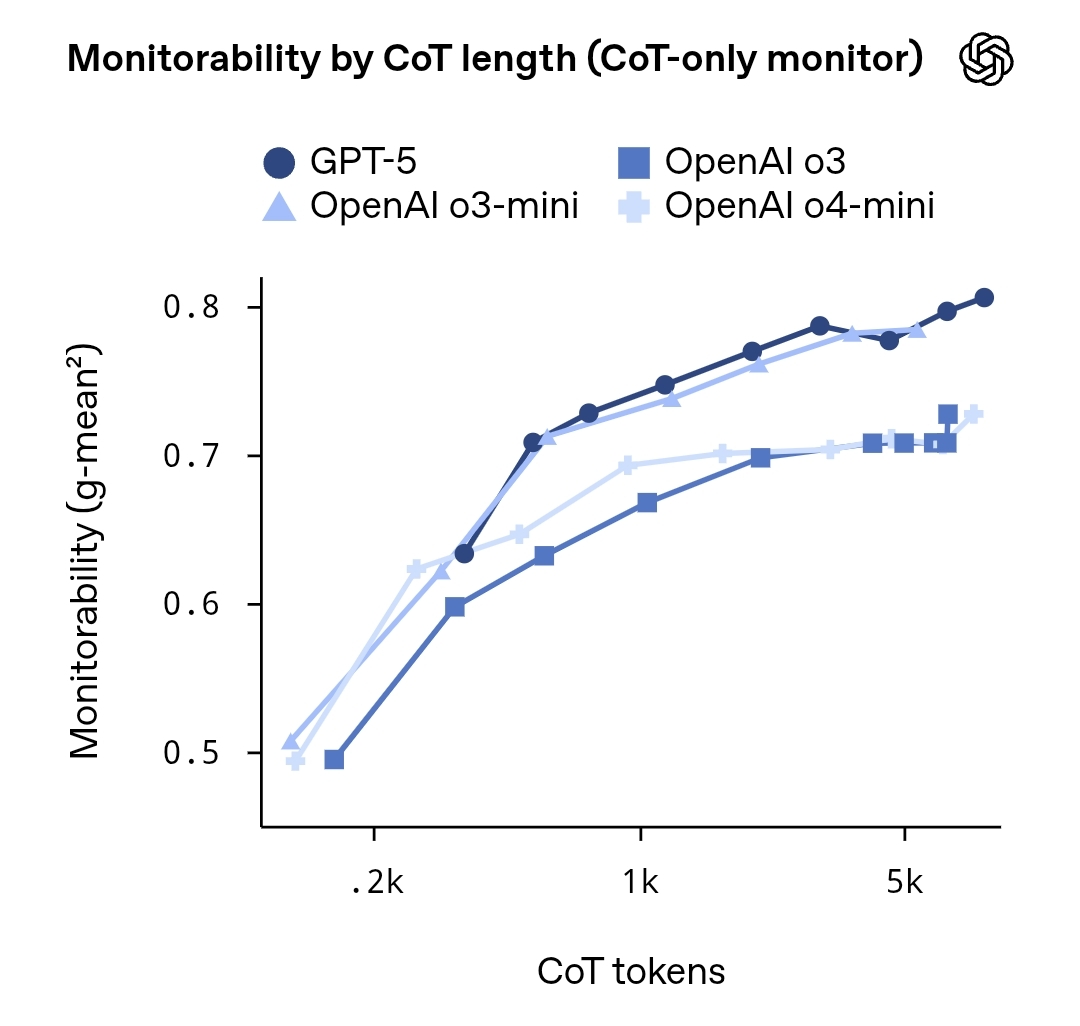
OpenAI released a research report "Evaluating Chain-of-Thought Monitorability", which systematically evaluates the monitorability and security impact of the "Chain-of-Thought" (CoT) within large language models. The report pointed out that although the reasoning process generated by the model can be predicted to a certain extent through external prompts or proxy models, its complete and accurate thinking trajectory is still highly uncertain and unreproducible.


The research team used different model sizes and task types in multiple experiments to analyze how to evaluate the transparency and auditability of the model chain of thought through "proxy model monitoring" and "implicit labeling reasoning steps". The results show that higher-level inference targets can be partially monitored, but there is still a risk of randomness and sensitive information leakage in the details. The report recommends maintaining a balance between security and privacy, and in the future, AI can be improved in mission-critical scenarios through specific oversight mechanisms, sandbox reasoning, and explanatory annotation frameworks.


OpenAI emphasized at the end of the article that the study aims to provide technical reference for AI governance, risk auditing and scientific research security, and does not mean that the current public model has or exposes an internal "complete chain of thought". Subsequent research will focus on how to improve inference transparency and process verification without affecting model performance.


FAQsQ: What is the topic of this study?

A: The research mainly explores whether the "chain of thought" within large language models can be monitored, interpreted, or partially predicted, and the security implications of this visibility.


Q: What is a "Chain-of-Thought"?

A: Refers to the intermediate reasoning steps or logical processes of the model before generating answers, which are usually not visible in the output but affect the final result.


Q: What are the main conclusions found by the study?

A: Chains of thought can be partially predicted, but they cannot be fully reproducible, and there are risks of randomness, privacy, and abuse.


Q: Why study the monitorability of chains of thought?

A: In order to improve the security and auditability of AI systems, researchers can better understand the reasoning behavior of models in critical tasks.


Q: Does the research mean that OpenAI has disclosed its internal reasoning mechanisms?

A: No. The report is for academic evaluation and security governance reference only, and does not disclose any interfaces or features that can access the model's internal inference.
OpenAI reports assess chain-of-thought monitorability OpenAI research parses CoT auditable boundaries OpenAI's review reveals the difficulty of reproducibility of the inference chain OpenAI reports that the trajectory of thought is highly uncertain OpenAI research discusses chain-of-thought transparency and risk OpenAI experiments test agent model monitoring CoT OpenAI proposes an implicit labeling inference step method OpenAI report found that high-level targets can be predicted OpenAI research points out that detailed reasoning is still random OpenAI reminds that chain-of-thought monitoring includes privacy leaks OpenAI suggests a balance between security and privacy OpenAI proposes sandbox reasoning to improve controllability OpenAI Initiative Interpretive Annotation Framework for governance OpenAI reports focus on mission-critical reasoning verifiable OpenAI emphasizes not disclosed the complete internal chain of thought OpenAI research provides a reference for AI audit and governance OpenAI evaluates CoT visibility for models at different scales OpenAI conducts reasoning monitoring and comparison of multi-task types OpenAI discusses the upper limit of predictive inference from external prompts OpenAI pointed out that complete CoT is difficult to reconstruct accurately OpenAI research evaluates the effectiveness and bias of monitoring tools OpenAI report reveals the trade-off between monitorability and performance OpenAI proposes specific oversight mechanisms to improve transparency OpenAI recommends that process verification should not sacrifice capabilities OpenAI assesses the impact of proxy monitoring on sensitive information OpenAI analyzes reasons why reasoning details are unauditable OpenAI report explores the path of interpretability labeling OpenAI studies engineering solutions that focus on reasoning transparency OpenAI commented that the inference chain can be predicted partially uncontrollable OpenAI points out that chain-of-thought generation is non-reproducible The OpenAI report discusses how security audits can leverage CoT signals OpenAI research experiments with implicit reasoning markers OpenAI proposes risk mitigation recommendations for monitoring the chain of thought OpenAI emphasizes that the public model does not expose internal reasoning interfaces OpenAI's research summary is still limited in transparency OpenAI reports evaluate the security benefit boundaries of inference monitoring OpenAI's analytical reasoning visibility can lead to abuse OpenAI proposes to deploy sandbox inference in key scenarios The OpenAI report emphasizes that governance goals are controllable and auditable OpenAI research points out that the agent model can only capture summary intent OpenAI's review shows that detailed reasoning is still difficult to predict stably OpenAI recommends using an interpretation framework that takes into account privacy and compliance The OpenAI report discusses how audit signals can avoid leaks OpenAI research proposes to focus on process verification capabilities in the future OpenAI assesses the significance of chain-of-thought monitoring for scientific research security OpenAI reports a technical roadmap for sorting out CoT monitoring OpenAI research reflects on the upper limit of reality for reasoning transparency OpenAI proposes that monitorability is not the same as an accessible chain of thought The OpenAI report concludes that monitoring CoT needs to be carefully designed OpenAI research points to new tools for AI governance and risk auditing

Recommended Tools

More