Back to AI information
Meta Open Source Perception Encoder Audiovisual (PE-AV): Supports SAM Audio's audio separation engine

Meta Open Source Perception Encoder Audiovisual (PE-AV): Supports SAM Audio's audio separation engine

AI information Admin 142 views

AI at Meta, a subsidiary of Meta, announced the open-source Perception Encoder Audiovisual (PE-AV) and positioned it as a key technology engine to drive SAM Audio to achieve cutting-edge audio separation effects. Based on the earlier Perception Encoder system, PE-AV natively integrates audio and visual perception to align audio, video (or audio and video clips) and text information in the same representation space.


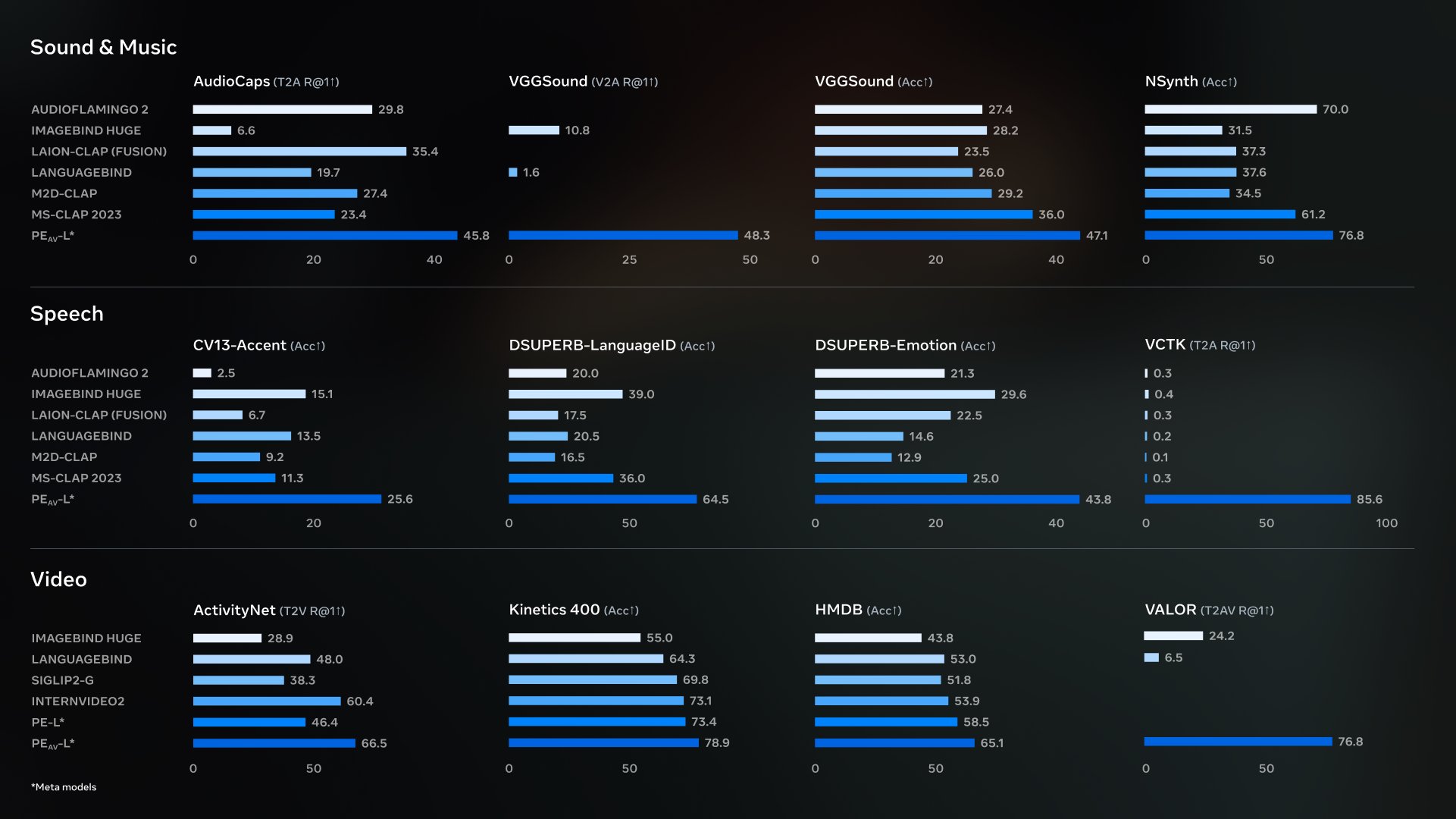
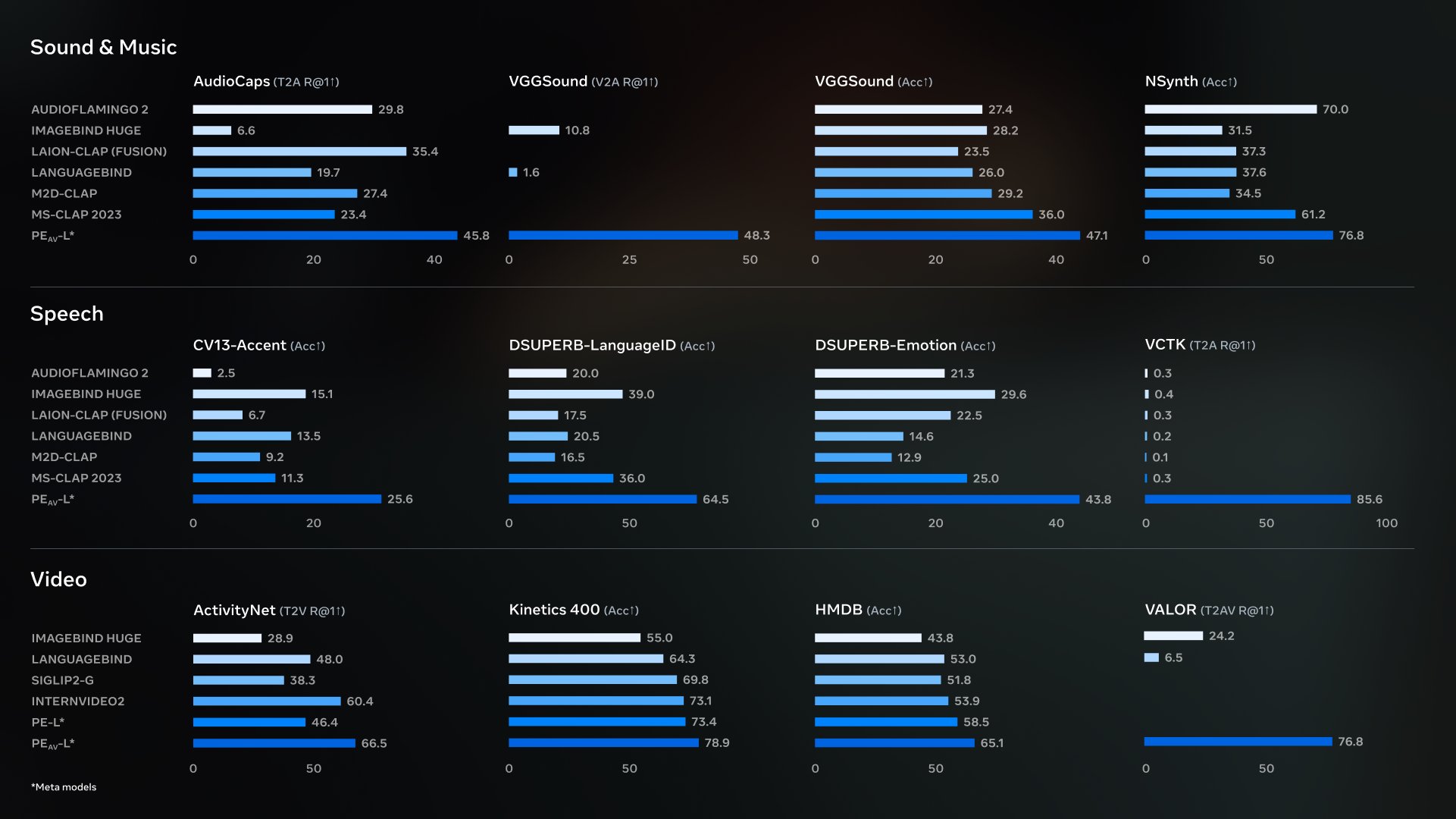
According to public information, PE-AV focuses on multi-modal capabilities, which can be used for sound retrieval, sound detection, and richer audio and video scene understanding, and has achieved leading performance in a number of audio and video benchmarks. In terms of supporting resources, the code is open source on GitHub; Model weights are published on Hugging Face at multiple scales, making it easy for developers to reuse them in audio separation, cross-modal retrieval, and understanding tasks. It should be noted that the specific comparison settings and reproducible details of the official "benchmark leading" conclusion are still subject to the disclosure of papers and model cards.


FAQ

Q: What is the technical component of PE-AV?

A: PE-AV is an audio-visual multimodal perception encoder used to map audio, video, and text into a unified embedding space to support downstream separation and understanding tasks.


Q: What is the relationship between PE-AV and SAM Audio?

A: PE-AV is described as an important technology engine for SAM Audio to achieve cutting-edge audio separation effects, which can be used to improve audio-visual alignment and separation-related capabilities.


Q: What daily or application scenarios can PE-AV do?

A: PE-AV can be used for sound detection, cross-modal retrieval (finding sound from text or images), and more complete audio and video scene understanding and analysis.


Q: Where can I get the code and model of PE-AV?

A: The code is publicly available in GitHub's facebookresearch/perception_models repository, and model weights are available in multiple scale versions under Hugging Face's facebook organization.


Q: What are the limitations I need to be aware of when using PE-AV?

A: Different weights and datasets may have their own licenses and terms of use, and some models may need to apply for access on the platform side.
Meta open-source PE-AV multimodal engine technology Meta releases PE-AV to support SAM Audio separation AI at Meta open-source PE-AV audio and video encoder Meta open-source PE-AV unified embedding space solution Meta launches PE-AV audio-visual native fusion Meta says PE-AV improves SAM Audio alignment Meta open-source PE-AV for cross-modal sound retrieval Meta released PE-AV support for sound detection tasks Meta's open source PE-AV helps upgrade audio and video understanding Meta announced that PE-AV is leading the way in multiple benchmarks Meta's open-source PE-AV code is available in the GitHub repository Meta released PE-AV weights on Hugging Face Meta provides PE-AV multi-scale weights that can be reused Meta's open-source PE-AV promotes stronger audio separation Meta uses PE-AV to build an audio-visual text alignment engine Meta open-source PE-AV supports audio and video clip retrieval Meta released PE-AV to find sound from the picture Meta open-source PE-AV is used to find sounds in text Meta launches PE-AV to enhance multimodal scene understanding Meta's open source PE-AV improves AV alignment consistency Meta releases PE-AV extension Perception Encoder Meta open-source PE-AV continues the perception encoder system Meta launches PE-AV unified representation of spatial alignment Meta open-source PE-AV for enterprise multimedia analysis Meta released PE-AV for sound event targeting Meta open-source PE-AV enhanced audio and video semantic representation Meta launches PE-AV to help developers reuse separation capabilities Meta's open source PE-AV provides a foundation for retrieval understanding Meta announces PE-AV support for audio and video alignment Analysis of Meta's open-source PE-AV multimodal retrieval capabilities Meta launched PE-AV for audio and video content moderation assistance Meta open-source PE-AV is used for intelligent annotation of media materials Meta released PE-AV for short video sound understanding Meta open-source PE-AV for conference audio and video analysis Meta launched PE-AV for cross-modal retrieval scenarios Meta's open-source PE-AV supports multi-task transfer learning Meta released PE-AV to emphasize native audio-visual integration Meta's open-source PE-AV provides the engine for audio separation Meta launches PE-AV to promote SAM Audio cutting-edge effects Meta's open source PE-AV improves audio and video retrieval accuracy Meta releases PE-AV for sound similarity retrieval Meta open-source PE-AV is used for audio and video semantic search Meta launched PE-AV to accelerate the implementation of multimodal applications Meta's open source PE-AV weight license needs to be verified Meta released PE-AV model card to disclose comparison details Meta's open source PE-AV benchmark leads need to be read in papers Meta launches PE-AV for easy access and fast reproduction Meta open-source PE-AV adaptation separation retrieval understanding Meta released PE-AV to connect GitHub and the HF ecosystem Full interpretation of Meta's open source PE-AV multimodal encoder

Recommended Tools

More