1. Product positioning
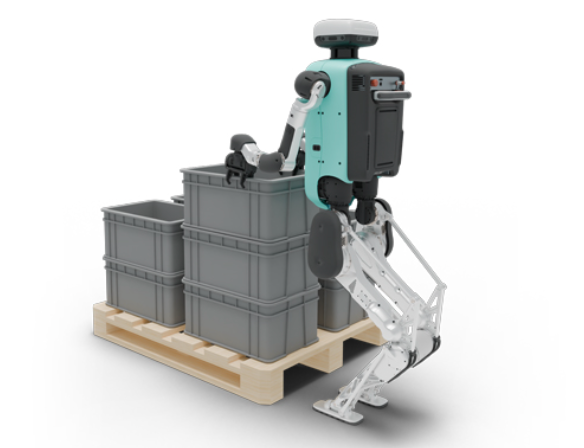
Digit is Agility Robotics' bipedal humanoid robot for warehousing, logistics, and manufacturing, mainly responsible for high-repetitive physical tasks such as handling turnover boxes, loading and unloading, and material transfer. The goal is to alleviate the shortage of front-line labor without renovating the existing warehouse as much as possible, and to invest more manpower in quality inspection, exception handling and on-site management.
2. Core highlights
With a height of about 1.75 meters and a weight of about 65 kg, Digit uses bipedal walking and two-arm grasping to move and complete pick-and-place operations in standard shelf aisles, ramps, and other human work environments, reducing the need for site structure modification.
Its walking speed is about the level of walking speed, and the rated handling load is about 16 kg, which is suitable for moving boxes from conveyor lines to pallets, shelves or cages, covering common box rules in e-commerce and third-party warehouses, freeing front-line movers from frequent bending and lifting work.
The whole machine integrates a variety of vision and distance sensors, and uses the Agility Arc platform for fleet management, task allocation, and remote monitoring, making it easy to connect with existing WMS, MES, and other systems to realize the automatic process from orders to robot actions.
The new version adds front and rear status displays, improved safety features, and the ability to work with AMR trolleys, allowing operators to visualize connections, battery levels, and alarm status, making it easier to adopt a "humanoid porter + trolley" combination in the field.
3. Applicable groups and scenarios
Digit is mainly aimed at warehousing and manufacturing enterprises with labor gaps, high turnover rates, or the need for three shifts, especially material handling scenarios based on cartons and plastic turnover boxes. Typical applications include depalletizing, inbound and outbound buffer handling, sorting station replenishment, and line-side feeding.
For existing warehouses, Digit can work directly between existing channels and stations, which has a lower initial transformation cost than reconstructing into a fully automated warehouse, and is more suitable as a phased solution of "automating from some stations first".
4. Key points of deployment and operation and maintenance
For deployment, Agility provides a standard work unit, a control handheld terminal, and an automatic charging dock, allowing Digit to autonomously dock and switch between different stations. Enterprises need to reserve safe workspaces and robot paths, and access the mission system through Arc.
In terms of operation and maintenance, Digit monitors power, connection, and operation logs through the cloud platform, allowing for remote upgrades and policy adjustments, reducing the investment of on-site professional engineers, and is more suitable for continuous operation according to a "multi-locomotive fleet".
Q&A Frequently Asked Questions
Q1: Is the Digit suitable for 24×7 hours of continuous operation?
A: Digit supports shift work and achieves nearly 7×24 hours of coverage through multi-machine collaboration and automatic charging, but the charging time for a single machine still needs to be reserved based on battery and task strength, which is more suitable for shift planning rather than completely uninterrupted operation.
Q2: What is the biggest difference between Digit compared to traditional conveyor lines or robotic arms?
A: Traditional conveyor lines and robotic arms require relatively fixed stations and cycles, with high transformation costs but stable efficiency; Digit can move between existing aisles, shelves, and workstations like a human, making it more suitable for warehouses with highly variable order structures and frequently modified layouts.
Q3: How to ensure safety during human-machine collaboration?
A: Digit relies on a variety of sensors to sense surrounding people and obstacles, slow down or stop the machine through software policies, and provide front and rear status displays and remote monitoring functions; The site still needs to set up isolation areas, walking paths and emergency procedures in combination with safety assessment.
Q4: If you want to do a pilot in the warehouse, what are the main thresholds for introduction?
A: The key is to select high-repetitive, regular handling stations, reserve sufficient travel space and safe distance, and coordinate the IT team to complete data docking with existing business systems. Rather than large-scale civil renovations, it is better to start a small pilot with a small number of Digit fleets.