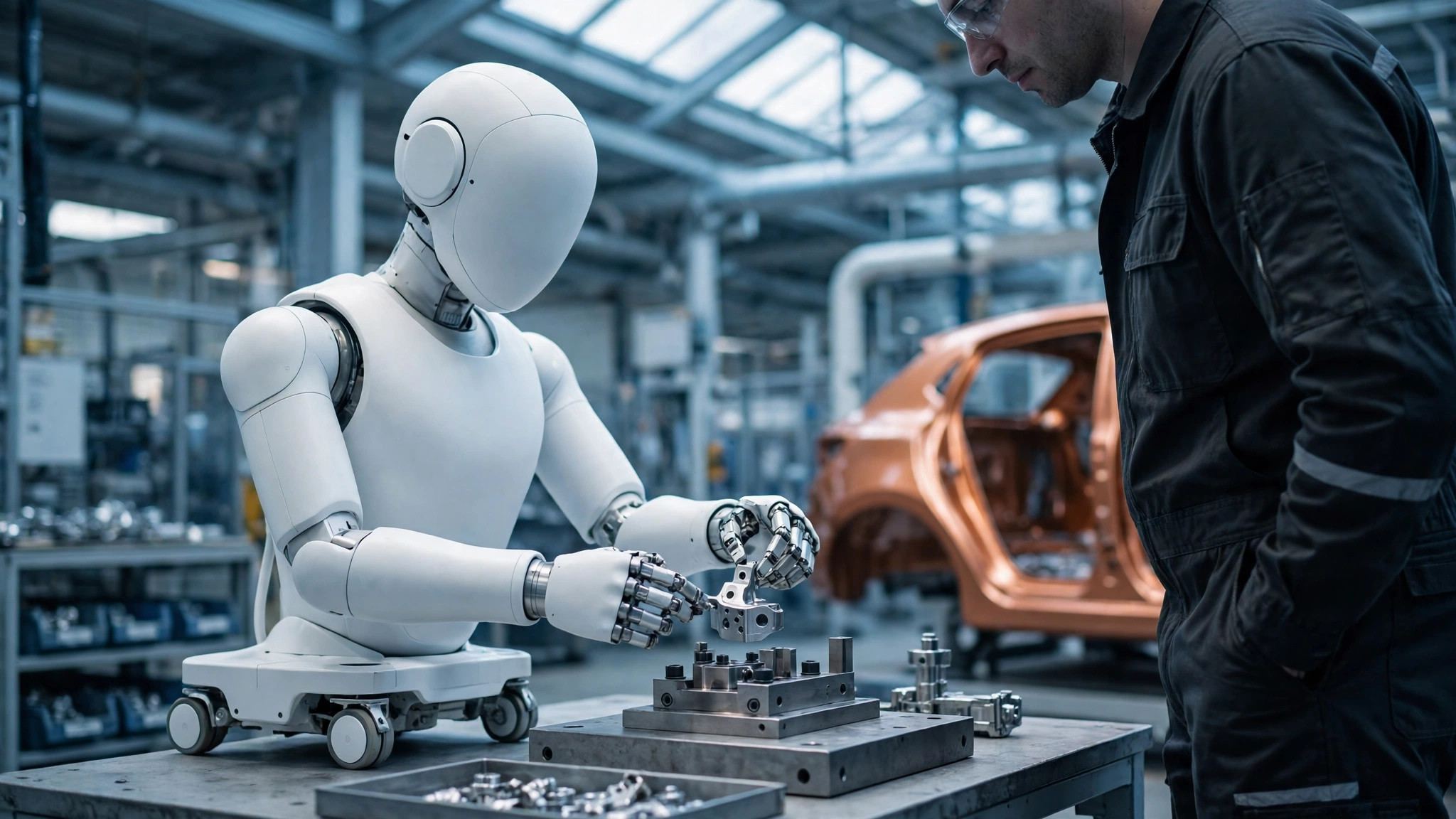
On November 26, 2026, Volvo Cars announced it has brought Hexagon Robotics' AEON humanoid robots into its Ghent plant in Belgium, where they are being trained and validated on real production tasks. It is the first Volvo Cars plant to try humanoid robots, and the goal is not to replace workers but to have the robots take over repetitive, physically straining work, with real production starting in mid-2027.
What it learns first: precise placement in two fixtures
Right now AEON's first lesson is a specific one: using imitation learning, a standard technique in embodied AI, to place parts precisely into two fixtures. Volvo's own team is training the robot together with Hexagon's robotics division, mastering this one motion first and adding more parts, movement and interaction with the plant's automated systems only once each step is proven. AEON is 1.65 metres tall and weighs 60 kilograms. It has no feet and moves on wheels, reaching up to 2.4 metres per second and carrying 10 kilograms, using cameras and sensors to see its surroundings and handle parts precisely. Magnus Nilsson, Volvo Cars' Chief Manufacturing Officer, put it this way: AEON's humanoid design lets it fit into production as it stands today, working alongside teams and existing automation.
Slow for a reason: validate first, then scale
What makes this worth watching is not how new the robot is, but how carmakers are settling on a way to use humanoids: no leap straight into production, but small-scale validation on a real line first, then expansion. Gemini Robotics is already doing picking work on a Mercedes production line; Volvo has chosen a slower rhythm — training first, pilot second. It is equally important to see what Volvo did not say: no task success rate, no cycle time, and no word on how many AEON units are in the plant today, so 'production in mid-2027' remains a target, not a promise.
Under the plan, more AEON units will arrive in Ghent in the first half of 2027 for a wider factory pilot, and if validation goes well, they will take on real production work from mid-year. Whether the timetable holds will depend on how stable training proves over the next six months, not on what was said at the announcement.