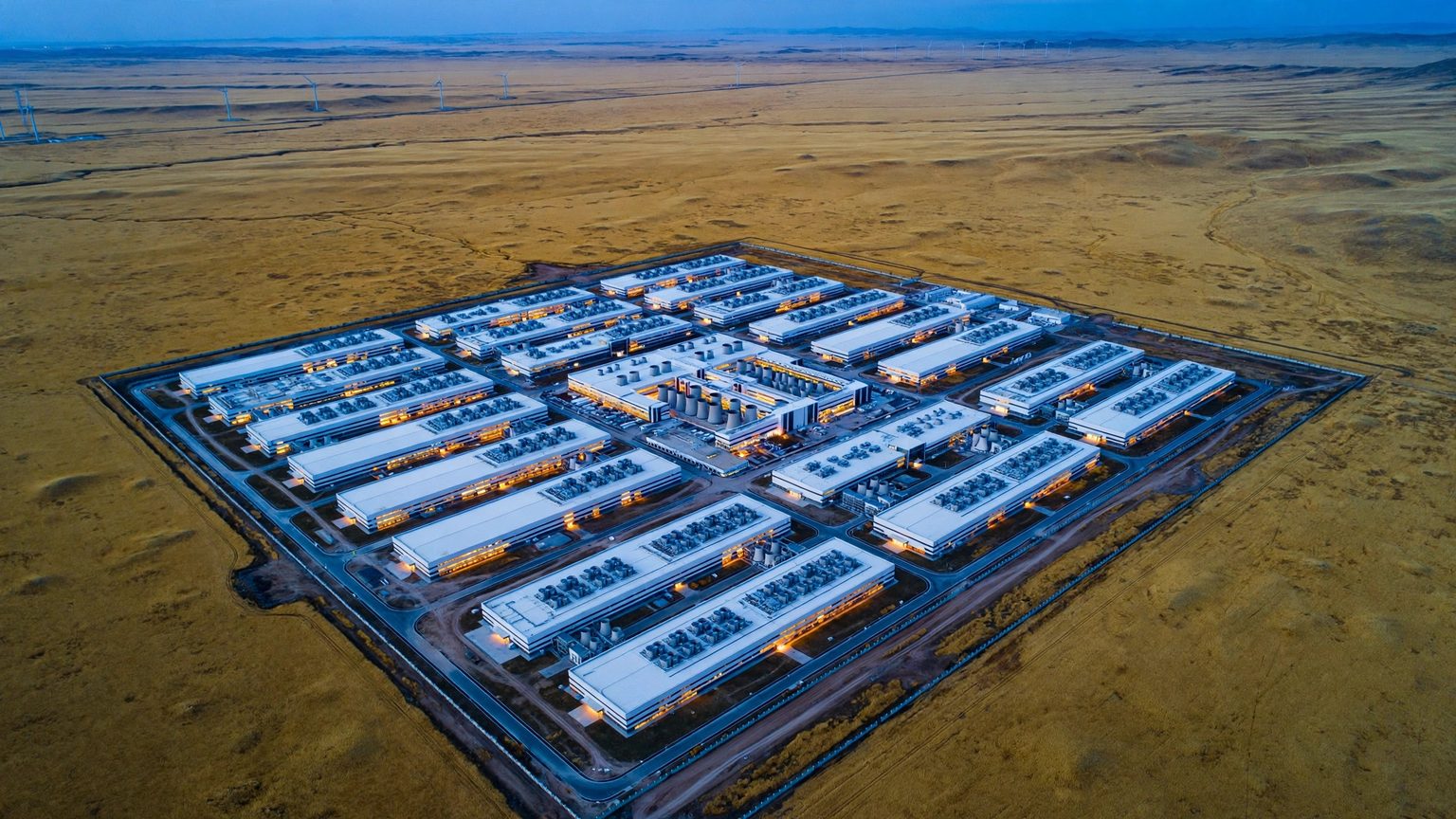
On November 12, 2026, Epoch AI published a report calculated from satellite imagery: Huawei's data center in Horinger, Inner Mongolia, currently has about 81,000 Nvidia H100 equivalents in operation — roughly 7% of SpaceX's Colossus 2, the world's largest AI data center. It is the first time anyone has put a concrete, publicly verifiable number on one of China's largest AI data centers.
Epoch AI's method is straightforward: count the cooling equipment in commercial high-resolution satellite images, estimate each building's heat rejection capacity from the type, size and number of cooling towers, and from that derive IT power; then combine Huawei's chip sales over time with a four-month lag from sale to deployment to work out which chips fill the racks. Excluding the low-density North zone, the four remaining buildings total 286 megawatts of IT power, three of them already in operation and the fourth expected to come online in December. The estimate: about 105,000 Ascend 910C chips and 8,000 910B chips are already running.
The key figures, side by side:
| Metric | Value |
|---|---|
| Operational Ascend 910C / 910B | About 105,000 / 8,000 |
| In H100 equivalents | About 81,000 (90% confidence interval: 36,000–141,000) |
| Per-chip performance | One 910C ≈ 0.76 H100; B200/B300 ≈ 2.5 H100 |
| Versus Colossus 2 | About 7%; Colossus 2 is about 14× larger |
| After expansion in early 2028 | Campus compute ≈ 141,000 H100 equivalents |
What these numbers really mean is the gap they make measurable. By Epoch AI's math, 10% of Horinger's current compute — 8,100 H100 equivalents — would be enough to train a DeepSeek-V4-Pro-scale model in a month; concentrating the whole campus on a single run would take a year to train a GPT-6 Astra-scale model. More important is efficiency per unit of power: US AI data centers support 2.5 times more compute per unit of electricity than their Chinese counterparts, and the largest US campuses have already reached 1,000 megawatts. In other words, China is not short of power or land for data centers — it is short of the chip efficiency that turns each unit of electricity into more compute. That also helps explain why, even as Nvidia's share in China has fallen to 34%, Huawei is still catching up: its share is rising, but the per-chip efficiency gap remains.
Expansion will not close the gap quickly. At least three more buildings are planned at Horinger, one already under construction in the South zone; at the current pace it should come online in February 2028, lifting campus compute by more than 70% to about 141,000 H100 equivalents. But Colossus 2 is expected to reach at least 1.8 million H100 equivalents by then, so its share could actually shrink. Epoch AI's conclusion: over the next two years, China's compute constraints are unlikely to ease, and its model capability and deployment scale will keep lagging the US — but given what Chinese models have achieved in the past two years, the pace of that 'lag' is itself worth watching.