On November 11, 2026, Runway open-sourced the weights and code for Praxis-1 under the Apache 2.0 license, including for commercial use. It is a 27B-parameter world action model: it first learns from video pretraining what the world will look like next, then turns that prediction into robot actions. The verdict first: worth a look for researchers and teams with GPUs; ordinary users can't run it yet.
What This Project Actually Is
Praxis-1 is Runway's first world action model. Its backbone is a 26.9B-parameter mixture-of-experts diffusion transformer, with only about 2.8B parameters active per token, plus a roughly 314M-parameter action expert that converts predicted video features into motion. The official code is in Runway's GitHub repository, the weights are on Hugging Face, with LeRobot and vLLM-Omni support, and hosted inference is available through Runway's Reactor.
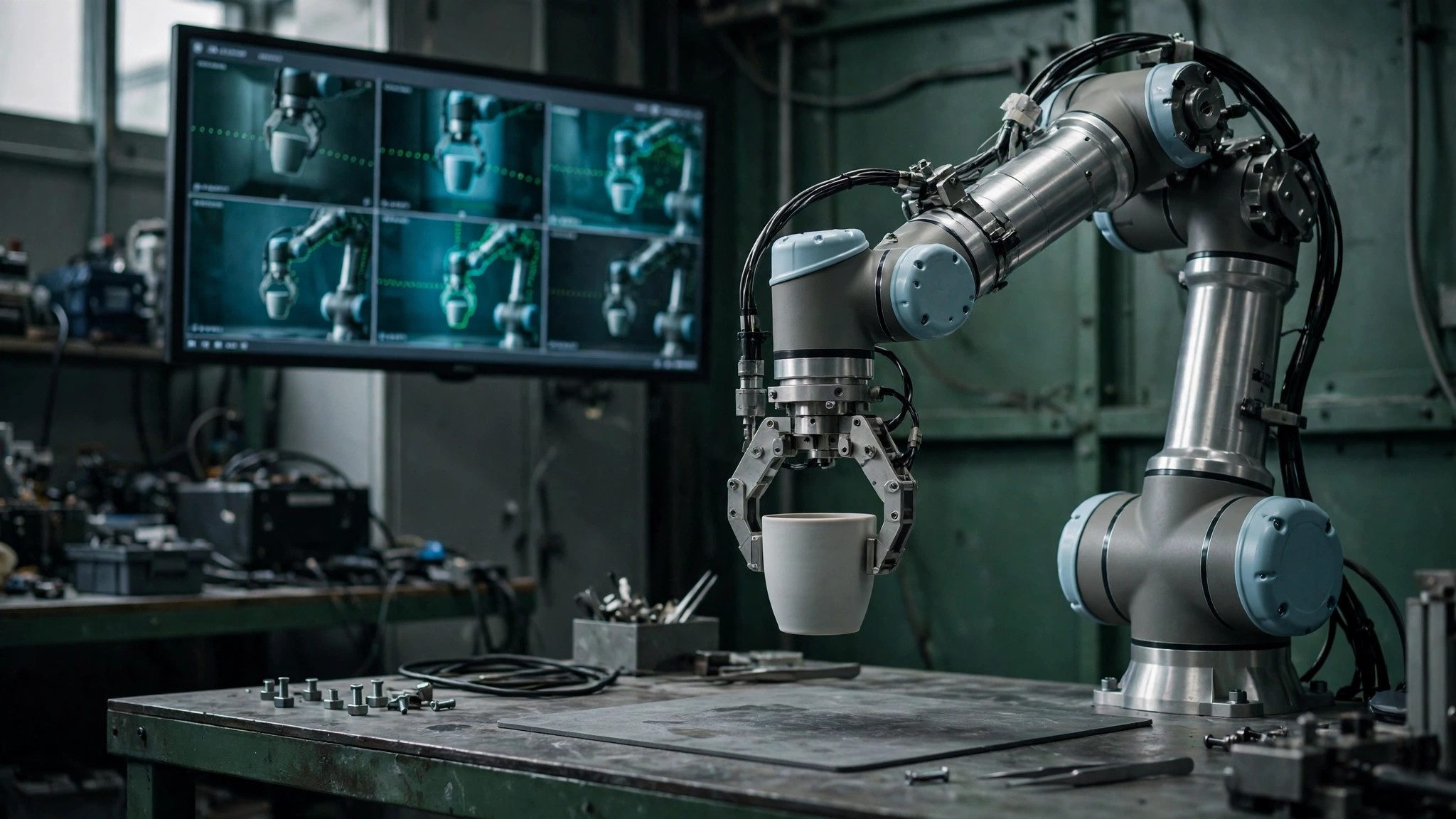
On NVIDIA's RoboLab-120, the DROID-fine-tuned Praxis-1 succeeded in 555 of 1,200 trials—a 46.2% success rate—ranking first among world action models and open-source robot foundation models, ahead of FLUX 3 Action, π0.5, and GR00T N1.6. It controls a bimanual YAM robot and a single Franka arm, and can be fine-tuned onto the low-cost SO-101 for real tasks.
Deployment Cost and Getting Started
The full model has 27.2B parameters and takes 54.4GB in bf16 precision; a single 80GB GPU can run it, covering H100 and B200 data-center cards, RTX 5090 and RTX PRO 6000 workstation cards, and the Jetson Thor inside the robot itself. The release includes three checkpoints—DROID-fine-tuned, bimanual YAM-fine-tuned, and the base model—with full fine-tuning and cheaper LoRA support, plus 4-bit NVFP4 quantization.
The barrier isn't downloading, it's what comes after: you need a robot or a simulation environment (the release includes a MuJoCo simulation environment), plus your own task data for fine-tuning. Without hardware, if you just want to try it on a laptop, use Reactor's hosted inference first—don't rush to download the weights.
Real Pitfalls
First, look-alike objects are easily confused: put two similar-looking items together and the model may reach for the wrong one. Second, the scores are self-reported by Runway; as of release there is no independent third-party replication, so treat 46.2% as a reference. Third, it needs data-center-class compute: a personal workstation can barely run inference, while training and large-scale fine-tuning remain team work. Who it's for: researchers in embodied AI and robot learning, and teams with GPUs and robot hardware. Who it's not for: casual users who just want to try it, and developers without robot hardware—try the hosted version first and wait for the ecosystem and tutorials to catch up. For Runway's announcement that same day, see Runway open-sources Praxis-1; for the previous major entry on the world-model path, see NVIDIA Cosmos.