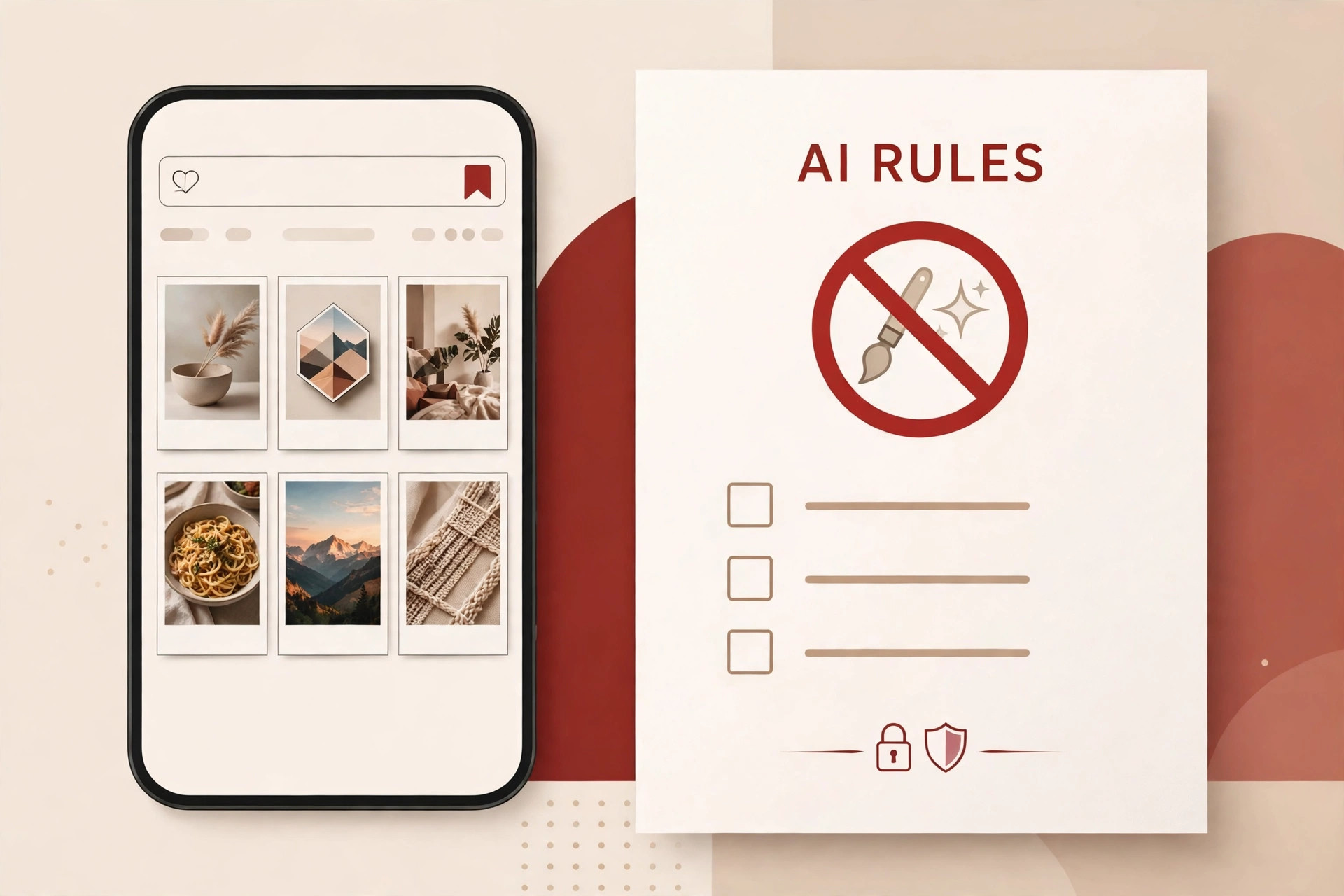
Pinterest's generative AI rules are about to become contract terms. Pinterest's policy pages already carry the notice: new Terms of Service and Privacy Policy take effect on November 12, 2026, and the GenAI Acceptable Use Guidelines appear for the first time in the list of policies the Terms incorporate by reference. From that day, breaking the AI guidelines is no longer just ignoring a help page — it is a direct breach of the user agreement.
What changes: three key points
The change comes in three parts. First, penalties are spelled out in the guidelines for the first time. The new version adds one sentence: abuse of Pinterest's generative AI technology may result in account enforcement, including loss of access to GenAI features, account suspension or termination. The 17 bans themselves are unchanged, in three groups — dangerous or illegal use, misleading or deceptive use, and explicit, hateful or violent use — covering intellectual property and privacy violations, jailbreaking, reverse engineering and scraping, impersonation, spreading harmful misinformation, sexual content and non-consensual intimate imagery; the rules cover both inputs and outputs, so AI image generation, editing and chat are all in scope. Second, the training language is clearer. The new Privacy Policy states that Pinterest uses information, including Pins posted at any time, to train, develop and improve its technology, including machine learning models and generative AI models; data from interactions with GenAI features is also listed as collected. Third, consent works differently by region. Users outside the EEA, Switzerland and the UK consent to the processing described in the Privacy Policy by accepting the new Terms; users in the EEA, Switzerland and the UK are covered by the mechanisms under local law.
Before November 12: what three groups of people should do
Ordinary users should watch what they type into the tools first: human reviewers may check GenAI inputs and outputs to improve the service, so do not put private, sensitive or confidential information into AI image generation, editing or the AI assistant; breaking any of the 17 bans can cost you the AI features first, then the account. Creators and brands should review their back catalogue: Pins posted years ago fall within the training scope too, so if you object to your work being used for model training, check the relevant options in your privacy and data settings — delete or adjust as needed. Advertisers have one more thing to note: revised Advertising Guidelines taking effect the same day add bans on synthetic-media misrepresentation, scam tooling and impersonation, so AI-generated ad creative should be checked for accuracy and labelling before it runs. Similar changes keep coming: OpenAI's usage policy update requires model routers and gateways to pass review before selling access, while Meta's commercial terms update was paused after courts in several countries ordered it halted.
Two boundaries not to get wrong
Two limits are worth stating plainly. First, Pinterest has not added a clause to the Terms granting itself a licence to train AI on user content — the content licence is word-for-word unchanged, and the training basis sits in the Privacy Policy, not in the contract itself. Second, this change concerns only Pinterest's own GenAI tools and platform rules; it does not change what the EU AI Act or any national law requires. After November 12, continuing to use Pinterest counts as accepting the new terms — the only way to object is to stop using the service or delete the account before the effective date.