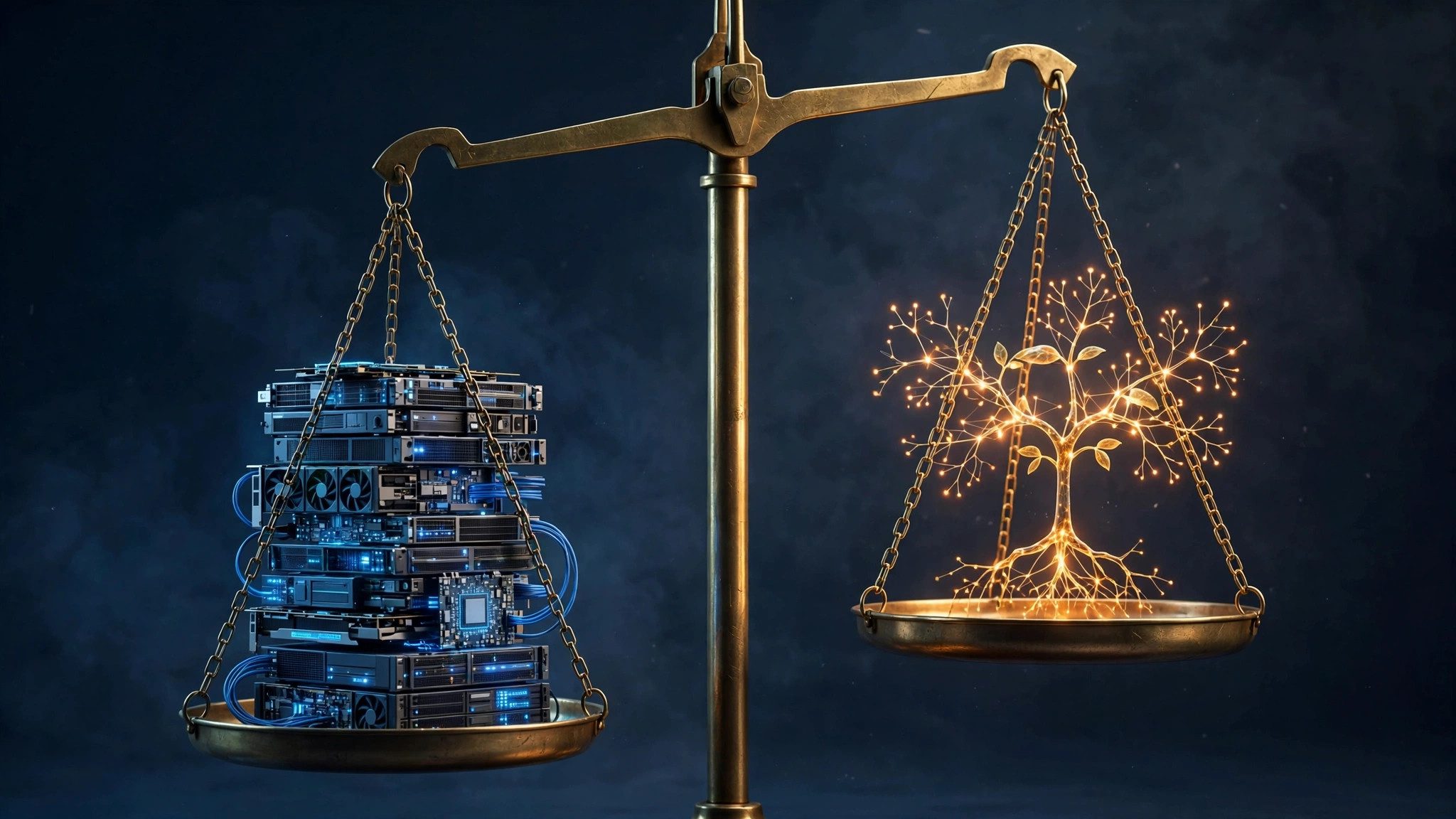
On November 8, 2026, The Decoder reported that Richard Sutton, Turing Award winner and a founder of modern reinforcement learning, recently wrote that compute alone will not lead to true intelligence, and that AI science needs cleverer new methods — and is "far from finished." The remarks drew wide discussion in the AI community, with OpenAI and Anthropic's chiefs on the other side of the argument.
What Sutton Actually Said
To understand the remarks, go back to Sutton's famous 2019 essay, "The Bitter Lesson." It argued that the methods that ultimately win are the ones that grow stronger with compute, with search and learning as the prime examples. Large language models were long the best illustration: the more internet text they were fed, the more capable they became. But Sutton now argues that LLMs expose the limits of that path: once trained, they stop learning, their weights frozen from the day they ship. In August he went further, calling synthetic data a "big mistake" for breaking through the bottleneck: the real world is infinitely complex, and any simulation is only a tiny slice of it. The direction he proposes is agents that accumulate experience on their own, equipped with world models and learning continuously from interaction with their environment, without discarding old knowledge. The yardstick for this debate is the scaling law: as parameters, data, and compute grow, gains diminish — the question is who hits the ceiling first.
Who in Research Agrees With Him
Sutton is not alone. Jerry Tworek, a former OpenAI researcher, argues the bitter lesson itself still holds — but the more compute is poured in, the more the algorithm matters: some algorithms scale, others hit dead ends, and the temporary success of the transformer route, combined with a misreading of the old essay, "has reward-hacked the brains of a whole generation of scientists." Researcher Jayden Teoh adds that the misreading has also kept promising ideas from being tested in academia before being dismissed: "An idea doesn't necessarily have to survive scaling forever to be an important contribution to AI progress." The Decoder's count shows the latest Frontier Radar tracking 45 new AI labs betting on exactly these gaps, including Tworek's own Core Automation and Oak Lab, which Sutton co-founded with a former student.
Why the Other Side Isn't Buying It
But the other side is just as loud. OpenAI CEO Sam Altman argues LLM scaling is far from exhausted, and has accused scaling skeptics of slowing down a generation of researchers; his evidence is an OpenAI model that recently disproved an 18-year-old quantum conjecture, verified in Lean. Anthropic CEO Dario Amodei is equally bullish on scaling, calling progress "a rainbow with no end." The disagreement is not about whether compute helps, but where the ceiling sits: one side bets new learning methods will open the next door, the other bets the current recipe pushed to its limit still has a long way to go.
For ordinary readers, the debate will shape what AI progress looks like over the next few years: bigger, more expensive models, or agents that grow capable on their own. There is no verdict yet — Sutton's Oak Lab and a wave of new labs are building the answer rather than arguing it. Notably, neither side rejects the other's premise: Sutton never said compute is useless, and Altman never denied the value of world models. The disagreement is only about where to place the next bet.