DeepSeek Super-agent surfaced on the evening of October 31, 2026. The DeepSeek Harness team published a technical article, 'Super-agent Design Exploration: Toward a More Autonomous Agent System,' aiming to free agents from single sessions and turn them into continuous entities that stay online long-term, handle multiple tasks in parallel, and respond proactively to changes in their environment. This is not a formal product but an architectural exploration, with some designs already implemented through an open-source prototype.
One AI Coordinates, Many AIs Do the Work
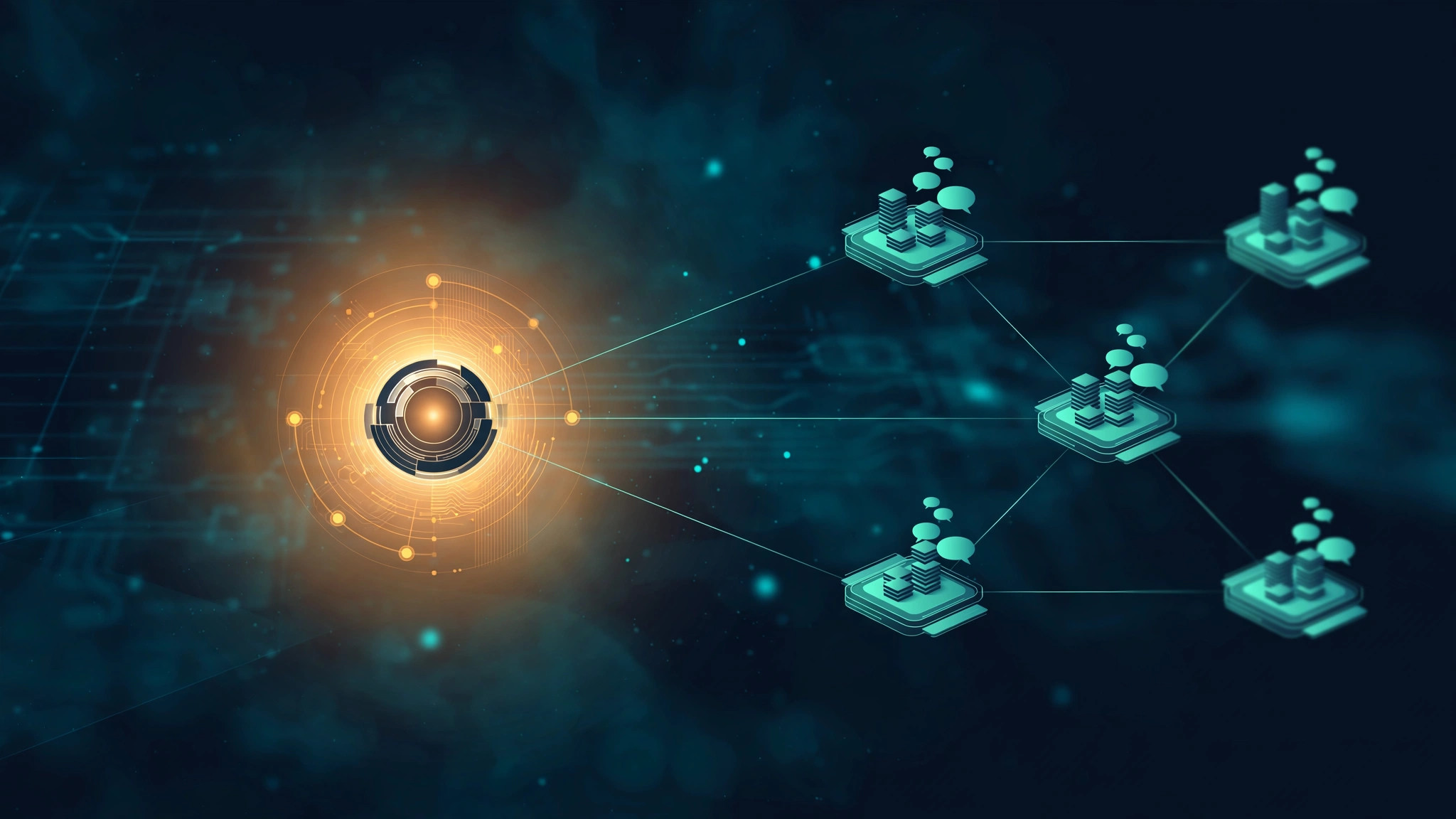
The article divides the system into two layers: Router and Worker. The Router is a global coordination node that receives information from group chats, GitHub, email, and other channels, maintains context, and assigns tasks; Workers each have their own context and tools and concurrently handle issue reproduction, code review, and feature development in isolated sessions, reporting results back to the Router for external communication. The user always faces the same assistant.
It Acts First, Even When Nobody Calls It
Group chats, email, schedules, code-review comments, and CI results can all trigger action. Most group-chat messages need no AI involvement, so the article designs a two-stage filter: programmatic rules first exclude irrelevant messages, then a large model judges from context whether to act. It also borrows speculative execution, trying in the background before deciding whether to submit: the 'silent reproduction and repair' policy configured in an internal group reproduces an issue and looks for a fix as soon as someone reports a bug, submitting a Pull Request only when the issue is confirmed and the fix is simple.
Faster, but More Expensive in Tokens
The team compared approaches using about 300 simulated messages, roughly 20 of which were real work requests, repeating each approach five times. Super-agent's median task-completion time was 12.4 minutes, with a 95th percentile of 15.7 minutes; the traditional single-session approach reached a 95th percentile of 29.5 minutes under neutral prompts. The cost was higher cache reads: after removing the event pass-through, total cache reads rose from 23.23 million to 31.77 million tokens, an increase of about 37%. The experiment used synthetic messages and simulated tools, validating scheduling and collaboration only, without directly evaluating real coding quality.
Asynchronous ReAct Loop, compute-storage separation, and Watchdog solve three more problems: long-running tasks move to the background while the foreground keeps accepting new instructions; the execution loop runs in the cloud and state is stored in a database, with only a lightweight daemon left locally; Watchdog checks progress, identifies unproductive loops, and tries to repair them. The asynchronous task mechanism has already been implemented in DeepSeek Harness, but is not yet enabled by default.
DeepSeek says the design proposes no new theory; it simply applies classic systems ideas—task scheduling, cache management, event-driven design, and compute-storage separation—to agent architecture. An internal instance is already running, taking part in issue reproduction and code review. Three hurdles remain before real deployment: accurately restoring long-term memory, defending against prompt injection and server intrusion, and letting users track progress and decide which actions require human approval.