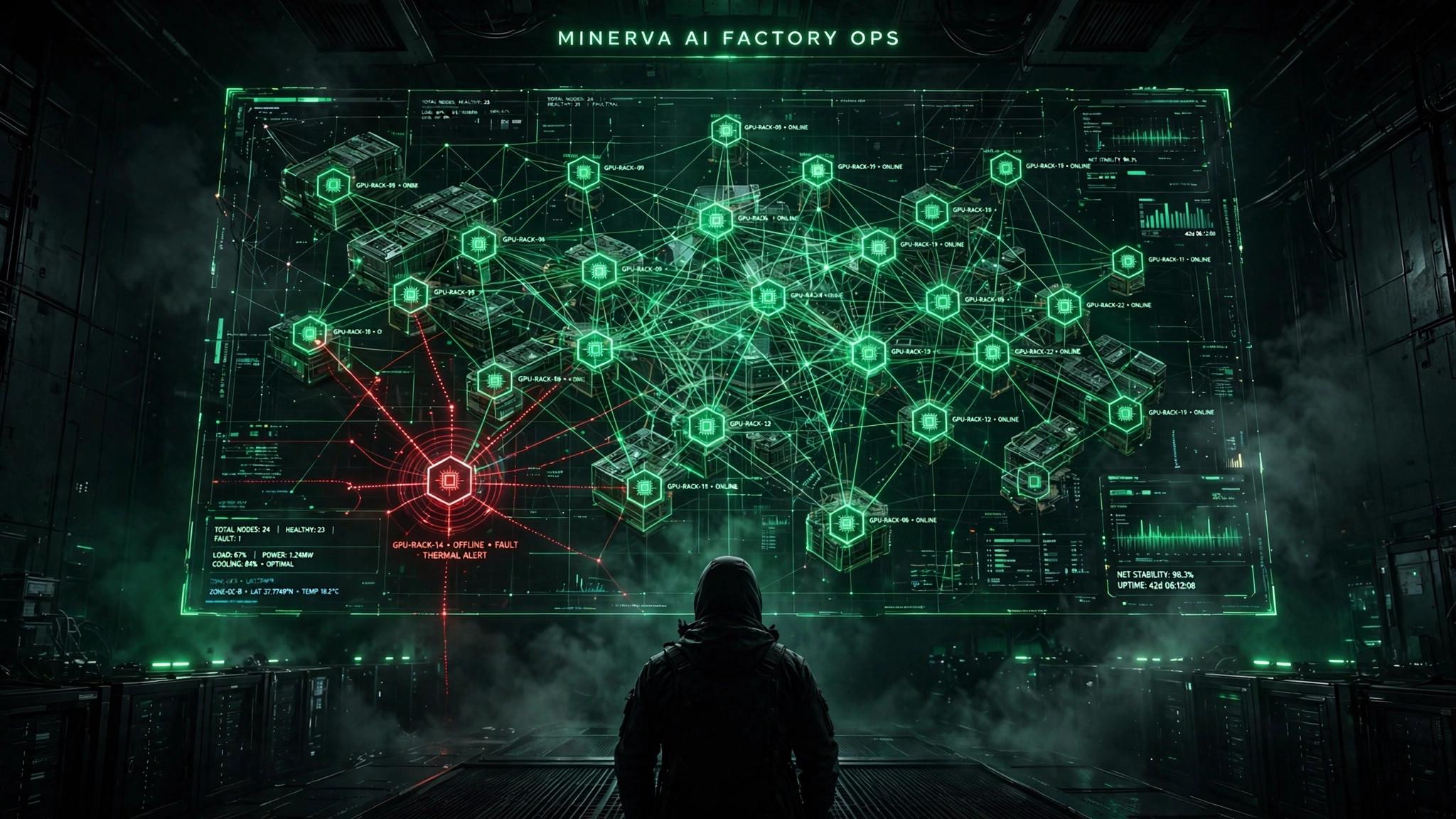
NVIDIA launched Minerva at GTC Berlin on October 22, 2026. Described on NVIDIA's official blog, it is an AIOps platform built for "AI factories" — training and inference clusters running hundreds of thousands of GPUs — that brings end-to-end observability to their operations. The idea is straightforward: pull telemetry from infrastructure and AI workloads into one place, and let AI models turn alerts into actionable remediation items.
Too many alerts, too hard to find the cause
The pain of AI data center operations is scale: one degraded component slows an entire training run, while traditional monitoring splits networking, compute and storage into separate views, so nobody has the full picture when a job slows down. Minerva draws the physical and logical connections between GPUs, SuperNICs, switches and cables — plus the jobs running on top — into one dynamic knowledge graph. Supervised and unsupervised machine-learning models analyze billions of data points per hour, learn what "normal" looks like, catch anomalies early, predict failures, and group related alerts around a likely root cause using the factory's topology.
Sherlock: an assistant you can ask about the cluster in plain language
Minerva ships with Sherlock, a native multi-agent AI assistant connected to live telemetry through an MCP server. Operators can ask in natural language whether a cluster is healthy, get fix recommendations, and choose whether to hand off to automation with one click. The metric NVIDIA wants optimized is specific: "AI factory yield" — GPU hours, goodput (useful work after stripping retries and failed jobs), cluster uptime and token production. The platform can be deployed standalone or integrated into NVIDIA DSX OS.
Early users are already on board
The launch list includes IREN, Bitdeer AI, IBM, Jio, Lambda, Quake AI and Tesla planning to deploy it, while Dell, Lenovo and Supermicro add it to their AI factory portfolios. Denis Skrinnikoff, IREN's CTO, said Minerva gives his operations team one view across the network, the GPUs and the jobs running on them, shifting effort from firefighting to proactive maintenance.
What it means
The AI infrastructure bottleneck is shifting from buying GPUs to keeping them busy. At hundreds of thousands of GPUs, finding one overheating card is itself a major cost — cheaper than buying another one. Minerva's value is not in any single feature but in productizing cross-layer correlation, which is also what separates it from generic observability tools. The flip side: it solves the problem inside the NVIDIA ecosystem. The knowledge graph covers NVIDIA's own parts — NVIDIA GPUs, ConnectX SuperNICs, BlueField DPUs, NVLink and Spectrum-X — so non-NVIDIA clusters can't use it. For teams building AI factories it deserves a serious look; for small and mid-size clusters, existing monitoring with alert aggregation may be the better deal.