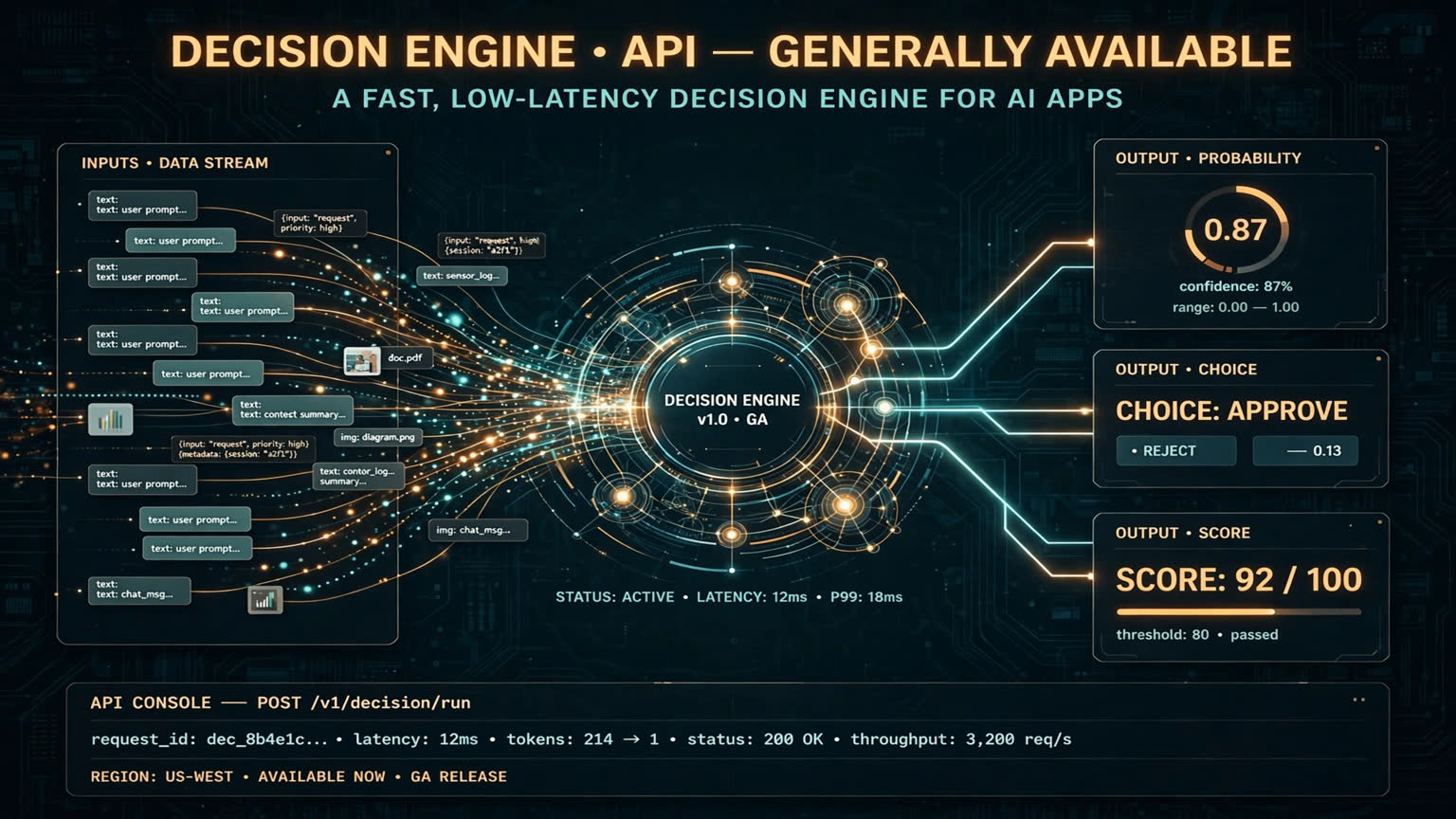
OpenAI's Decisions API became generally available on October 22. Built on GPT-6 Luna, it is designed for small decisions with bounded answers. In its official announcement, OpenAI writes that applications and agents make countless micro-decisions throughout a workflow: labeling an input, choosing which route a request should take, deciding the next action — each trivial on its own, but at scale the latency and cost pile up.
The Decisions API carves these judgments out into a dedicated fast lane. Developers define a question and its allowed answers, then pass text, images, or native JSON context; the API returns one of three answer types: predicate gives the probability that a condition holds (0 to 1, e.g. whether a product photo shows visible damage); choice picks one of the predefined options (e.g. continue, retry, or ask for clarification), with probabilities and confidence attached; score rates against an ordered rubric and returns the probability-weighted average of the level indices (e.g. damage severity). The headline number: up to 10x faster than calling GPT-6 Luna through the Responses API.
GA adds quite a bit over the public beta: native GPT-Live integration for fast decisions inside live voice sessions — a support agent deciding whether to ask a follow-up or escalate, an avatar changing expressions as the user speaks; prompt caching for reused context; inference residency in the US and EU; up to 400 questions per request, twice the previous limit; and added capacity in several regions in Asia.
Pricing targets high-frequency small decisions: $0.10 per million input tokens, $0.01 per million cached input tokens, input-only billing with no output-token charges, and 30-minute and 12-hour cache-write options. Eligible customers can also use Zero Data Retention.
Three direct implications
Once agents actually run, the bottleneck is rarely the single smartest step — it is the thousands of intermediate judgments. Developers used to either call a large model for every small decision, swallowing latency and bills, or train their own small classifiers and own the maintenance. The Decisions API turns "judgment" into infrastructure: the answer space is locked down, the model never has to compose language, so latency and cost drop naturally.
The direct impact on developers comes in three layers. First, classification, routing, and arbitration logic already running in Responses API workflows can migrate to the cheaper fast lane. Second, latency-sensitive real-time voice scenarios — support, avatars — get an official "decide while talking" solution for the first time. Third, input-only pricing makes billing for high-frequency calls predictable — exactly the uncertainty that scares teams scaling agents.
The boundary matters too: it only answers bounded questions; open-ended generation and long reasoning still go through the regular model interfaces. Think of it as the agent's reflex arc, not its brain — that is the right way to use it.