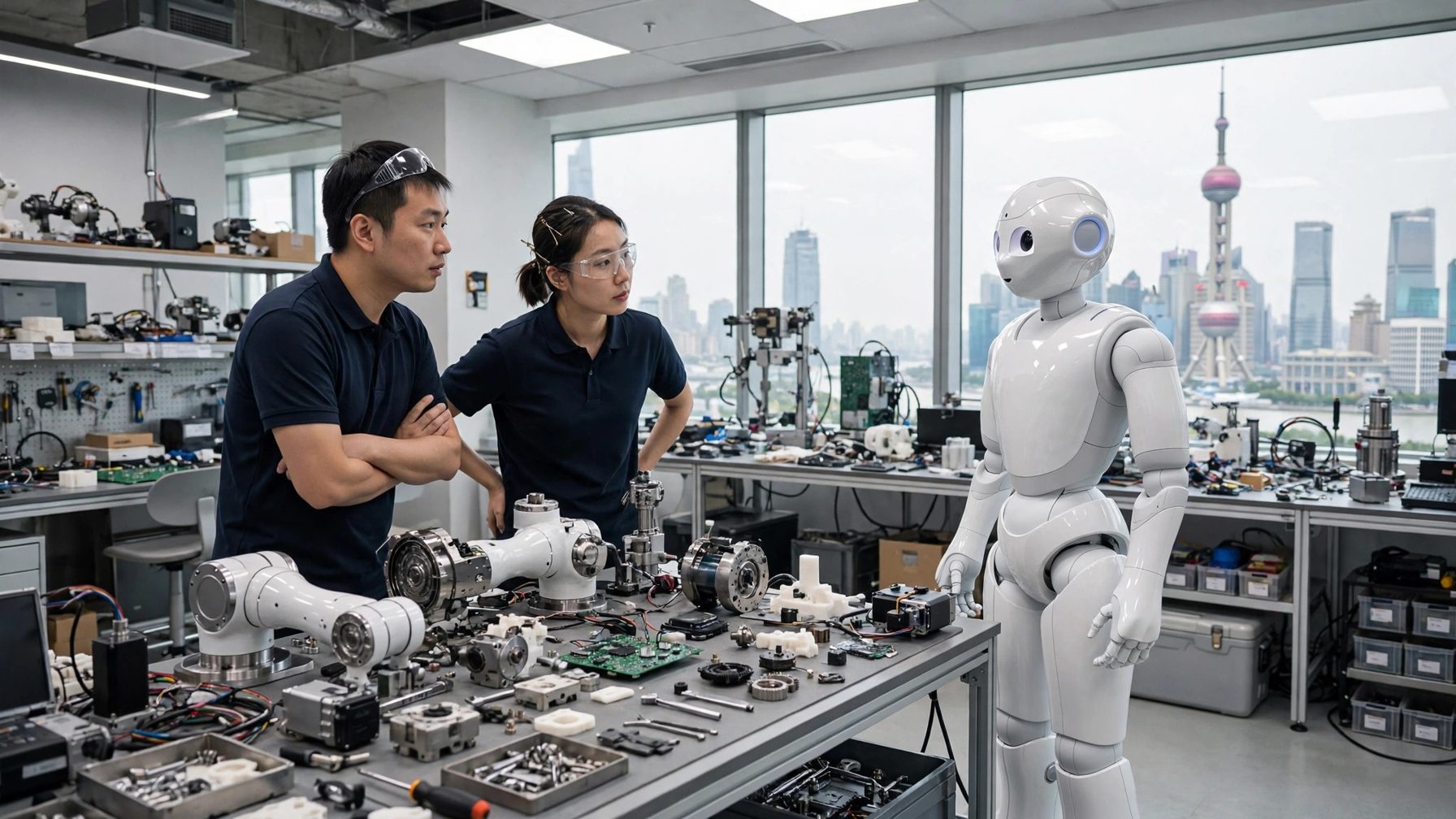
Gamma Robotics was registered and established in Xuhui District, Shanghai, on October 21, 2026, and moved into the Model Speed Space (Moshu Kongjian) innovation hub. According to reports that day by The Paper and Jiemian News, it is the first market-oriented venture spun out of China Telecom's Artificial Intelligence Institute (TeleAI) — the first time TeleAI has carved a line of business into a standalone company. The new company focuses on full-model innovation and applications for self-evolving humanoid robots, and will build a joint humanoid robotics laboratory with TeleAI to push the institute's research toward real industrial settings.
Why an institute spins out a separate company
An institute is good at models and papers, but getting humanoid robots into factories, industrial parks and care facilities requires product definition, supply chains, delivery and after-sales service — all of which need an entity that can sign contracts, raise financing and answer for market results. Gamma's capital structure reflects exactly that division of labor: it received a strategic investment from the China Telecom (Shanghai) AI Industry Private Equity Fund, jointly funded by China Telecom, Shanghai State-owned Capital Investment's Pioneer Fund, a central-SOE strategic emerging industries fund and Xuhui District's Shanghai Huizi — a classic central-SOE plus local state capital combination. On the people side, Li Xuelong, China Telecom Group CTO and TeleAI's president, serves as scientific adviser, while Bai Chenjia is founder and CEO.
What cards does a telecom carrier hold in robotics?
China Telecom's entry into embodied AI does not rest on robot hardware experience, but on three other assets: a nationwide network with edge computing capacity, long-standing enterprise and government customer channels, and delivery teams that package new technology into industry solutions. What the humanoid industry lacks most right now is not yet another hardware maker, but an entry point that can place robots into real settings and stand behind how they run. That said, the caveat belongs up front: as of its founding day, Gamma had announced no product, no specifications and no timeline, and what exactly "self-evolving full-model" means, or when the laboratory's first results will appear, remains unanswered. The founding is worth recording because it marks a carrier moving from selling networks and compute to the robotics industry toward building a robot company itself; how far it gets will be judged when its first product or first deployment order shows up.