Dream-1, a robot foundation model from Dream Labs, was officially released on October 19, 2026: the company, emerging from stealth the same day, announced a $90 million seed round and launched the Dream API, so any bimanual robot with grippers can start working from a camera feed and a plain-language instruction, even if the model has never seen that machine before.
What exactly is being sold
Dream Labs was founded in 2026 by former leaders of NVIDIA's GR00T robotics research, including Joel Jang and You Liang Tan, and is headquartered in San Francisco. The round was led by B Capital and Kindred Ventures, with A.Capital, Unusual Ventures, SV Angel, Wing VC, Scribble VC and Adrian Aoun among the participants. The offer is direct: developers connect a robot, Dream-1 turns visual input and text instructions into motor commands in the cloud at $3 per hour for the full version; unsupported hardware or new tasks can go through a fine-tuning service that returns a tailored model within hours; and anyone without a robot can open the Robot Playground and direct a real machine in the company's San Francisco office from a browser, live and unedited.
Why learning from human video transfers to a new machine
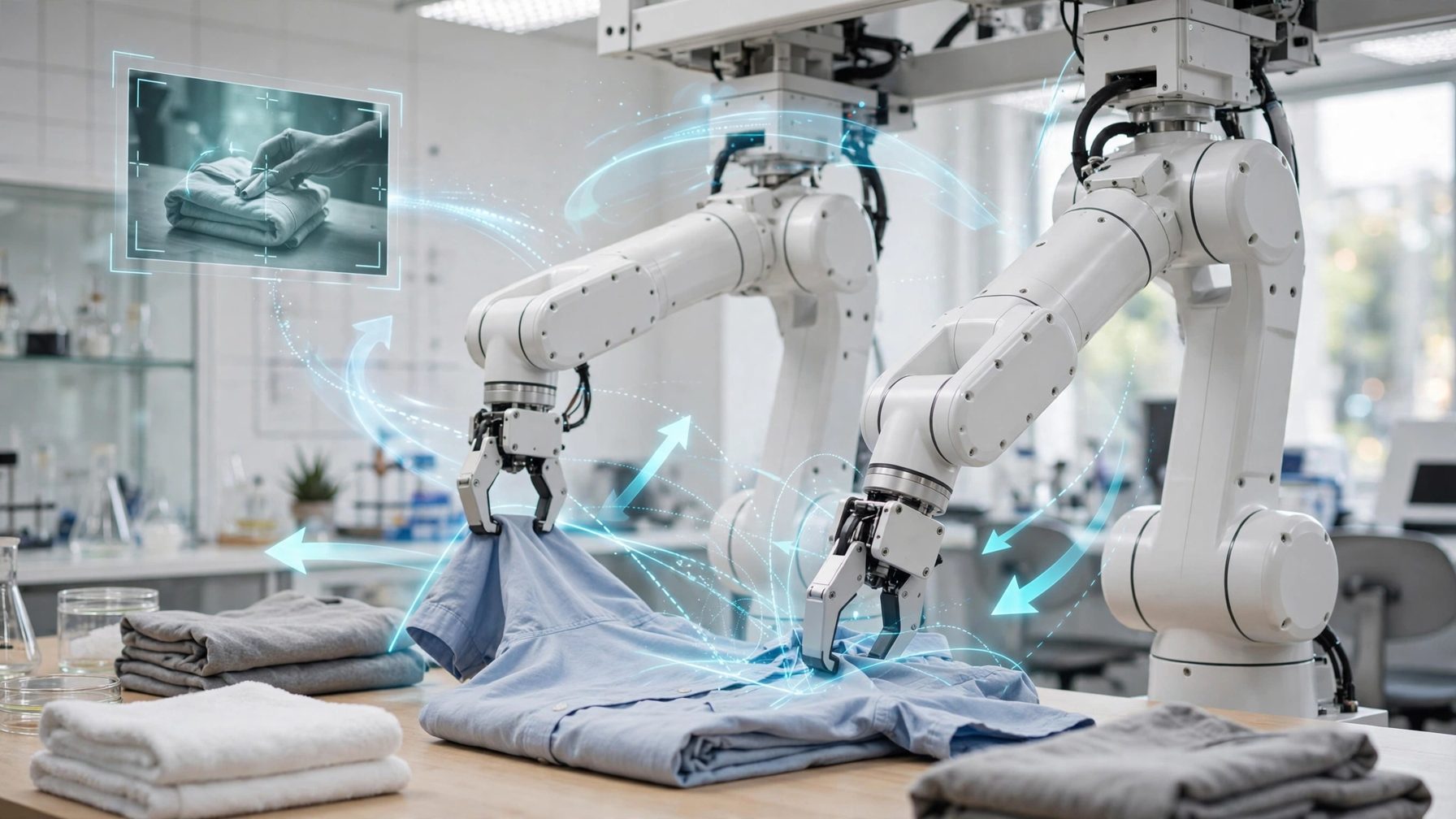
The traditional route trains a separate policy per robot, and new hardware means starting over. Dream-1 reframes skill learning as video prediction: it watches large amounts of first-person human video, learns what should happen next, then works out which robot action would make that happen. Because it learns the task rather than one machine's joint parameters, the skill carries across hardware. Today it reliably handles tabletop work such as picking, placing and folding laundry, on robots costing roughly $2,000 to $10,000; more than 20 hardware partners are tuning it per machine, with wheeled mobile robots and more dexterous hands on the roadmap. This outsourced general-purpose brain contrasts with the single-model benchmark route of the ACE-Brain-0.6 embodied model covered earlier on this site.
The boundaries, stated plainly
A dose of caution: Dream-1 is still a research beta, the company concedes it will make mistakes, and it has not been validated for safety-critical use; the minutes-to-start promise also assumes a bimanual robot with parallel grippers, and anything outside that envelope waits for fine-tuning or later versions. A $90 million seed round is large for robotics, but the company says the money mostly buys compute — the video route saves on robot data and moves the bill to GPU training and inference instead. Whether it works comes down to whether cross-hardware success rates stay high enough for customers to pay, and whether $3 an hour covers cloud inference costs. For hardware makers the maths is simpler: building a general policy in-house means funding a whole team, while renting a ready-made brain by the hour at least allows cheap experiments, which is why makers of $2,000 bimanual arms such as MakerMods are willing to endorse it.