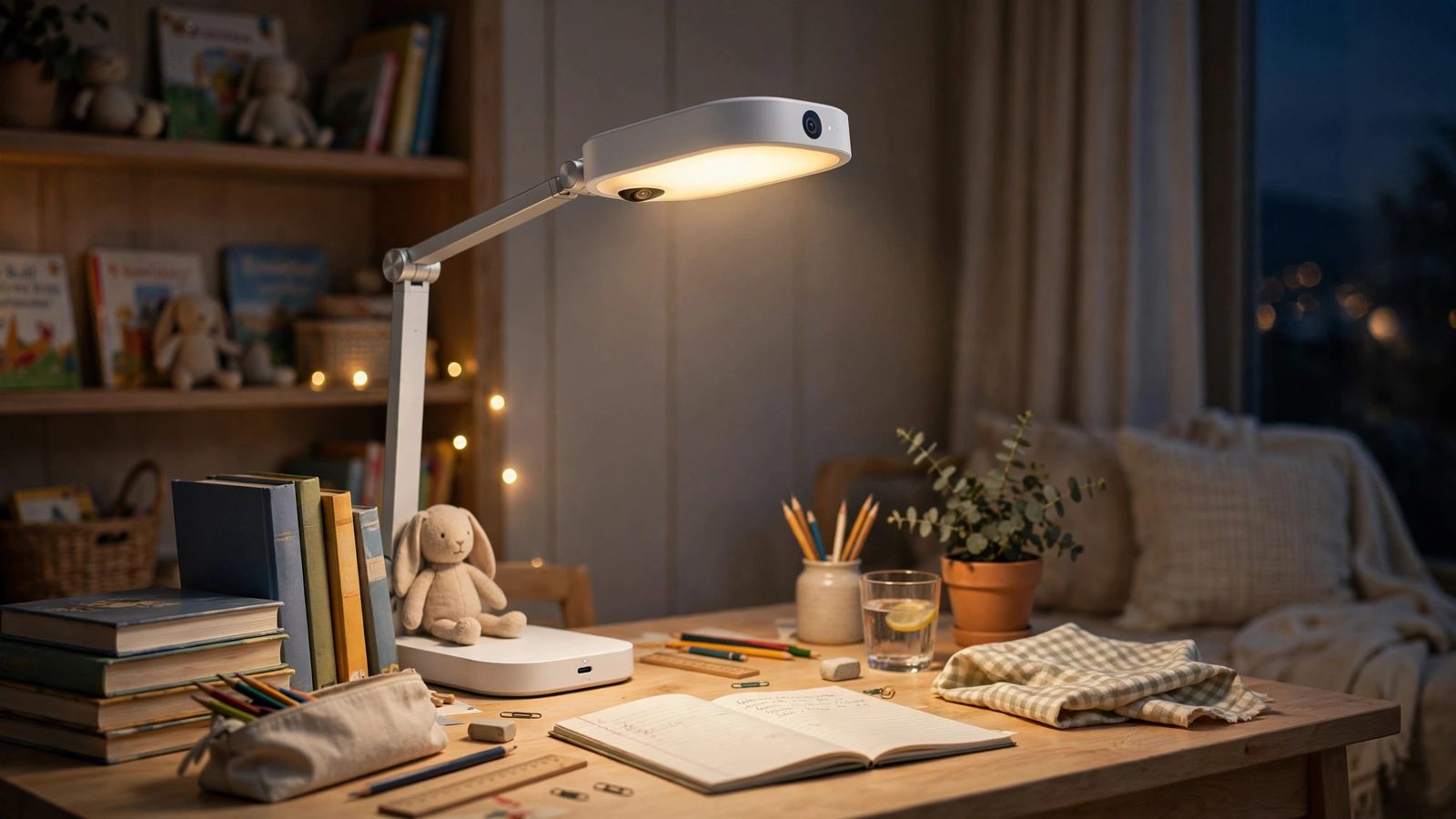
Whether an AI eye-care desk lamp is worth buying depends on whether you are paying for the light or for the camera: auto-dimming and presence sensing genuinely save effort, but the loudest advertised features, posture reminders and focus scoring, have limited accuracy in practice, and the premium charged for them is the money most easily wasted.
Only three real selling points
First, the light itself: illumination uniformity, colour temperature, colour rendering and flicker control decide whether a lamp is easy on the eyes, and none of that has anything to do with AI; check optical specifications and test reports. Second, auto-dimming: an ambient sensor adjusts output to the desk's brightness, so nobody fiddles with controls at dusk or on cloudy afternoons, a real convenience when a child does homework alone. Third, lights that switch on when someone sits down and off after they leave save parents the daily open-and-close nagging.
The usage threshold is higher than it looks
Camera models need Wi-Fi and an app, and posture alerts judge the distance and angle between head and desk: leaning in or tilting the head to think can trigger them, and after enough false alarms the child gets annoyed and parents end up disabling the feature. The tone of the alerts and a camera permanently facing the desk are also things to agree on with the child first. And its effective pool of light covers only a small patch: on a desk wider than 1.2 metres, or shared by two children, the edges are noticeably underlit.
Where it is not worth it
The optical quality a good ordinary lamp delivers for two or three hundred yuan is sold here at over a thousand, with the entire markup sitting in the smart features. Focus-duration statistics and posture reports are fine to glance at, but they cannot tell you whether a child actually learned anything. Some models also lock advanced features behind subscriptions or their own app, so switching brands means buying a new ecosystem.
It fits households where desk light changes a lot, a child studies alone for long stretches, and parents truly do not want to supervise switching and dimming every day. It does not fit homes whose overall lighting is already good, children who clearly object to a camera, or anyone hoping to fix posture with it: posture is solved by desk and chair height, not by a lamp's reminders.