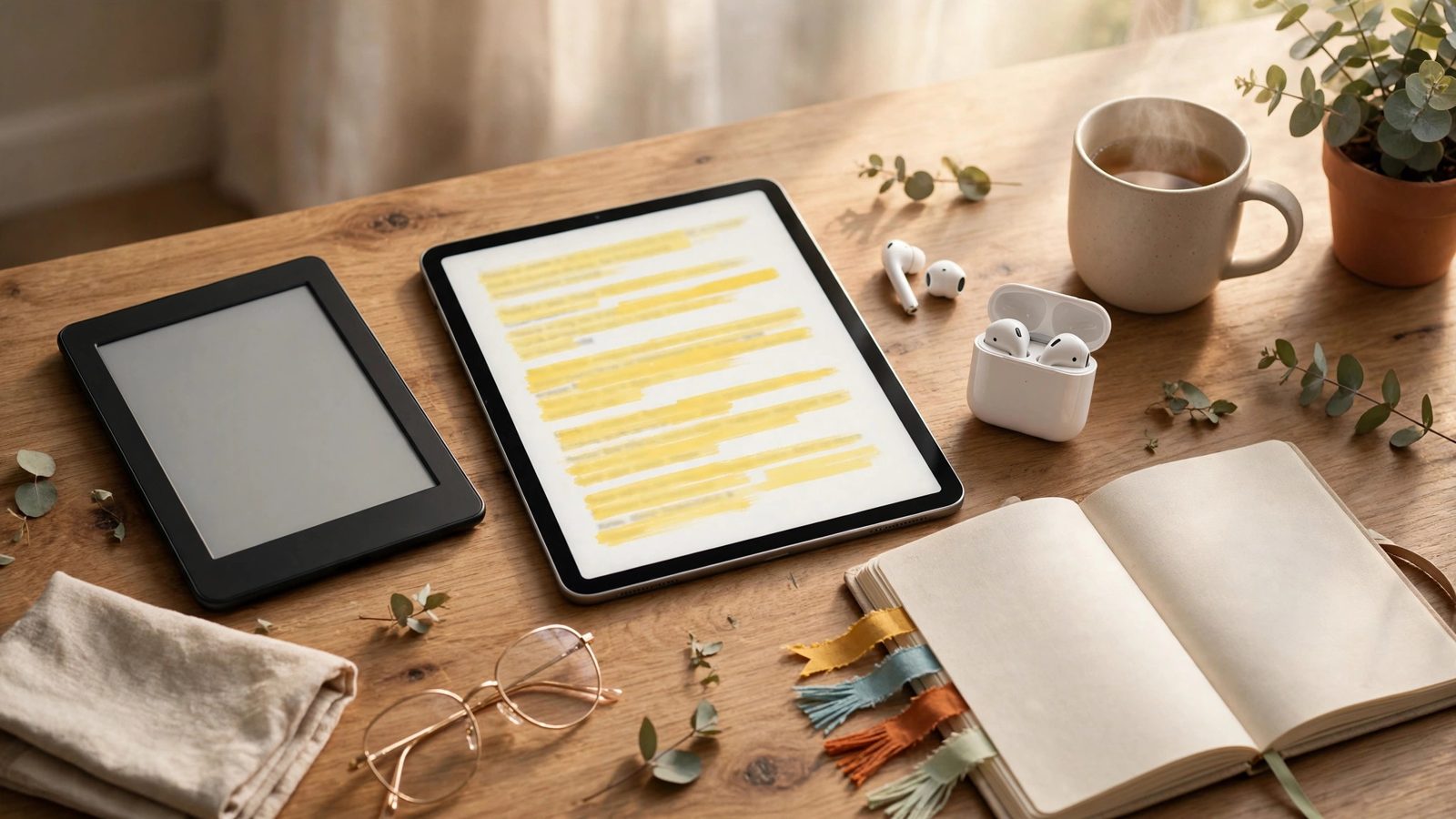
How to choose an AI reading tool starts with a question most comparisons skip: what form does your reading take? Is it long articles and PDFs sitting in your bookmarks, podcasts and audiobooks on your commute, or a pile of sources you simply want to interrogate? The form decides the tool. Picking wrong does not give you a mediocre tool — it gives you one you will never open.
Split by what you actually read
| What you mainly read | Start with | Its strongest point |
|---|---|---|
| Web articles, PDFs, ebooks | Readwise Reader | Saving, highlighting and review in one flow |
| Podcasts and audiobooks | Snipd | Transcripts, clips, turning listening into notes |
| A batch of sources to question | NotebookLM | Answers grounded only in your sources |
Readwise Reader: for people who hoard long reads and actually return to them
Its core is not summarisation; it gathers scattered reading into one place. Web pages, PDFs, ebooks and feeds can all be saved, highlights are collected automatically and resurface on a spaced schedule, and the built-in AI assistant can summarise, explain and answer questions about the article in front of you. Who it is not for: people who mainly learn by listening will find no home turf here; people whose highlights live on paper pages lose the sync chain and much of the value; and it is a yearly subscription, so anyone who reads two long pieces a month is fine with a free read-later tool.
Snipd: for people whose ears are busier than their eyes
Snipd is built for podcasts and audiobooks: automatic transcripts, chapters and summaries, and one-tap clipping of the exact segment you want to keep, exportable to note apps. Who it is not for: people who mainly read long documents, papers and ebooks get nothing from its transcription strengths; and heavy listeners of niche non-English podcasts should trial it for a week first, because transcript and summary coverage varies a lot by show — do not pay for a year before checking your own feed.
NotebookLM: for people holding a pile of sources who just want answers
It works by fencing in the sources first — one book, a set of papers, a batch of documents — and then answering only from within that fence, with the option to turn the material into an audio overview. Who it is not for: anyone wanting a long-term highlight library spanning many books, since it is organised by project, not as a bookshelf; and anyone needing precise page citations for academic writing still has to verify every generated claim against the original text rather than submitting it as a quotation.
The buying order is simple: count what you actually finished last month across long reads, audio and source piles, equip the biggest category with one tool, use it for a full month, and only then consider a second. People who subscribe to two or three at once usually owe review debt in all of them — the real cost of a reading tool was never the subscription fee, it is whether you ever go back.