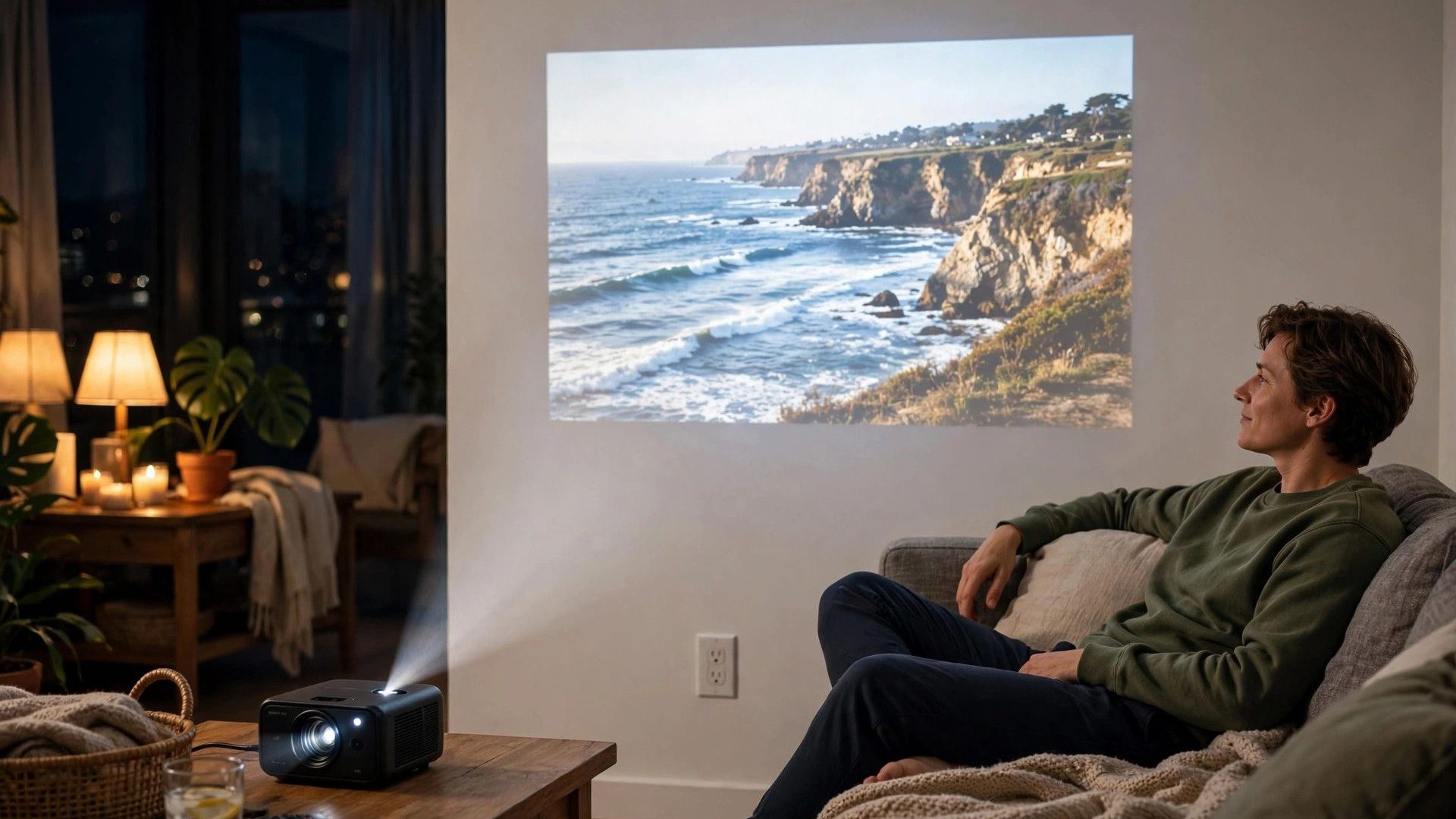
Whether a smart projector is worth buying starts with your wall and your room's light. What it does best is removing setup work: it focuses itself on start-up and squares the picture, so moving it no longer costs half an hour of fiddling. What it cannot compensate for is brightness — if the room's light cannot be tamed, no clever correction will project a vivid image. Judge those two things separately and the buying decision mostly makes itself.
The genuine selling point: no repeated setup
Models with a sensing camera can auto-focus and auto-correct keystone, pulling the picture into a proper rectangle even from a bedside table at an angle. More advanced ones avoid obstacles, steering around wall switches, sockets and picture frames, and align the image to a screen's edges. For renters, bedroom viewers and anyone who moves the device often, this is a real experiential difference: from power-on to watching takes seconds, and the voice assistant on the remote finds films faster than menu-diving.
Brightness: check the standard, then the room
The easiest trap on a spec sheet is the brightness unit. Trust figures in ANSI lumens or China's CVIA lumens, which follow unified measurement methods; numbers given only as light-source or LED lumens are often inflated by a wide margin and cannot be compared across brands. As a rule of thumb, a bedroom with the lights off at night is comfortable at moderate brightness; for daytime living-room viewing behind ordinary curtains, you need substantially more, or the picture washes out to grey — a point sales support will not volunteer. Also note that keystone correction at steep side angles crops part of the picture and reduces effective sharpness; it solves watchability, but a fixed long-term setup should still face the wall squarely.
Thresholds you only learn by living with it
Fan noise appears on no spec sheet: with the unit near the sofa or bedhead, a constant fan hum during quiet night scenes is more noticeable than a TV's. The built-in speakers are fine for dialogue; expect little movie bass, and plan on a soundbar or headphones for serious watching. Built-in systems vary widely in smoothness and app coverage between brands, and some stop keeping up with app updates after a couple of years — an external streaming box can outlive the built-in system. One easily forgotten point: auto-correction relies on a camera, and the voice assistant keeps a microphone on standby, so check whether these sensing features can be switched off and whether the indicator light is unambiguous if that matters to you.
Who it suits, and who it does not
It suits renters who cannot drill holes for a TV, people who watch in bed before sleep, anyone who likes projecting onto the ceiling while lying down, and households that move the device around. It does not suit families planning to replace a TV in a bright daytime living room — at the same budget, a television wins brightness and contrast without contest; latency-sensitive console gamers, since input lag is rarely this category's strength; or demanding film enthusiasts, because auto-correction and a portable body are bought with exactly the optical and cooling headroom they care about.
Before ordering, measure your room once
First, measure the throw distance and wall width: work out how large the image can be and whether sockets or switches block the wall. Second, at the time of day you plan to watch, draw the curtains and see how bright the room still is; if light is strong, put budget into brightness rather than flashy features. Third, confirm how far the placement spot sits from your seat; closer than two metres means you should scrutinise fan-noise reviews. If all three pass, a smart projector can become one of the most-used devices at home; if any one fails, hold off ordering.