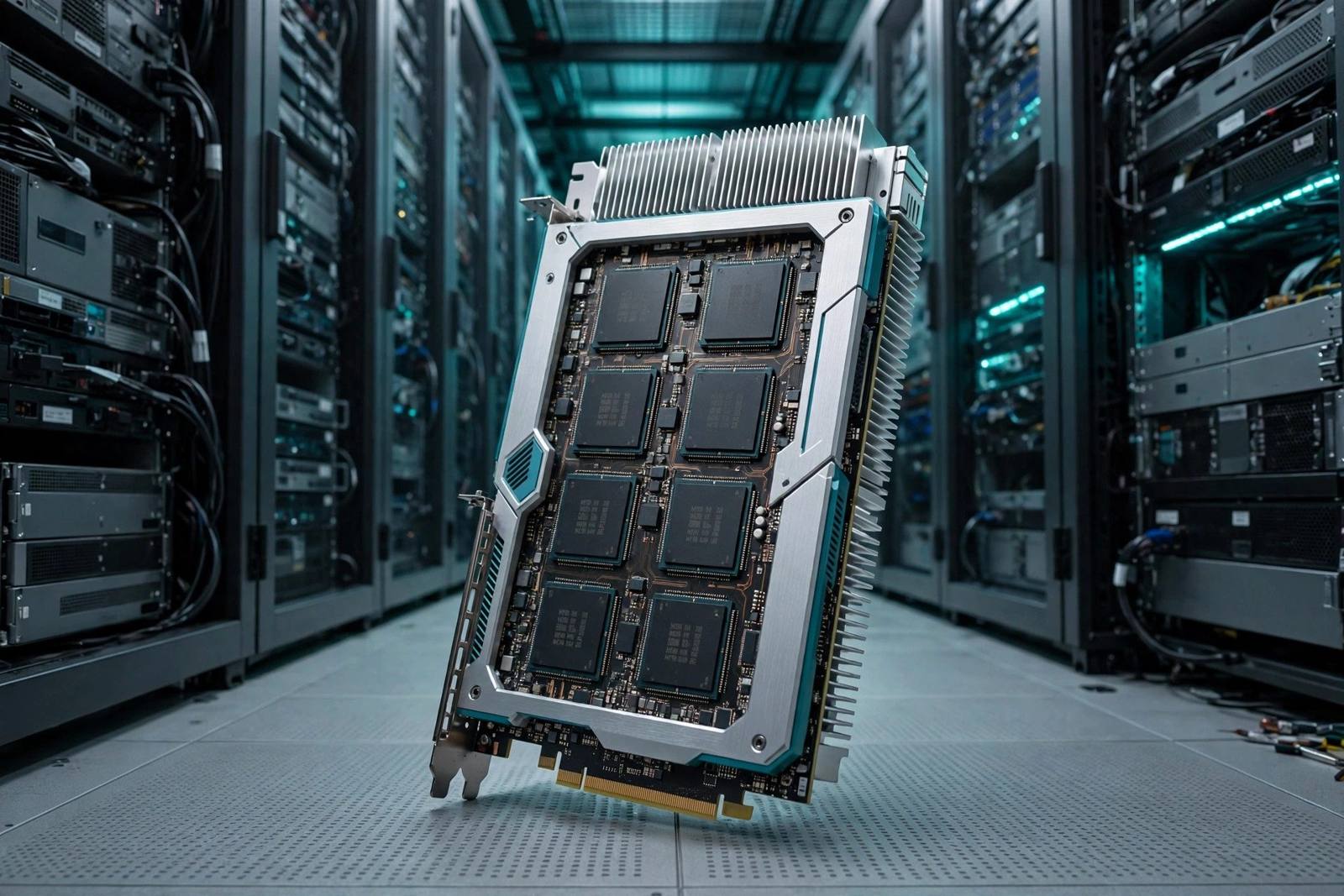
On October 12, 2026, the Intel GPU D270 was formally named and introduced at the Open Compute Project Global Summit. Previously known by the codename Crescent Island, this data-center card drops 3D graphics and ray-tracing hardware entirely and gives that silicon area to AI inference. Intel's own version carries 160GB of LPDDR5X memory, while partner-built versions can go up to 480GB.
The pitch is capacity, not compute
The D270 is built on the Xe3P architecture, with 32 Xe3P cores and 256 XMX matrix engines, delivering 1.3 petaflops of peak FP8 compute and 1.5TB/s of memory bandwidth. On those two figures alone, it sits well below the HBM flagship cards from Nvidia and AMD. Intel's bet lies elsewhere: LPDDR5X is cheaper and easier to source, so capacity can scale. Intel says a single card can host models of about 300 billion parameters, and an eight-card system can exceed one trillion, with room for the KV cache that keeps growing during long-context agentic inference. For inference providers, how large a model fits on one card often matters more to cost than any peak-compute ranking.
Air cooling and standard racks lower the entry barrier
The D270 is rated at 350W, uses air cooling and a standard PCIe 5.0 slot, and needs no liquid-cooling retrofit. That is the opposite direction from the kilowatt-class training clusters: the target customers are enterprises and neoclouds that want more inference capacity without rebuilding their facilities. At the same summit, Intel also showed rack-scale systems built around Xeon 6+ processors, packaging the CPU-side work of agent pipelines — token routing, retrieval and code execution — into the same pitch.
Sampling has begun; two key facts are still missing
Intel confirmed that D270 samples are already with server makers, cloud providers and software vendors, with Dell, HPE, Lenovo and Supermicro among the system partners, and vLLM and Hugging Face on the software side. Pricing and a general availability date, however, were not announced, and several outlets report broader supply only in 2027. Whether the card can hold its ground between Nvidia and AMD will be decided by real tokens-per-dollar figures, not launch-day capacity numbers. Until independent tests appear, the fair verdict is: a clear direction, with the evidence still to come.