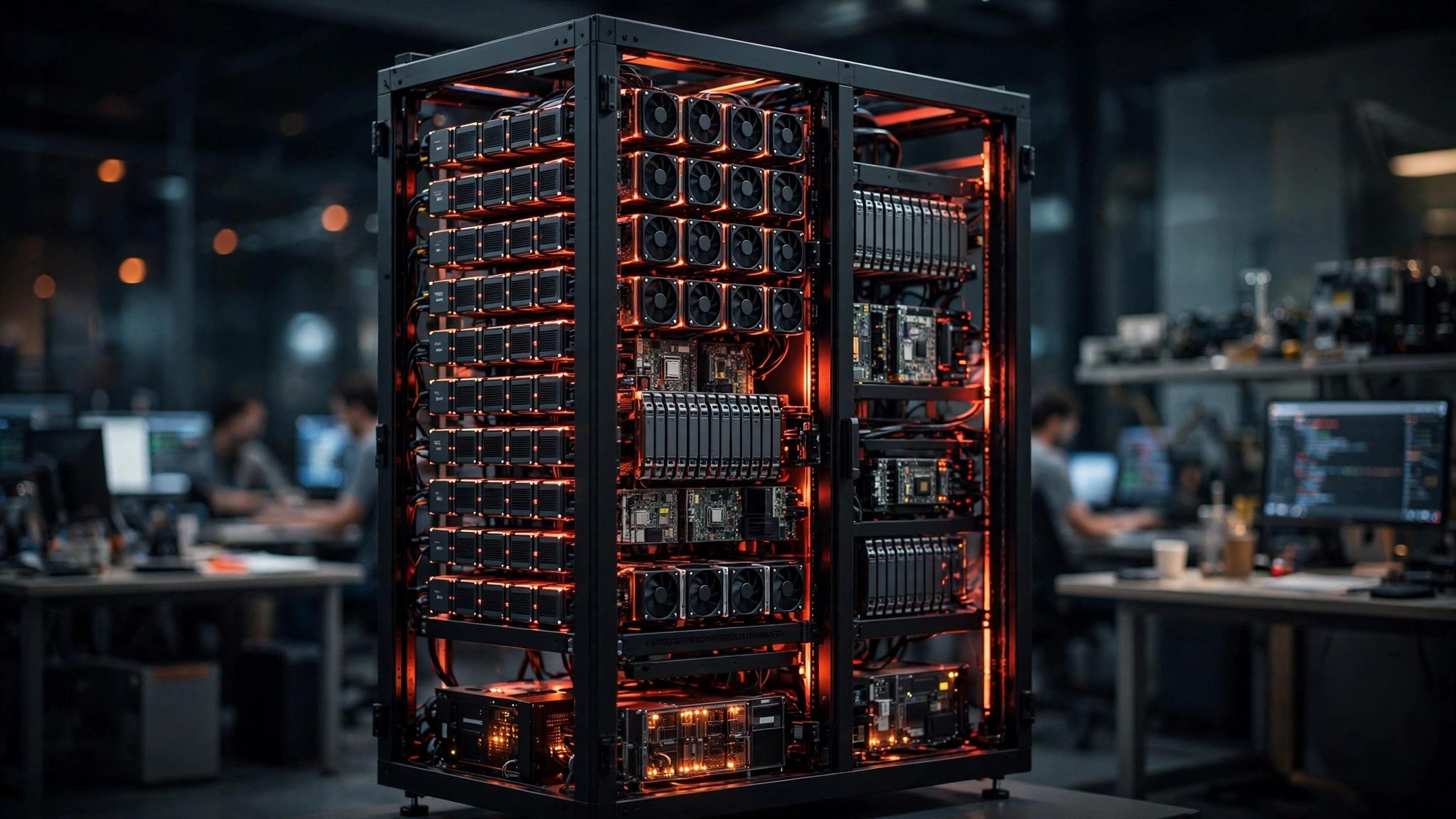
AMD Helion is an agentic AI rack design that AMD announced in an official press release on October 12, 2026. It is not a finished machine you can order today, but an open blueprint based on Open Compute Project (OCP) specifications: AMD supplies the reference design, and server makers and cloud providers build their own racks from it. That positioning frames the problem it addresses. The question is not how fast a single chip is, but how the shape of agent workloads is changing what a rack needs to look like.
Half of an agent's work never touches a GPU
When an agent runs, the flow is continuous: read context, call tools, execute code, check results, decide the next step. Only the model inference segment truly leans on GPUs; much of the orchestration, code execution and state management actually runs on CPUs. Dan McNamara, who leads AMD's compute and enterprise AI business, put it plainly in the release: agentic AI is not a single workload, and personal agents, enterprise applications, code execution and complex workflows each demand different compute. Feeding such work into GPU-only racks leaves expensive accelerators waiting for CPUs to hand them the next step. Helion instead splits execution and inference into separately sized parts, which is its biggest difference from GPU-centric rack designs such as Helios.
Two recipes for two kinds of buyer
| Configuration | What is inside | Who it suits |
|---|---|---|
| CPU-only rack | 6th Gen AMD EPYC processors, up to 32,768 CPU cores | Hyperscale customers dedicating capacity to agent execution, with inference on separate infrastructure |
| All-in-one rack | EPYC compute nodes plus Instinct MI350P GPU nodes and general-purpose compute | Enterprises that want execution and inference inside one rack |
Both recipes share the same open hardware and software base and come in air-cooled and liquid-cooled versions. One easily missed component is the integrated token router, which directs an agent's model calls across frontier and open-source models. Moving model choice into the rack layer means switching models becomes a routing decision rather than a redeployment project.
The blueprint is open; the machines arrive in November
AMD plans to contribute the Helion specification to OCP for community development. Cisco, Dell, Hon Hai, HPE, Lenovo, QCT, Supermicro and Wiwynn all voiced support in the release, and rack configurations are under development with ecosystem partners, planned for availability in November 2026. The limits deserve equal clarity: what exists today is a reference design and a partner list. The 32,768-core figure is the ceiling of the CPU-only configuration, not a starting point, and the token router's scheduling and metering details are not spelled out. The real story unfolds over the next few months. If an open blueprint lets many vendors build interchangeable racks, customers become less locked to a single supplier. If only AMD's own ecosystem ships it, Helion is a product-line expansion with a fresh name.