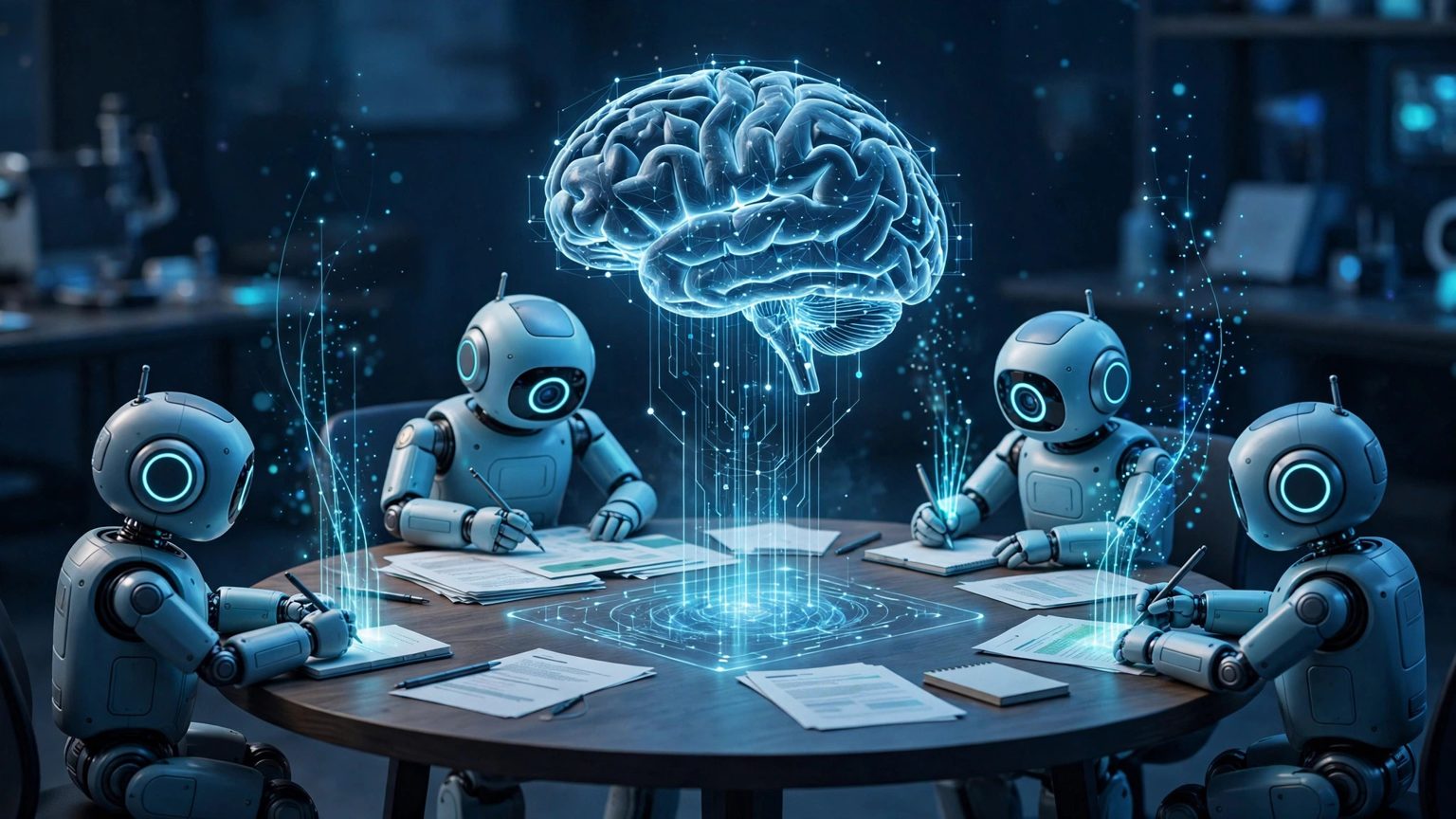
Sakana AI published MASS on October 11, 2026, a method developed with researchers at UC Berkeley that gives recursive self-improvement a new source of training material: instead of letting a single agent grope forward alone, the same model first works as a team, and the team's best experience is then distilled back into the model's weights. MASS stands for Multi-Agent Self-Supervision. The experiments use Qwen3.6-27B as the base model, running inside the qwen-code coding-agent environment.
Why a model would teach itself
Frontier tasks have an awkward property: the harder the work, the fewer people can judge whether it was done well. Code can be checked by tests, but the quality of a research report usually has no automatic scoring rule. MASS therefore adopts an extreme setup — executor, workflow optimizer and evaluator are one and the same model. It hands in the assignment, redesigns how the team splits the work, and grades its teammates' output. The question the authors set out to test is whether this same-body loop genuinely improves round after round when no stronger supervisor exists. It forms a neat contrast with the measured study in which multi-agent teams cost 5.1 times more with almost no quality gain: that study asked whether teaming up at runtime is worth it, while MASS asks whether team experience can settle into the model's own ability.
How the two loops turn
MASS runs in two layers. The inner loop optimizes the division of labor: an orchestrator splits a task among subagents, and the workflow spells out each role's responsibility, delivery contract and call order. The evaluator compares the workspaces produced by different workflows, keeps the current best, and the optimizer revises the split for the next attempt. The outer loop does the learning: the best workflow is run repeatedly, the highest self-rated execution trajectories are selected, and the shared model is fine-tuned with LoRA. The updated model then sits back down in all three seats for the next round. Training tasks come from a synthetic research suite spanning finance, robotics and pharmacy — 12 tasks in total, with 3 held out for testing and never trained on.
The scorecard after two rounds
- On the 3 held-out test tasks, the round-two model's win rate against the base model reached 69.9%, up from 53.9% after round one.
- Across MLR-Bench, DSBench, ScienceAgentBench and AstaBench, the round-two model's score per output token rose to 1.2–1.6 times the base model's level.
- The round-one model reached a 68.3% win rate using 28.8 million supervised tokens; the single-agent-trajectory control used 42 million tokens and reached 64.0%. Team trajectories carry a denser signal — the most concrete evidence MASS offers.
- The evaluator's agreement with external judges (GPT-5.5 and Claude Opus 4.8, kept entirely outside the loop) climbed from 73% to 93%.
The cold water, poured by the authors themselves
The scorecard has a clear other side. The same round-two model scored only 0.96 and 0.94 times the base model per token on Terminal-Bench 2.0 and SWE-bench Verified — in other words, the gains did not transfer to software-engineering tasks. The authors suggest the training mix lacked coding-engineering samples, but the deeper point is that self-improvement gains depend heavily on task distribution. The larger risk is spelled out in the paper's conclusion: when execution, optimization and evaluation share one pair of eyes, shared blind spots can be written into the next model generation as if they were progress, and they get harder to spot with every round. Ablations also show the loop's bottleneck is more often the optimizer than the evaluator — accurate feedback is useless if the workflow cannot be redesigned around it.
MASS has run only two rounds, far from any claim of a model that continuously evolves itself. But it turns a vague vision into a reproducible experiment: the value of team collaboration shows up at training time, not only at runtime, and it puts the risks of same-body judging on the table. What is worth watching next is whether the gains survive rounds three and four, and whether external checking mechanisms can keep up with the blind-spot problem.