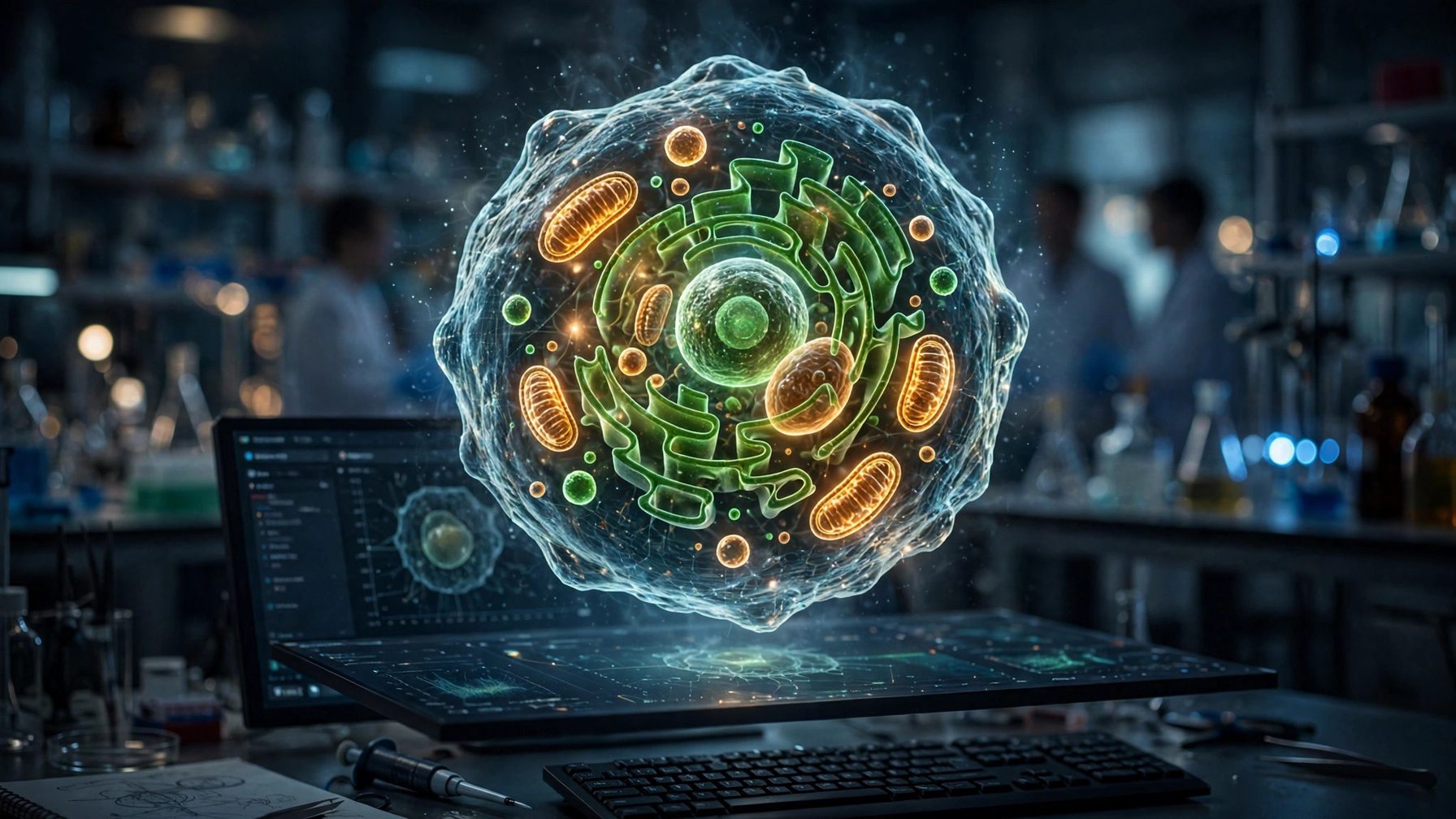
Biohub's virtual cell effort expanded again on October 7, 2026. Reuters reported that day that Google DeepMind, Meta, and drug-discovery company Isomorphic Labs are jointly investing $300 million. Together with more than $500 million from the U.S. Department of Energy over five years, data resources coordinated by the National Institutes of Health, and the $500 million Biohub itself committed in April, total investment in the effort reaches $1.8 billion.
What the money actually buys
The Virtual Biology Initiative is not trying to fix one weak model. Its premise is that the training data itself is nowhere near sufficient. The plan is to measure how cells respond to changes across far more conditions than scientists have studied so far, organize those measurements into open datasets for AI training, and use them to build predictive virtual cell models. Much of drug development still advances by trial and error on real cells and animals, in cycles measured in years. If a model can first screen out hopeless options in a digital environment, laboratory effort can concentrate on the most promising directions. That is the return this money is meant to buy.
Who pays, and who uses the data first
The funding structure sets the rhythm of openness. Biohub, the nonprofit founded by Mark Zuckerberg and Priscilla Chan, says the data will eventually become a public resource for researchers worldwide, but commercial funders receive an embargo period: a head start to work on the data before it opens up. On the public side, the Department of Energy funds laboratory measurement, modeling, and computation, while the NIH coordinates datasets and repositories built with more than $500 million in earlier federal funding and standardizes them for AI training. In short, public money buys the data foundation, and industry money buys a time advantage.
How far from helping patients
A note of caution: the virtual cell is still a direction, not a product. Cellular interactions are extraordinarily complex, and current data volumes fall orders of magnitude short of high-accuracy prediction, which is precisely why the plan spends first on data generation. Isomorphic Labs grew out of the DeepMind ecosystem and builds drug discovery on the protein structure prediction lineage of AlphaFold; its participation shows industry betting on the same logic, that predictable biological models must come before drug discovery can speed up as a whole. For general readers, the significance is not a new drug nearing market. It is that competition in AI-driven drug discovery is shifting from models to data infrastructure, and that layer is now being paid for jointly by governments, philanthropy, and tech companies.