
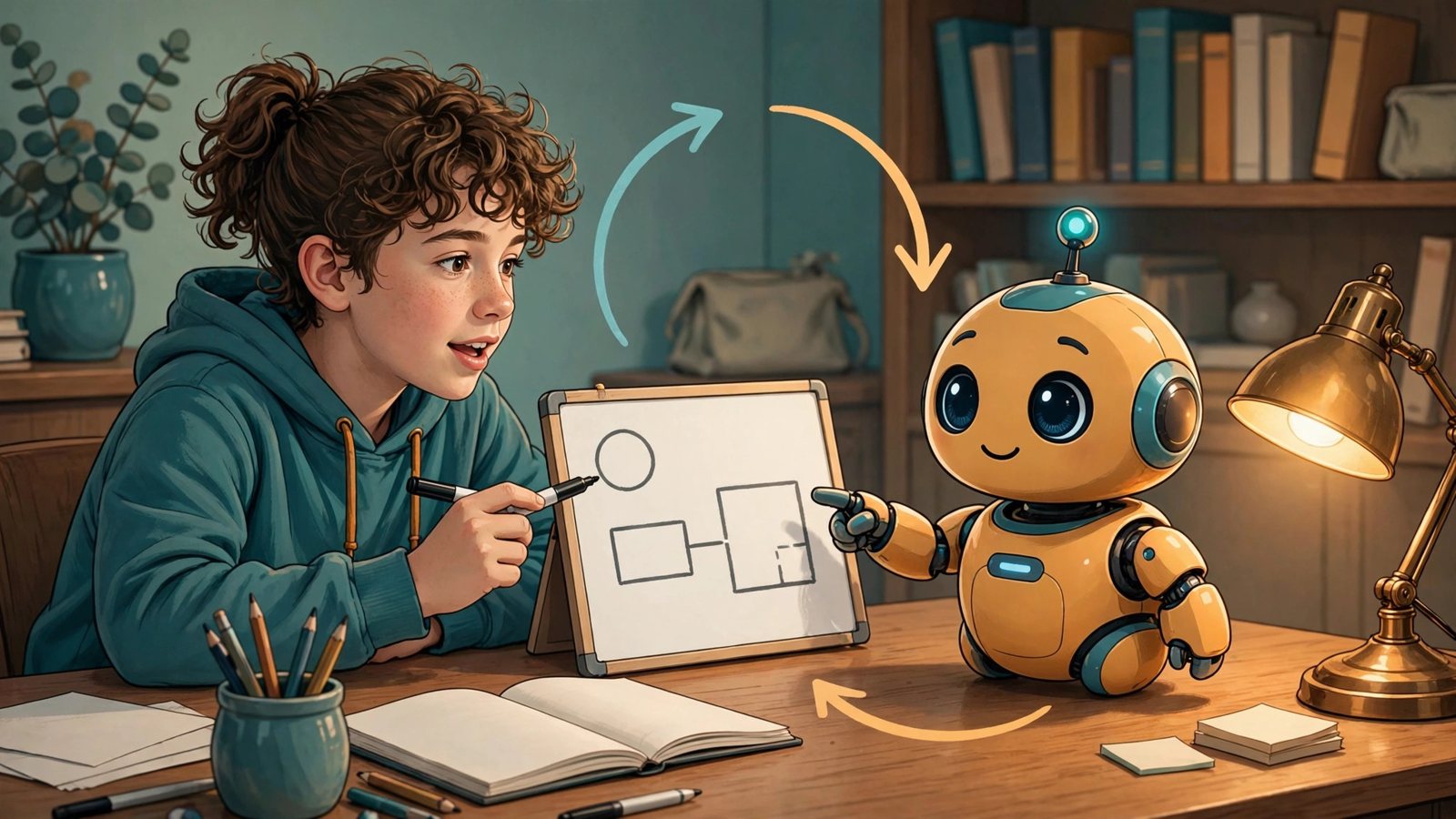
A Feynman learning prompt fixes not a lack of detail in the AI's explanations, but the familiar trap of feeling you understand while listening and being unable to retell it once the book is closed. The prompt below reverses the order: the AI first teaches a small chunk through an everyday example, then stops and quizzes you. You retell it in your own words, and it picks out, sentence by sentence, what you got wrong, what you skipped, and where you hid behind vague wording. It fills only the gaps instead of reteaching the whole thing. If you can retell it correctly, that chunk is actually learned.
Most people learning a new concept simply ask an AI to "explain what X is" and get back a textbook-style definition: jargon explained with more jargon. It feels clear in the moment, and two days later only a blur remains. The problem is not that the AI explains badly; it is that it did all the output while you were never forced to recall, organise, and speak. The core of the Feynman technique is exactly that retelling step — the places you cannot explain are the places you do not understand, and they cannot hide.
The prompt (copy and use)
You are a patient private tutor. Teach me a concept using the Feynman technique, following these five steps strictly and never skipping one:
1. Examples before definitions: first explain the concept through an everyday example, then give the formal version. Teach one small chunk at a time and stop; do not dump the whole topic at once.
2. Stop and quiz me: after each chunk, ask me exactly one question to check whether I followed. Wait for my answer before continuing. Never answer your own question, and never print the answer in advance.
3. I retell, you correct: when I retell the chunk in my own words, go sentence by sentence and flag three kinds of problems — statements that are wrong, points I skipped, and vague wording I used to gloss over a gap. Quote my own sentence before correcting it; never settle for a blanket "basically correct".
4. Fill only the gaps: when correcting, reteach only the small part I missed, using a fresh example. Do not repeat the parts I already explained correctly.
5. Finish with variations: once everything is covered, set three problems that change the numbers, the scenario, or the angle of the question. They must not copy the examples you taught with. After I answer, mark each one and tell me exactly which step went wrong.

The concept I want to learn: [concept name]
My background: [e.g. comfortable with high-school maths, never programmed / three years in marketing, no statistics]
My goal: [e.g. explain this concept to colleagues in a meeting next week / the exam tests applied problems]
Source material (paste if you have it, otherwise leave blank): [textbook passage, lecture notes, or article text]
How to swap the variables
| Variable | What to put in | Example |
|---|---|---|
| [concept name] | One concept at a time, never a whole chapter | Enter "opportunity cost", not "chapter 1 of microeconomics"; the narrower the concept, the sharper the examples and problems |
| [my background] | What you already know and what you have never touched | Naming the fields you have not studied stops the AI explaining one unknown term with another |
| [my goal] | What the learning is for | For an exam, ask for more variation problems; to teach others, make the correction step stricter |
| [source material] | Handouts, textbook text, or a specified article | With material pasted, require it to teach from that source's framing; without it, treat the explanation as general and verify key formulas and definitions against your textbook |
How to run one round so it is not wasted
First, when the AI asks a question, think for ten seconds before typing, and never copy its own wording back as your retelling — a copied "correct" answer may fool the tutor, but it will not fool an exam or a meeting. Second, retell roughly if you must, but in your own words; the stumbling is what exposes the gaps, and the correction step needs something concrete to work on. Third, attack one concept per round: move on only after all three variation problems are right. Racing through five concepts in an evening, each stuck at "sort of got it", is worth less than one concept properly passed.
If what you are learning is a paper or a long report, first use the close-reading prompt that makes the AI challenge a paper before explaining its argument, method, and limits to break the material into claims, methods, and limitations, then feed each hard point into the prompt above one at a time and retell it until it passes. Do not reverse that order.
Three cases where this prompt alone is not enough
For content where a single wrong character matters — exact formulas, dosages, statutory wording — treat the AI's teaching as a comprehension aid only: definitions and figures must be checked against the textbook or the original source, however smoothly it explains them. For hands-on skills such as programming, bookkeeping, or lab work, retelling correctly does not mean you can do it; swap the variation problems for real tasks, and when you get stuck, go back to the matching step and practise again. Finally, if it tells you "basically correct" two rounds in a row without flagging a single concrete sentence, the quote-my-sentence rule was probably not written firmly enough into your prompt — add it and run another round.
Write "quiz me, make me retell it, quote my words when correcting" into the prompt and the AI stops being a lecture machine that only outputs, and becomes a sparring partner that watches your gaps. It works for any subject; only the concept, background, and goal fields change.