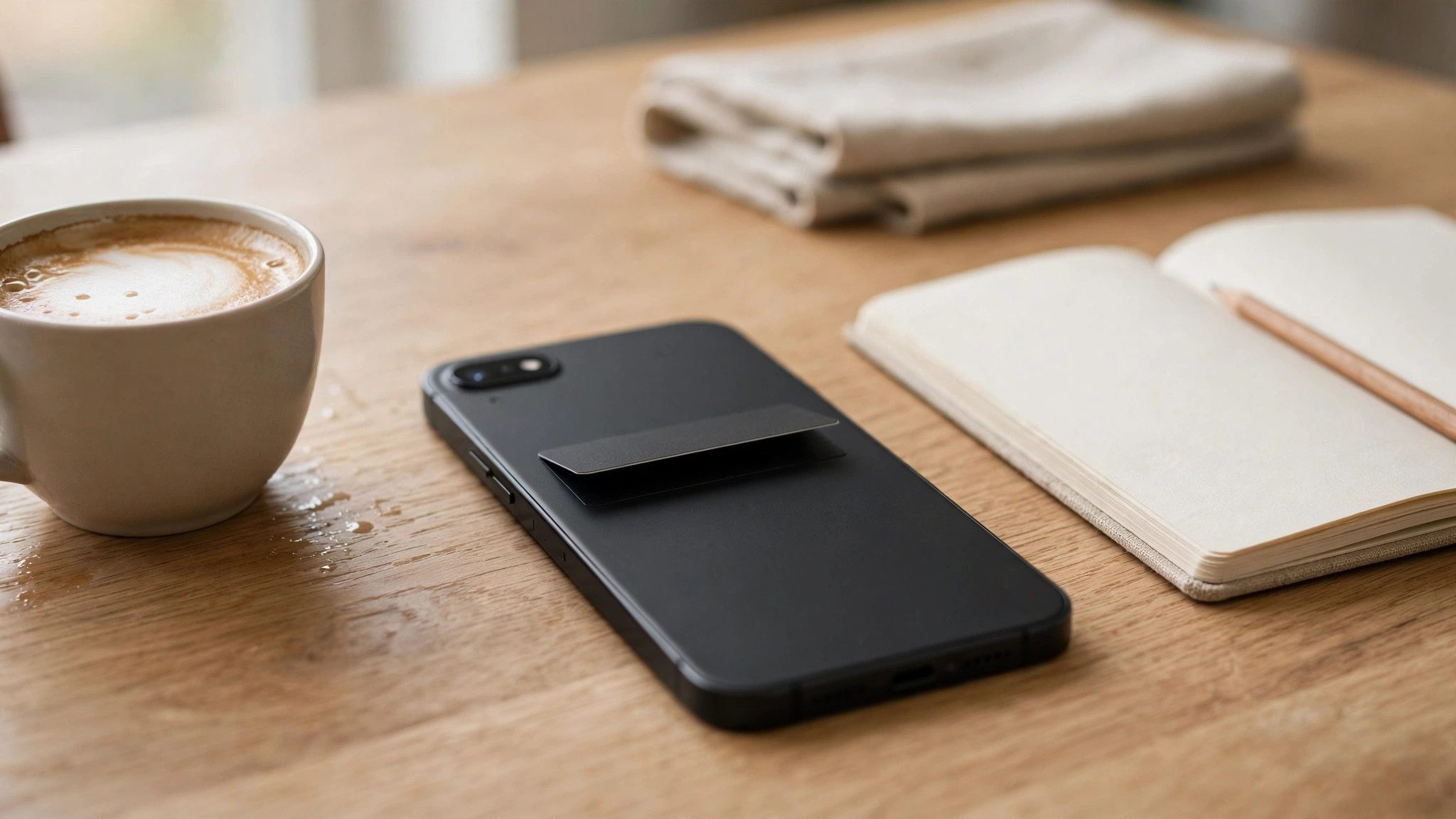
AI voice recorder cards are worth buying for some people and not for others: if you record meetings, interviews, or calls several times a week and always forget to carry a recorder, one can genuinely help you miss less; if you only record once or twice a month, or you have zero tolerance for recordings being uploaded to the cloud, it is not good value — do not let the lightness of sticking it on the back of your phone talk you into ordering one.
Its biggest appeal is not having to carry a separate device
Products in this category, represented by Plaud Note and TicNote, are made as thin cards about the size of a bank card. They stick to the back of your phone or slip into your phone case, so wherever your phone goes, the recorder goes too. Press once and recording starts — no unlocking, no hunting for an app, no checking whether it is actually recording. More distinctively, they can pick up call audio through vibration conduction from the phone body, covering both face-to-face conversations and phone calls, something ordinary phone recording often cannot do. Afterward, files sync automatically to the companion app, are transcribed into text, and can be turned into summaries and action items. For journalists, salespeople, and consultants, what you save is not the few minutes of recording, but the time later spent replaying audio and writing up notes.
You pay for the hardware once, but the AI features keep costing
Many buyers only look at the price of the card itself and overlook that the real long-term cost is the subscription. Transcription, summaries, and translation all run on the maker's service, and the free allowance is usually only enough for light trial use. Once your recording hours climb, you have to keep paying monthly or yearly. You are not buying a one-off recorder; you are buying a hardware-plus-service bundle, and the longer you use it, the more you pay. If you ever cancel the subscription, what is left is just a card that can record, with much of its core appeal gone. When you do the math, do not just ask what the card costs — ask whether you are willing to keep paying for transcription over the next year or two.
Whether you may record, and how clearly, is more complicated than it looks
Call recording is legally restricted in many places, and whether you need the other party's consent varies by jurisdiction. In work settings you should also check company policy first — do not assume recording is allowed just because the device makes it easy. Real-world results also depend on your phone: different models and different case thicknesses and fits affect how clearly sound travels through the body, and a case that is too thick or loosely attached can make call recordings sound muffled or drop words. On top of that, recordings and transcripts are processed through the maker's cloud, so content leaves your phone. That is fine for ordinary notes, but when customer information or sensitive meetings are involved, many companies do not allow personal devices like this at all, so the privacy cost has to be weighed before you buy.
Who gets their money's worth, and whose card will gather dust
It suits heavy recorders: people with regular weekly meetings, interviews, or client calls who also have to produce notes afterward, where the subscription fee is offset by the note-taking time saved. The people it does not suit are just as clear: if you already record comfortably with a voice recorder or meeting software, switching brings limited improvement; if you record only once or twice a month, you will not even use up the free allowance and the hardware cost will be hard to earn back; and if you have zero tolerance for recordings going to the cloud, a solution with local recording and local transcription fits better. An AI recorder card sells portability and effortlessness, not overwhelming audio quality — it is only worth it if you record often enough and your use cases are compliant.