Volantis's $88 million Series A was announced on October 1, 2026 by Volantis via PR Newswire, co-led by Lachy Groom and Abstract Ventures, with participation from John Doerr, VXI Capital, Triatomic and Susa Ventures, plus angel investors Dwarkesh Patel, Naveen Rao and Sholto Douglas, bringing total funding to $97 million. The San Francisco semiconductor startup has a concrete aim: connect compute chips to memory with photonic links, so memory capacity and bandwidth rise together instead of trading off against each other.
The memory wall is about moving data, not computing it
Large-model inference is often slow not because chips cannot compute, but because data cannot be fed in fast enough. Parameters and context must sit in memory and stream continuously into the compute units: on-chip SRAM offers high bandwidth but small capacity at high cost, HBM on GPUs offers more capacity while its bandwidth increasingly lags model growth, and newer options such as 3D DRAM stay on the same tradeoff curve. Volantis's first system, A-1, targets raising capacity and bandwidth together by nearly two orders of magnitude, designed to run models exceeding 20 trillion parameters at up to 10,000 tokens per second per user, while lowering cost per token.
Its optics are not the data center's optics
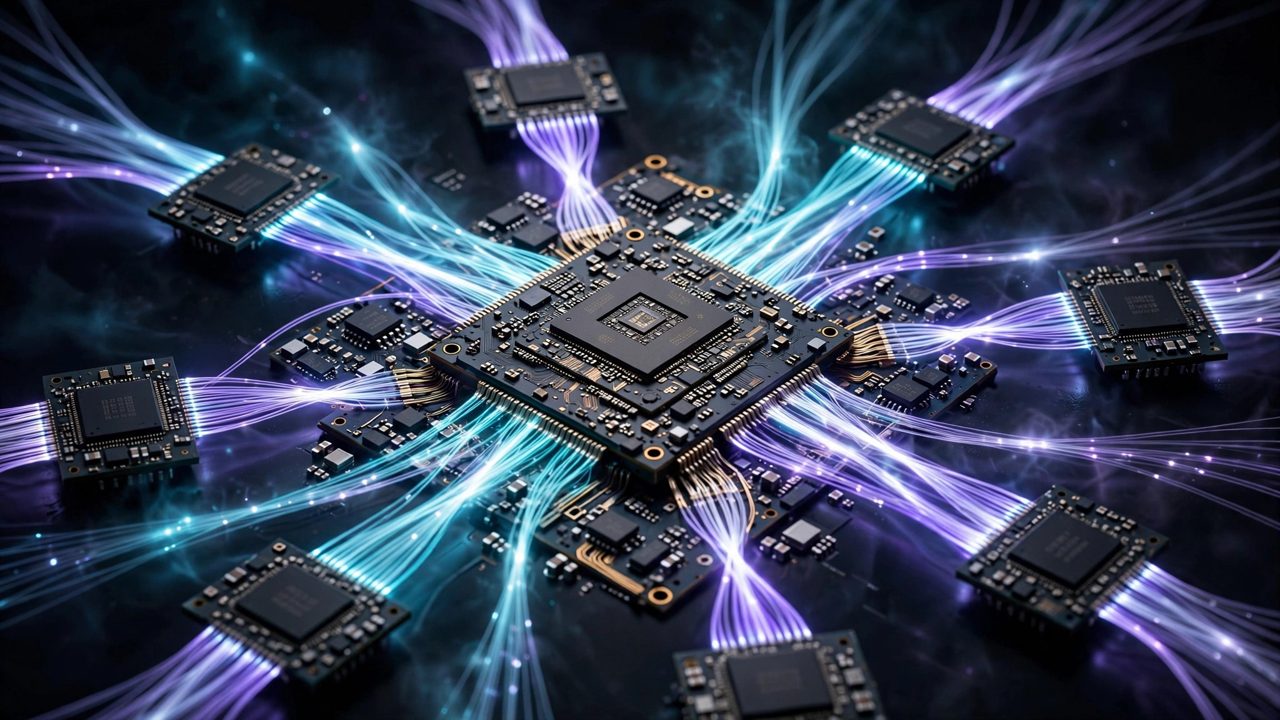
Photonics already moves data between chips in data centers, but chip-to-memory links are a different problem: far shorter distances, more than 100 times the data volume, and much tighter energy and cost limits. Volantis built a custom micro-VCSEL platform for this environment, drawing on the mature gallium arsenide VCSEL supply chain and avoiding indium phosphide constraints, with end-to-end links targeted below one picojoule per bit. Its optical fabric ties large numbers of memory chips into one unified pool whose bandwidth aggregates as memory is added, allowing cheaper off-chip memory. The founding team comes from NVIDIA, AMD, Broadcom and Ayar Labs, with work on the first CoWoS product and early silicon-photonics co-packaged systems.
Design targets, stated plainly
A dose of caution: 20 trillion parameters and 10,000 tokens per second are A-1 design targets, not measured results from delivered customer systems. First integrated inference engines are planned for delivery in 2027, and this round funds A-1 development and commercialization plus engineering hires. CEO Tapa Ghosh argues that as agents take on more work, how fast they finish it will set how fast companies operate, while today's hardware forces a choice between running the largest models and running them fast. Whether photonic memory delivers will be decided by 2027 silicon, packaging and customer validation, not by today's funding headline.