
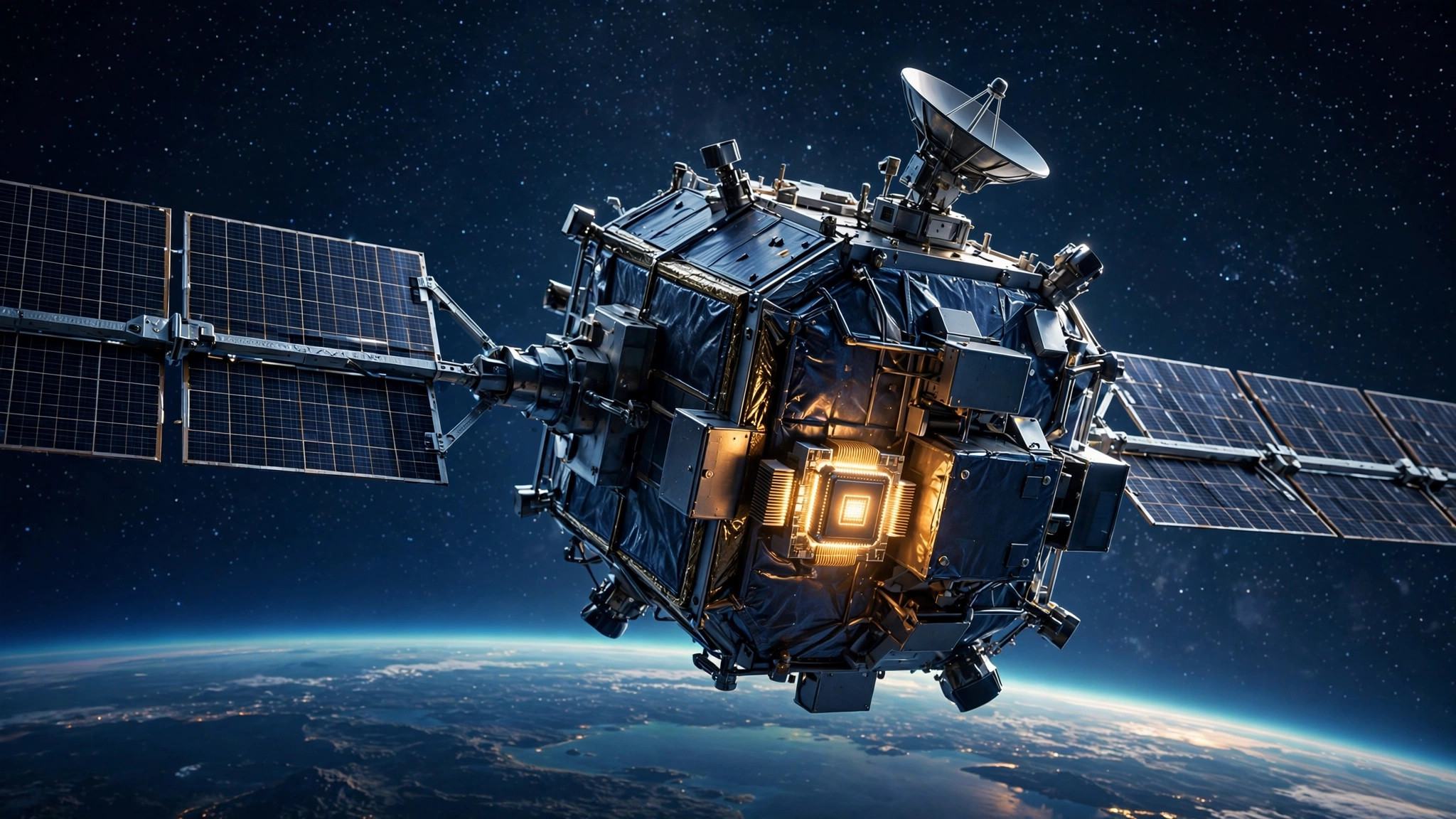
On September 24, 2026, Google announced on its official blog, The Keyword, that a prototype satellite carrying its homegrown TPU chips will launch next week aboard SpaceX's Transporter-18 rideshare mission, marking Project Suncatcher's first in-orbit test: whether TPU chips can run AI reliably in space. Satellite company Planet Labs is supporting the mission. It is the first step taking Google's "space-based AI compute" program from concept to reality.
The test aims to answer a very concrete question: can Google's Tensor Processing Units actually work reliably in space? Once in low Earth orbit, the team will evaluate whether the chips can survive the violent vibrations of launch, plus the omnipresent radiation and extreme temperatures of orbit. Until now, the TPUs had only run AI workloads in a ground facility at the University of California, Davis — real space-environment data is still a blank page.
Cooling is the most-watched engineering challenge of the mission. Space is a vacuum, so conventional air cooling simply does not work; Google designed a passive cooling solution combining heat pipes with radiators. Lab data previously disclosed by Google shows the Trillium-generation TPUs withstood radiation doses beyond what a five-year mission would expect, with no hard failures; the most sensitive part was the HBM memory subsystem, which began showing anomalies at lower doses — exactly the boundaries to be validated in orbit.
Why space? When Project Suncatcher was unveiled in November 2025, the logic was an energy equation: in a dawn-dusk sun-synchronous orbit, satellites bask in near-constant sunlight, with solar panels generating up to eight times more power than on Earth — and no heavy batteries needed. Google's vision is not one giant satellite, but a cluster of small satellites linked by laser connections, forming an orbital compute fabric. The plan calls for two more satellites in 2027 dedicated to validating high-speed inter-satellite laser links.
Google is not the only player. SpaceX and Starcloud are also pursuing orbital data centers with the same rationale: terrestrial data centers are being choked by power supply, so instead of waiting for grid expansion, go "sunbathe" in space. This race is not about whose model is stronger, but about who first moves "compute" — the means of production — beyond Earth's energy constraints.
A dose of cold water is warranted, too: Google itself stresses that the first mission's goal is to collect engineering data and identify failure points, not to demonstrate a commercial orbital data center. Launch costs, engineering complexity, and satellite manufacturing capacity are all real hurdles, and experts broadly agree commercialization is still years away. This launch is more of a pathfinder than a grand opening.
Ultimately, what this launch is testing is not a satellite but an equation: now that "do we have power" is replacing "do we have chips" as the real bottleneck of AI compute, Google's answer is to move compute to where energy is most abundant. Set a decade-scale goal, then approach it through a series of measurable small steps — the same moonshot methodology it used for self-driving cars and quantum computing. Ordinary readers shouldn't expect orbital compute next year, but "where to build compute" is becoming as important a question as "whose model is best."