
LangGraph is not a chat interface — it solves multi-step agent orchestration: tasks split into nodes, intermediate state persisted, long workflows that can pause, replay, and wait for human approval at key steps. Whether self-hosting is worth it depends on whether your agents need to run reliably for a long time. If you are just looking for a local chat entry point, you can close this article now.
The framework itself is free (MIT licensed), but running it in production means paying for a hosting platform, observability, and model calls.
Project Snapshot
The official repository is on GitHub, under the langchain-ai organization, project name langgraph, MIT licensed, with around 42,000 stars. It is the LangChain team's low-level orchestration framework, organizing multi-step tasks into traceable state graphs, with durable execution, human-in-the-loop, and recoverable long workflows as its selling points. One distinction matters: LangChain provides components like model calls and tool connections, while LangGraph adds state-machine-style scheduling.
What Problem It Solves
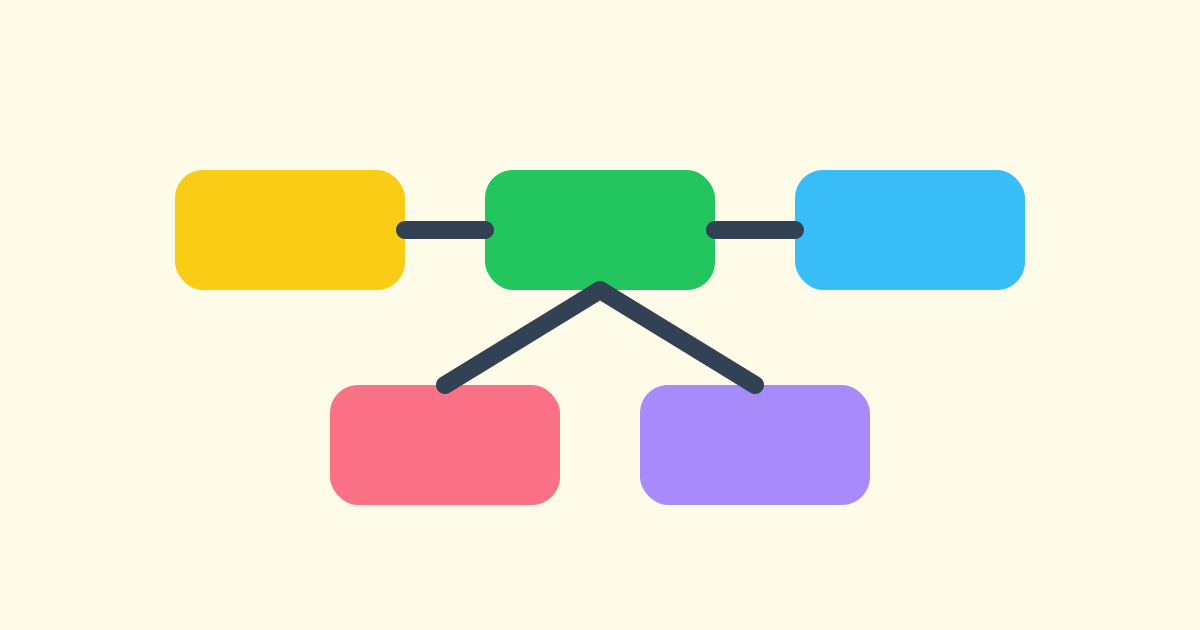
Ordinary agent frameworks are good at "one call, one answer," but real tasks often take a dozen steps: researching, waiting for human confirmation, surviving mid-run failures. LangGraph turns each step into a graph node with unified state storage: resume from checkpoints after failures, pause at key nodes for human sign-off, replay and audit the whole chain. That is the fundamental difference from chat interfaces — chat entry points like Open WebUI (/zh/article/1398-open-webui-zhi-de-bu-shu-ma-ta-bu-zhi-shi-ben-di-liao-tian-jie-mian-geng-xiang-y) solve "humans talking to models," while LangGraph solves "machines finishing multi-step work without breaking." If all you need is Q&A, LangGraph is over-engineering from day one.
Deployment Cost
The framework is MIT-licensed and free; running your own code on your own servers costs nothing. Spending comes in three tiers: the official managed platform is the easiest path, starting around $39 per seat per month plus usage-based billing, roughly $945 a month for a mid-size load of 50,000 runs; self-hosting on your own servers means a 4-core 8GB VPS at roughly $80 to $120 a month, trading platform fees for ops time (about 4 to 8 hours a month for a small team), with bigger volumes favoring self-hosting; the middle path is the official Self-Hosted Lite edition, free but node-capped and requiring a LangSmith API key, while production self-hosting needs an enterprise license — the platform server runtime is Elastic License 2.0, so read the license before signing. Do not forget observability: LangSmith's free tier covers 5,000 traces a month, Plus is $39 per seat per month.
Real Pitfalls
First, the learning curve is genuinely steep: state, graphs, and scheduling are a lot to absorb at once, graphs easily turn into spaghetti, and debugging often takes longer than writing code. Second, observability is tied to LangSmith by default — skip it and you wire up OpenTelemetry yourself; adopt it and you accept another bill. Third, "self-hosted" does not mean "zero lock-in": the platform server runtime is Elastic License 2.0, and production self-hosting requires an enterprise license. Fourth, free framework does not mean free operation: long workflows accumulate tokens step by step, and the model bill often outshines the platform fee.
Who It Fits, Who It Doesn't
Fits: development teams building long-running, auditable agents with human-in-the-loop; teams already in the LangChain ecosystem with real engineering capacity; compliance scenarios where data must stay in-house. Doesn't fit: anyone who just wants a local chat interface; simple one-shot Q&A; people who prefer drag-and-drop can start with the Flowise visual orchestration review (/zh/article/1450-flowise-shi-he-shui-ta-ba-agent-he-gong-zuo-liu-hua-chu-lai-hen-zhi-guan-dan-fu); solo developers with no ops capacity and small usage are better off on the managed platform.
Q: How do LangGraph and LangChain relate?
A: They come from the same team. LangChain provides components like model calls and tool connections; LangGraph adds state-machine-style orchestration. They can be used together or independently.
Q: Is self-hosting LangGraph completely free?
A: No. The framework is MIT-licensed and free, but you still pay for servers, observability, and model calls; production platform runtimes also require an enterprise license.
Q: How should an individual developer choose?
A: Get the prototype running locally first. Small volume and no ops capacity — use the official managed platform. Large volume, sensitive data, or existing server resources — consider self-hosting.