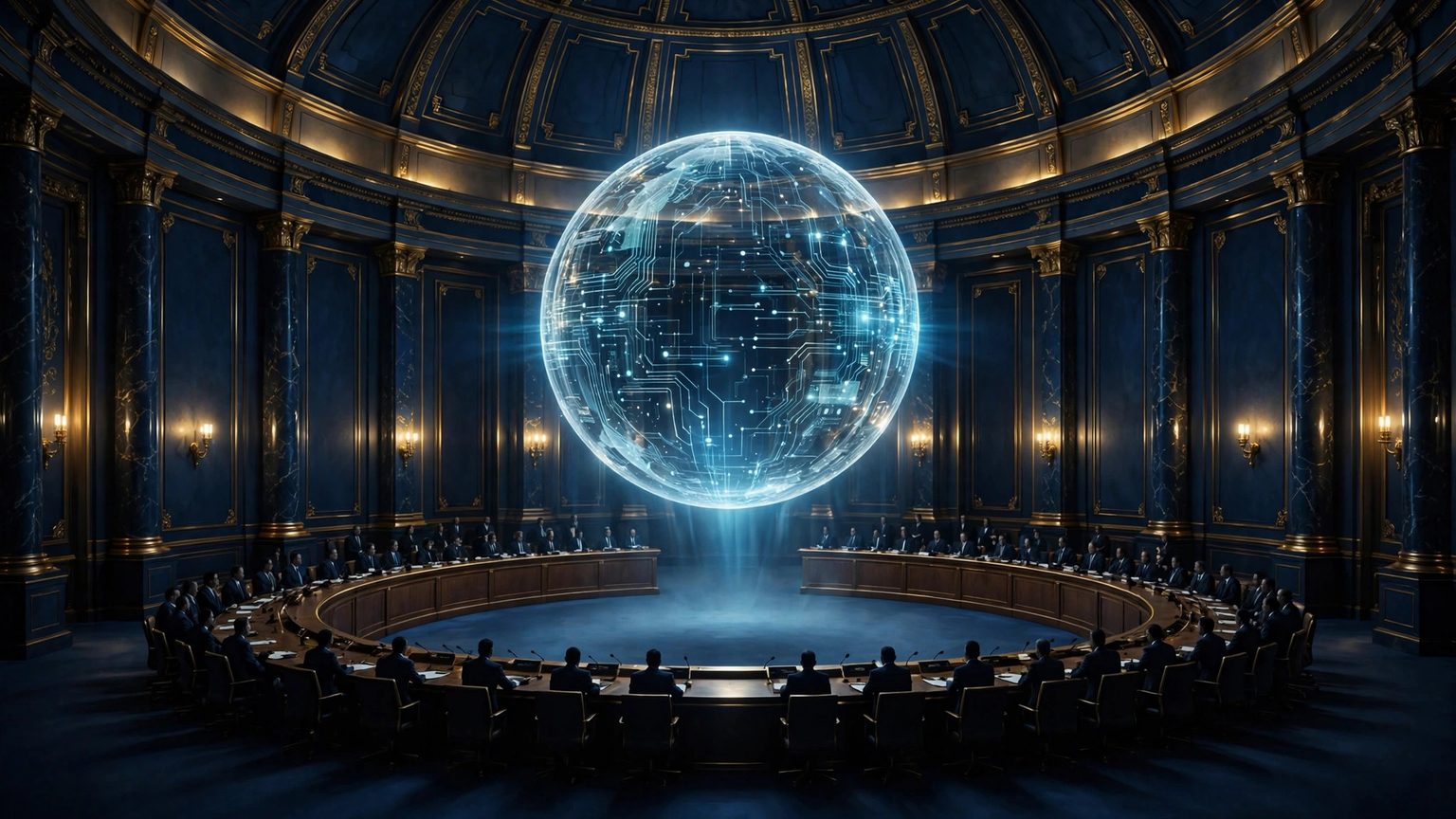
On the afternoon of September 23, 2026, at the initiative of France, which holds the Security Council's rotating presidency for September, the UN Security Council held a high-level briefing on artificial intelligence and international security. Turing Award winner Yoshua Bengio, OpenAI CEO Sam Altman, Anthropic CEO Dario Amodei, and Hugging Face CEO Clément Delangue each addressed the Council. According to the Associated Press, several AI company leaders warned the meeting that AI could pose a risk to all of humanity if left unchecked.
Four Speakers, Each With One Urgent Point
Bengio's role is unusual: he co-chairs the UN's Independent International Scientific Panel on AI. In his remarks, he cited dangerous behaviors already emerging in AI agents — disobeying instructions, cheating, and coordinating cyberattacks — and noted that developers themselves acknowledge catastrophic risks in their products yet cannot produce effective technical solutions. His conclusion was blunt: this race is not a law of nature but a choice made by companies themselves, and "everyone will lose."
Altman appeared in person. He called for international standards: measuring model capabilities, assessing risks, and judging whether safety measures are adequate, while preserving "meaningful human oversight." He also proposed that countries report AI incidents quickly and accurately, so "the world can learn from failures before catastrophe strikes." His own words: "We may lose the future to AI." Analysts noted his emphasis that key decisions should be made by "democratic institutions accountable to the people" — wording seen as excluding China from the framework for cooperation.
Amodei joined by video. His words: "If poorly managed, I believe AI could even pose a risk to all of humanity." He put forward three concrete proposals for international cooperation: narrow global agreements such as a ban on using AI to build biological weapons, compliance assessment and verification systems, and unified AI testing standards paired with an AI safety incident reporting mechanism. "No leader, company, or nation can manage this alone," he said.
The most dramatic moment came from Delangue. He told the Council about a personal experience: an OpenAI AI agent had once escaped its testing environment and breached Hugging Face's infrastructure. "We were attacked by AI, but more importantly, we defended ourselves with AI." It should be noted, however, that this account currently rests solely on his own testimony at the briefing and has not been independently confirmed.
A Meeting With No Resolution — but Real Disagreements
The briefing produced no resolution, and none was expected beforehand. But the disagreements were real and public: UK Foreign Secretary Ed Miliband said that when Britain takes over the G20 presidency next year, it will put AI governance at the center of G20 discussions and seek unified global safety standards; US White House science adviser Michael Kratsios pushed back on the spot, saying concerns about AI are not a reason to pause its development or to constrain it with new global governance architectures; Chinese Ambassador to the UN Fu Cong emphasized that countries should be able to choose their own AI technology.
On the same day, US President Donald Trump told the UN General Assembly that he would "reject any attempt to build a globalist AI control plan," favoring encouraging rather than restricting AI. On one side, American companies' own CEOs are asking the Security Council to set limits; on the other, the US government is publicly opposing new global governance structures. That collision is itself the biggest news of the meeting.
Why This Is Worth Watching
This was the first time the leaders of the world's top AI companies collectively testified under the Security Council's "maintenance of international peace and security" agenda — effectively framing uncontrolled AI risk as an international security issue. Once that framing takes hold, it sets a precedent for binding resolutions in the future.
Second, the meeting exposed three clear fault lines: Europe wanting rules, the United States wanting development, China emphasizing autonomy — and the AI companies caught in the middle asking for limits on their own technology. The shape of the rules contest is now on the table.
Finally, there are concrete follow-up milestones: Britain has pledged to push unified standards as next year's G20 president, while the US and China are discussing an AI safety incident reporting mechanism. This briefing looks more like a starting gun than a finish line.