
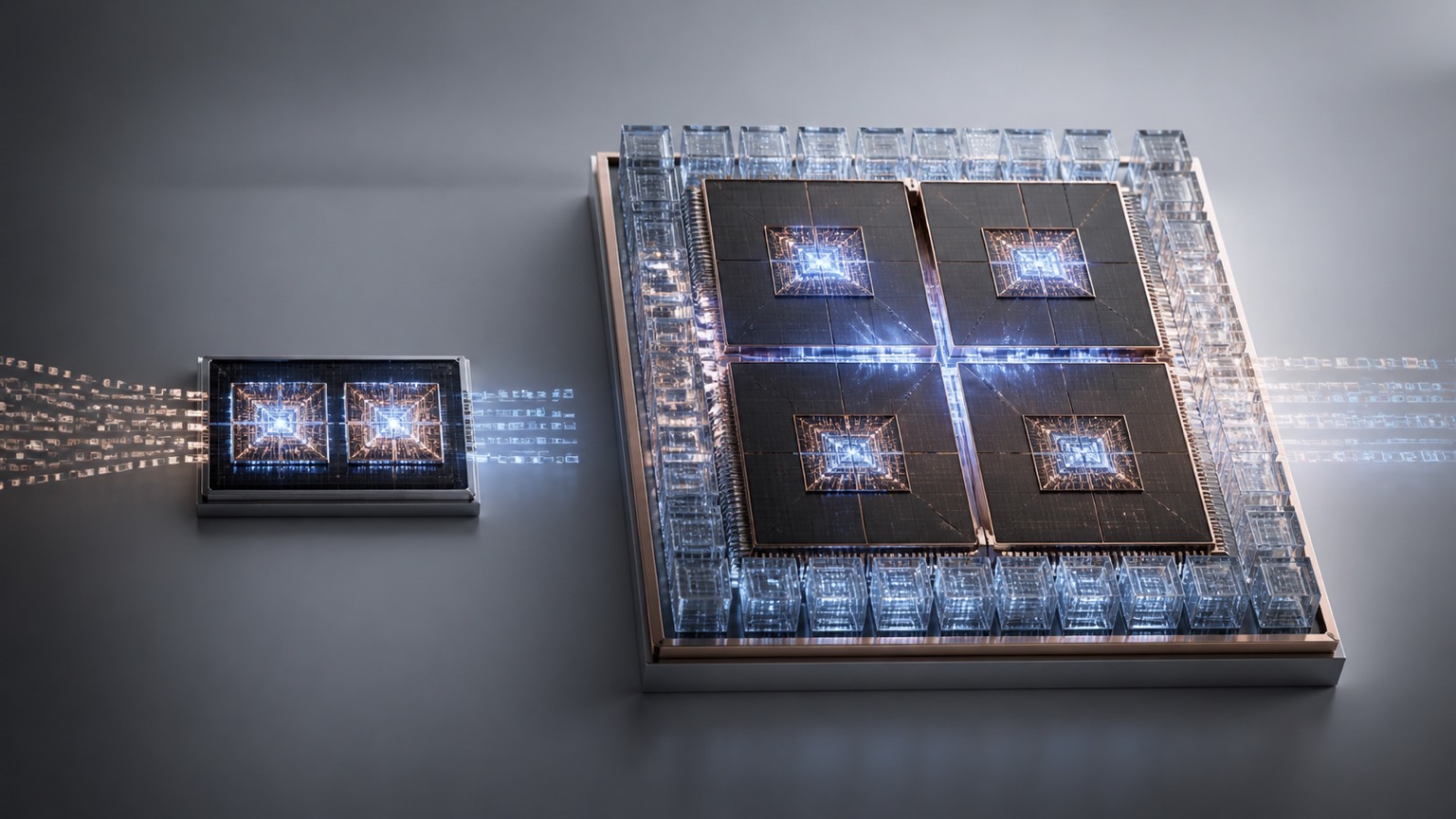
On August 25, 2026, Apple announced the M6 and M5 Ultra in a press release, focusing not just on switching chips to a new generation but on bringing local AI competition back to the combination of memory capacity, bandwidth, and neural network computing. The M6 is aimed at the new generation of Macs, while the M5 Ultra brings larger, unified memory to the desktop workstation level.
What problems do these two chips solve?
The M6 uses what Apple claims is the first 2nm process, equipped with a 12-core CPU, 12-core GPU, and dual 16-core Neural Engines, with unified memory bandwidth up to 170GB/s and support for up to 32GB of unified memory. Apple claims that the peak computing power of the dual Neural Engines can be up to twice that of the previous generation, and the GPU AI computing power is nearly 30% higher than the M5.
The M5 Ultra adopts a quad-chip interconnect design for the first time, offering up to 36 core CPUs, 80-core GPUs, 1.2TB/s unified memory bandwidth, and 512GB of unified memory. Apple states that this combination of capacity and bandwidth allows larger language models to run directly on devices, reducing reliance on remote servers.
The true value of unified memory for local AI
Model weights, context, and KV Cache all occupy memory; When capacity is insufficient, the system can only shrink the model, reduce context, or move work back to the cloud. Unified memory allows the CPU, GPU, and Neural Engine to share the same data pool, reducing transportation costs.
But "512GB" does not mean it can run any large model smoothly. Quantization methods, inference frameworks, operator adaptation, context length, and scheduling all change the experience. Developers also need to adapt native paths like Metal and Core ML, and handle power consumption and concurrency.
This upgrade still has clear boundaries
Apple Intelligence-related features are still in the testing phase, and the experience depends on the release date of macOS 27, language region support, and specific models. Large models also bring storage and cooling pressure; For users who only handle short texts, the extra memory of the M5 Ultra may not translate into significant gains.
Therefore, the M6 pushes the Mac's native AI baseline forward, while the M5 Ultra targets users who need large models, local data, and long contexts. It is worth watching when third-party frameworks will be adapted, and whether applications can deliver privacy, low latency, and offline capabilities.